
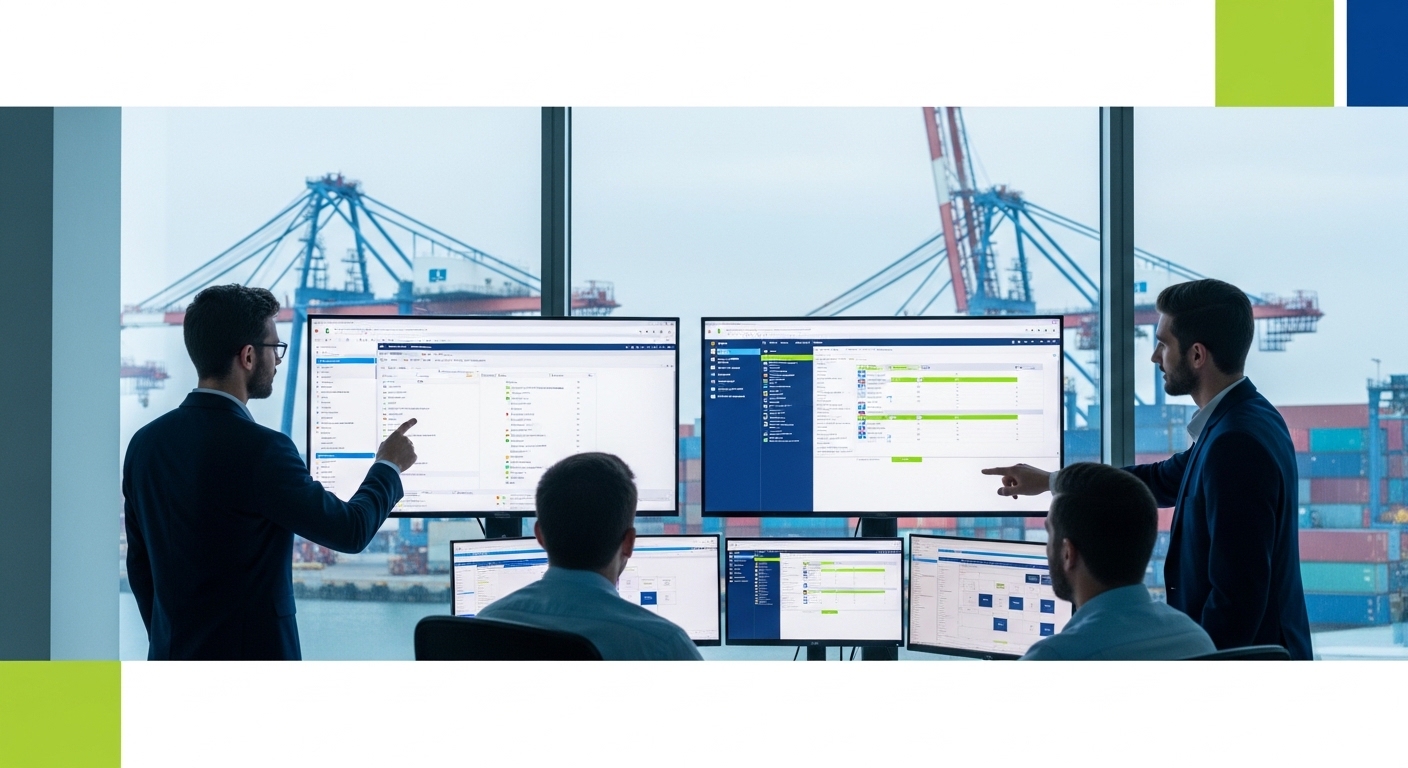
Florida moves a disproportionate share of United States trade, yet most of the logistics and supply-chain software running behind that trade was not designed for the volume, the exception rate, or the trade lanes that Florida operators actually run. That gap is where custom, AI-enabled applications earn their place. This is a guide for the logistics or supply-chain executive deciding what to build, what to buy, and how to do either one in production rather than in a pilot that never ships.
The scale of the Florida trade gateway
Florida is not a regional distribution afterthought. The system of state seaports supports nearly 900,000 direct and indirect jobs and contributes roughly 13 percent of the gross domestic product of the state through cargo and cruise activity. Two container gateways carry most of the containerized freight. PortMiami handled 1,089,443 TEUs in fiscal year 2024, ranking eleventh nationally, with Latin America and the Caribbean accounting for close to half of its trade. A TEU, or twenty-foot equivalent unit, is the standard way the industry counts container volume. Port Everglades moved more than one million TEUs in the same period and generates more than 48 billion dollars in annual economic activity.
Those numbers describe a specific operating reality. High Latin America and Caribbean exposure means shorter transit times, more frequent sailings, and a higher rate of documentation and customs exceptions per unit than a single trans-Pacific lane produces. Software built for a generic North American shipper does not model that. This is the argument for building close to the operation rather than accepting whatever a horizontal platform assumes.
Where AI earns its place in logistics operations
AI is not a feature you sprinkle on an existing screen. In logistics it pays for itself in three specific places.
- Real-time visibility. This means a single, current view of where freight is across carriers, terminals, and yards. The value of AI here is not the map. It is prediction: estimating arrival and dwell time from live signals so a planner learns about a delay before it becomes a missed appointment.
- Exception handling. An exception is any shipment that deviates from plan, such as a held container, a short pick, or a customs flag. AI models can classify incoming exceptions, rank them by cost impact, and recommend the next action. This is the highest-return use in a high-frequency Latin America and Caribbean lane, where exception volume is the operational bottleneck.
- Automation of judgment-light work. Document extraction, appointment scheduling, and carrier tender matching are repetitive and rules-bound. Language models handle the unstructured inputs, such as a bill of lading in a PDF, that older automation could not read.
Build versus buy: a working framework
Build-versus-buy is the decision of whether to license a vendor product or develop the application in house or with a partner. The wrong instinct is to treat it as one decision. It is a decision made component by component.
Buy the commodity layer. A transportation management system core, electronic data interchange connections, and standard accounting integrations are solved problems, and rebuilding them wastes capital. Buy them.
Build the layer that reflects how you actually compete. The exception logic tuned to your trade lanes, the visibility model trained on your carriers and terminals, and the integration glue between a port community system and your internal tools are not commodities. No vendor ships your specific advantage, and a horizontal product forces your operation to match its assumptions rather than the reverse. This is the layer where a research-driven build returns the most, because it encodes knowledge your competitors do not have.
A useful test: if a capability would look identical at any freight forwarder, buy it. If it encodes something specific to your lanes, your customers, or your service promise, build it.
What production actually requires
Most logistics AI efforts stall as demonstrations. A production application is different in kind, not degree. It requires live data pipelines from carrier and terminal systems rather than a static export, monitoring that catches model drift when a trade pattern shifts, and a human-in-the-loop path so a planner can override a recommendation and have the system learn from it. It also requires integration with the systems already on the floor, because an application that does not write back to the system of record is a second screen, not an improvement.
This is the difference between a pilot and an asset. A pilot proves a model can score well on last quarter data. A production application survives contact with a real week, real carriers, and real exceptions, and it keeps working when a lane reroutes. Building for production from the first line of code is the distinction between an R and D partner and a demo shop.
Why the window is now
Adoption intent is high and execution is thin, which is the definition of an opening. Gartner reports that AI, including machine learning, and generative AI are the top digital supply chain investment priorities, based on a June 2024 survey of 419 supply chain leaders. Yet a later Gartner survey found that just 23 percent of supply chain organizations have a formal AI strategy, with most leaders funding project-by-project rather than building a durable capability. Gartner further predicts that 70 percent of large organizations will adopt AI-based supply chain forecasting by 2030.
Read together, those findings describe a two-year to three-year window. The majority intend to invest, most have no plan, and the eventual endpoint is broad adoption. The operators who build production applications now, rather than running pilots, will hold a working system while competitors are still writing strategy decks. In a Florida trade gateway where exception volume and lane frequency are already high, that lead compounds every shipping week.
Sources
- Florida Ports Council, "The Florida System of Seaports," 2024. Link.
- Florida Ports Council, "PortMiami," 2024. Link.
- Broward County, "Port Everglades Statistics," 2025. Link.
- Gartner, "Gartner Survey Shows AI and Generative AI Top Digital Supply Chain Investment Priorities," 2024. Link.
- Gartner, "Gartner Survey Shows Just 23% of Supply Chain Organizations Have a Formal AI Strategy," 2025. Link.
- Gartner, "Gartner Predicts 70% of Large Organizations Will Adopt AI-Based Supply Chain Forecasting to Predict Future Demand by 2030," 2025. Link.
Next Steps
The decision in front of you is not whether to adopt AI in your logistics operation. It is which layer to build and which to buy, and whether your next effort ships to production or stalls as a pilot. If you are mapping that decision for your trade lanes, our App and Web Development practice builds production AI-enabled logistics applications, and you can contact our team to scope the build-versus-buy split for your operation.