

Why browser AI agents just went mainstream
In one week, the browser stopped being a human-only tool. On July 1, 2026, Apple shipped Safari Technology Preview 247 with a built-in MCP server. MCP, the Model Context Protocol, is an open standard that lets an AI agent call software through declared, documented tools instead of guessing at screens. An AI agent, autonomous software that acts on behalf of a person, can now connect to a real Safari window and see exactly what your customers see: how the page renders, what the console logs, which network requests fire. One day earlier, X launched a hosted MCP server exposing more than 200 API endpoints to agent tooling. The pattern is bigger than either announcement. Platform owners are giving browser AI agents first-class, supported access, and that changes how enterprise web teams build, test, and ship. Your organization does not need to react today. It does need a position this quarter.
What a browser agent can actually do
The Safari MCP server ships nearly 20 tools. The names are developer-facing, but what they add up to is plain: an agent can read buffered console logs, capture screenshots of the current page, list network requests with their status and timing, and perform page interactions in sequence, including clicking, typing, scrolling, and hovering. In other words, the agent can emulate a user session and report back with evidence rather than guesses.
That closes a long-standing gap. Coding agents have been able to write and edit code for two years. What they could not reliably do was verify how that code behaves in a real browser, on a real rendering engine, under real network conditions. Teams bridged the gap with screenshots pasted into chats and brittle scripted checks. A supported, local browser interface removes the bridge entirely: the agent inspects the page the way an engineer would, and it does so inside the toolchain your team already runs. Apple states that any MCP-compatible client can connect, which means the same agent your team uses for code review can now open the site it just changed.
What this changes for your web team
Three shifts matter for engineering and product leaders.
- Debugging and QA become agent-assisted by default. An agent that reads console output and network traces can triage a rendering bug, reproduce it, and propose the fix in one loop. The economics of routine web QA change when the first pass costs minutes of machine time instead of hours of engineer time.
- Cross-browser compatibility work gets cheaper. Safari has historically been the engine teams tested last, because automating it was the most friction. A native Safari interface inverts that: agent-driven checks against WebKit, the rendering engine behind Safari, can run continuously, and compatibility issues surface before release instead of in support tickets.
- Accessibility and performance checks move into the loop. The same session tools that debug a layout can audit contrast, focus order, and load behavior on every change, not once a quarter. Checks that were periodic projects become continuous properties of the pipeline.
There is a second audience to this story. The same protocol that lets your agents inspect your site lets everyone else run agents against the web, and traffic already reflects it: automated traffic passed human traffic in 2026, at about 57% of requests to web pages. We covered what that means for the site you operate in our agentic web readiness framework. This piece is the other half: what agents mean for the team that builds the site.
The stakes are bigger than tooling
Gartner put a number on the direction this week: up to 234 billion dollars of enterprise application software spend is exposed to what it calls agentic arbitrage by 2030, roughly 20% of global SaaS spend. Agentic arbitrage is the shift where agents execute tasks across applications directly, so the human never opens the vendor screen the subscription pays for. The forecast is about vendors, but the mechanism is about interfaces: when agents do the work, the interface stops being the moat. For a web team, that cuts both ways. The experiences you build will increasingly be exercised by software, and the teams that treat agents as both a tool and an audience will ship faster while their competitors debate.
A first-quarter playbook for engineering leaders
You do not need a program. You need four contained moves.
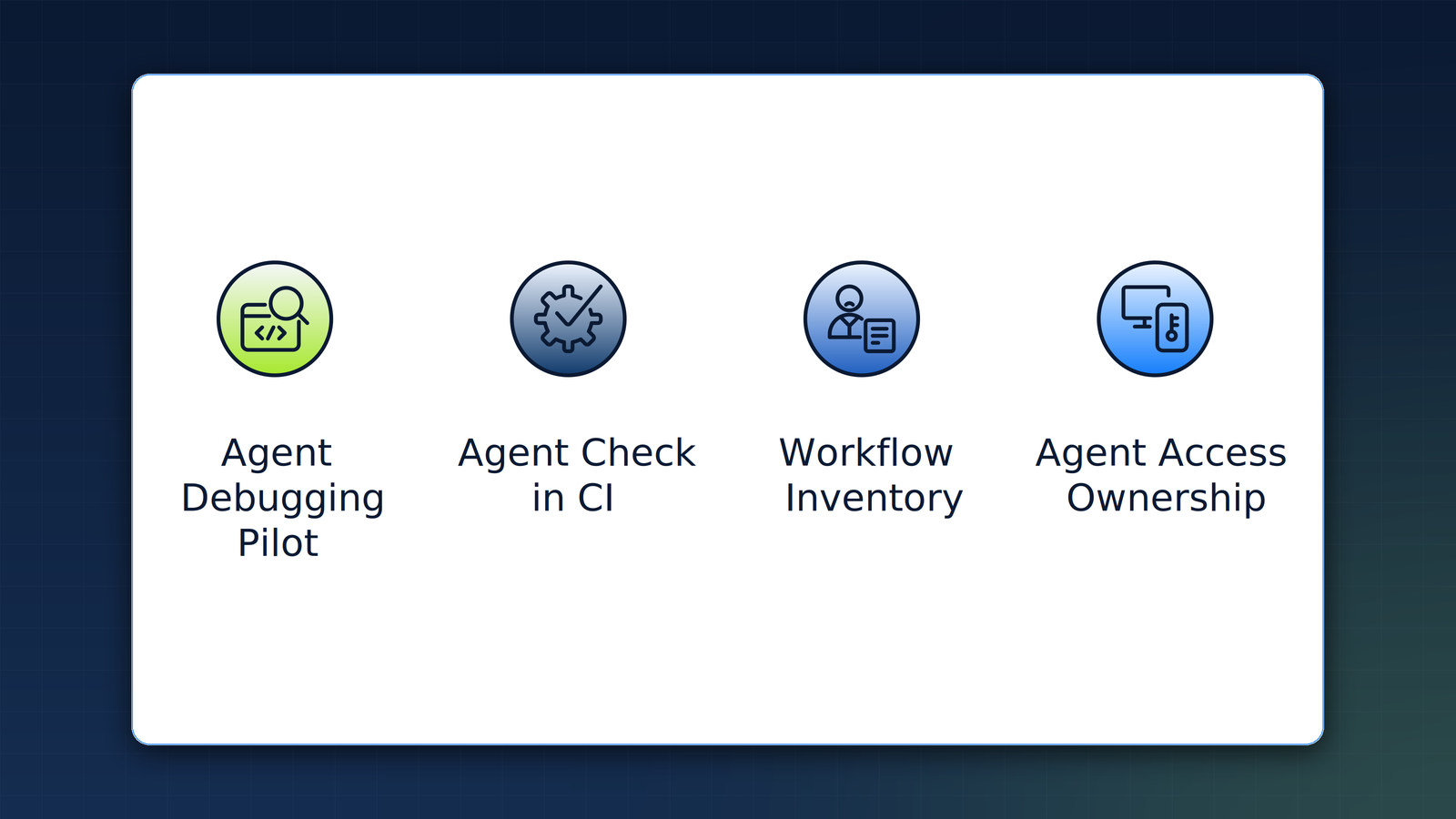
- Pilot agent-assisted debugging in one team. Connect a browser MCP server, Safari Technology Preview or an equivalent in your standard browser, to the coding agent one product team already uses. Scope it to triage and reproduction on real bugs for one sprint cycle.
- Wire one agent-driven check into CI. CI, continuous integration, is the automated pipeline that builds and tests every code change. Pick the check with the worst coverage today, often WebKit compatibility or accessibility, and have an agent run it on every merge. Keep the output as evidence, screenshots and traces, so engineers can audit what the agent saw.
- Inventory the workflows agents could execute end to end. List the top journeys on your web properties, then mark which ones an agent could complete against your current pages. The list doubles as your readiness map for agent traffic.
- Assign ownership before autonomy grows. Reading a page is low risk. Acting on one is not. Decide now who owns agent access, what credentials agents hold, and which actions require a human approval, so the governance exists before the capability expands.
Key Takeaways
- Apple shipped a native MCP server in Safari Technology Preview 247 on July 1, 2026, giving AI agents a supported window into real browser sessions.
- X launched a hosted MCP server one day earlier, part of a broader pattern of platforms exposing declared agent interfaces.
- Browser agents change web team economics first in debugging, cross-browser QA, and accessibility, where checks become continuous instead of periodic.
- Gartner estimates up to 234 billion dollars of enterprise application spend is exposed to agentic arbitrage by 2030, a signal that interfaces are ceasing to be the moat.
- The near-term move is contained: one pilot team, one CI check, one workflow inventory, and clear ownership of agent access.
Frequently Asked Questions
Is this the same story as the agentic web?
They are two halves of one shift. The agentic web is about your site serving agent traffic well. Browser agents are about your team using agents that operate a real browser. The same investment in clean, semantic web surfaces pays off on both sides.
Should we wait for these features to reach stable browsers?
The capability is already usable for internal tooling today, and the direction is set across vendors. Waiting for stable releases is reasonable for CI gates. It is not a reason to delay the pilot, because the learning, how your team works with an agent in the loop, transfers directly.
Does this replace QA engineers?
No. It moves them up the stack. Agents make the first pass on reproduction and evidence gathering cheap. Humans still decide what correct means, design the checks that matter, and own the judgment calls agents cannot make.
Sources
- WebKit, "Introducing the Safari MCP server for web developers," 2026. Link.
- Gartner, "Gartner Says 234 Billion Dollars in Enterprise Application Software Spend Is at Risk from Agentic AI," 2026. Link.
- TechCrunch, "X now offers an MCP server to make its platform easier for AI tools to use," 2026. Link.
- Cloudflare Radar, "Bots and AI agents surpass human web traffic," 2026. Link.
Next Steps
The question for your team is when browser agents enter your delivery loop, and on whose terms. Stable Solutions builds agent-aware web stacks as an R and D partner: evaluating browser agent tooling, wiring agent-driven checks into CI, and keeping the human experience first class while the machine one becomes reliable. Explore our App and Web Development work or contact our team to scope a pilot.