

Most marketing organizations spent the last decade producing content for two audiences: people, and the search crawlers that ranked it. In 2026 a third reader arrived, and it is the one deciding whether your company appears in an AI-generated answer or gets used by your own agents. It does not read the way the first two did, and content infrastructure for AI is now the constraint on both.
Your Content Estate Acquired a Second Machine Reader
Marketing usually owns the largest deliberately structured body of text in a company. The site, the knowledge center, product and pricing pages, case studies, documentation, the answers to every question a buyer asks before a call. That estate was built for humans first and for classic search crawlers second.
Two new consumers now read it. Externally, answer engines decide whether to cite your material inside a generated response, which is where a growing share of buyer research happens before anyone reaches your site. Internally, your own agents need that same material as context. An agent, meaning a system that takes actions across tools rather than only returning text, is only as good as what it can retrieve. Retrieval, the step where a system pulls relevant source material before generating an answer, fails quietly when the source is unstructured.
Both consumers want the same four things, and neither of them is more content.
What the Adoption Data Shows About Content Readiness
Box commissioned The Harris Poll to survey 1,640 IT decision-makers across the United States, United Kingdom, France and Japan between 30 April and 8 May 2026. It is a vendor-sponsored study and the sponsor sells content management, which is worth holding in mind. The spread between its numbers is still the clearest public measure of the gap.
83 percent of organizations are running AI agents. Only 36 percent have connected those agents to trusted internal content across multiple use cases. And 96 percent said agent access to internal content was important or very important.
If the first phase of enterprise AI was defined by access to models, the next is defined by access to context.
The governance layer is thinner still: just 34 percent have established formal standards governing how agents access information. Asked what blocks them, 38 percent cited security and privacy, 29 percent regulatory and compliance concerns, and 25 percent data fragmentation across systems. Not one of those is a shortage of content.
The maturity split is the useful part. Among organizations describing themselves as leading edge, 42 percent had connected agents to trusted content across many use cases, against 17 percent of early-stage organizations. The leaders are not running better models. Everyone has the same models.
Why Content Infrastructure, Not Content Volume, Is the Constraint
Content infrastructure is the set of properties that make a body of content retrievable and safe to use by a machine: how it is structured, how it is labelled, who is allowed to see it, and whether its claims can be traced to a source. It is distinct from a content management system, which is where content lives. A company can run an expensive CMS and have no content infrastructure at all.
The external case moves the same way. Answer engines lift passages rather than whole pages, and they favor material they can attribute confidently to a recognizable entity. That rewards a page whose claims are scoped, sourced, and cleanly delimited over a long undifferentiated argument, regardless of how much authority the domain has accumulated. The measurement details are still moving and the vendor studies circulating on this disagree with each other, so treat the direction as established and the coefficients as not.
What does not move is the substrate. A passage an answer engine can safely quote and a passage your agent can safely retrieve are close to the same artifact.
Four Properties That Make Content Usable by Machines
These are worth auditing against your existing estate before commissioning anything new.
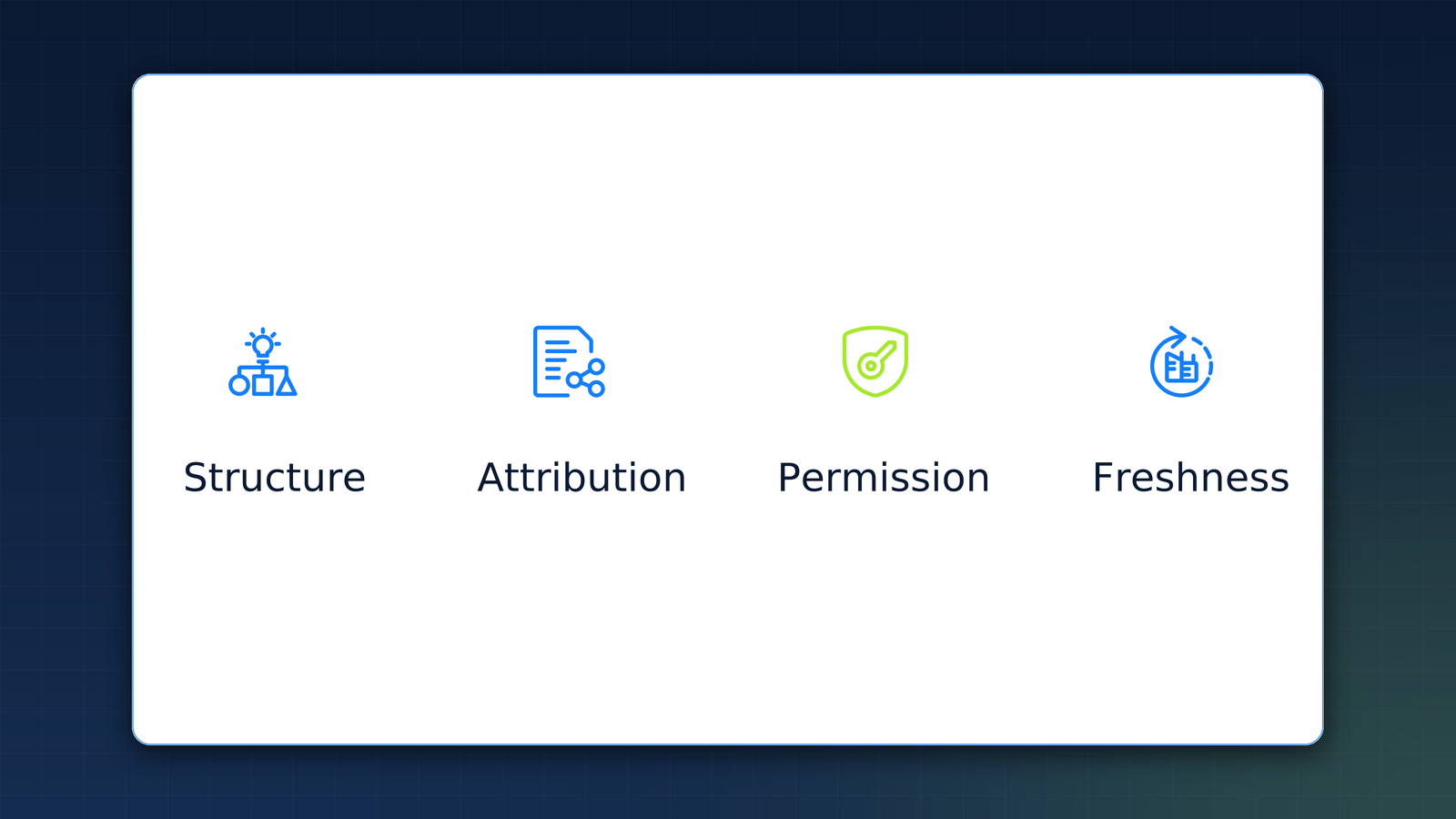
- Structure. One idea per section, with the answer stated before the elaboration. A machine lifting a passage takes the passage, not your intent. If the claim only makes sense after three paragraphs of setup, it will be quoted without them.
- Attribution. Every load-bearing number carries its source and date inside the content, not in a design element or a footnote the parser drops. Unsourced claims are the first thing a cautious answer engine declines to repeat and the first thing an agent should not act on.
- Permission. An explicit answer to who may retrieve this. The 34 percent figure above is the whole problem: most organizations connected agents to content before deciding what those agents were allowed to read.
- Freshness. A visible last-reviewed date and an owner. Content with no review record is content nobody can vouch for, which makes it unusable for the internal case and unciteable for the external one.
None of this is a writing exercise. It is closer to a data-modelling exercise performed on prose, which is why it tends to fall between the marketing team that owns the content and the engineering team that owns the retrieval.
What to Fix First
Start with the twenty pages that carry your commercial argument rather than the whole estate. Establish who is allowed to retrieve each of them, put the sources and dates inside the text, and restructure so each section answers one question in its opening sentence. Then connect a single agent to that subset and read what it returns, which surfaces the gaps faster than any audit document.
The broader readiness picture supports doing this now rather than next planning cycle. A separate 2026 survey of 1,550 AI decision-makers by Publicis Sapient found 73 percent reporting AI used regularly or across most business processes while only 10 percent said AI is core to how their business operates. Deployment has already happened almost everywhere. What has not happened is the unglamorous work that makes the deployment worth anything, and for a marketing organization that work is mostly content infrastructure.
Sources
- Campus Technology, "Report: Content Infrastructure, Governance Lag Behind Agentic AI Adoption," 2026. Link.
- Publicis Sapient, "2026 Global Enterprise AI Report Reveals Gap Between AI Adoption and Enterprise Readiness," 2026. Link.
Next Steps
If your agents cannot reliably retrieve your own commercial content, and you cannot say who is allowed to retrieve it, the constraint is the substrate rather than the model. Stable Solutions audits the content estate against these four properties and rebuilds the retrieval path around it. Explore our Digital Growth Strategies or contact our team to scope a content infrastructure audit.