

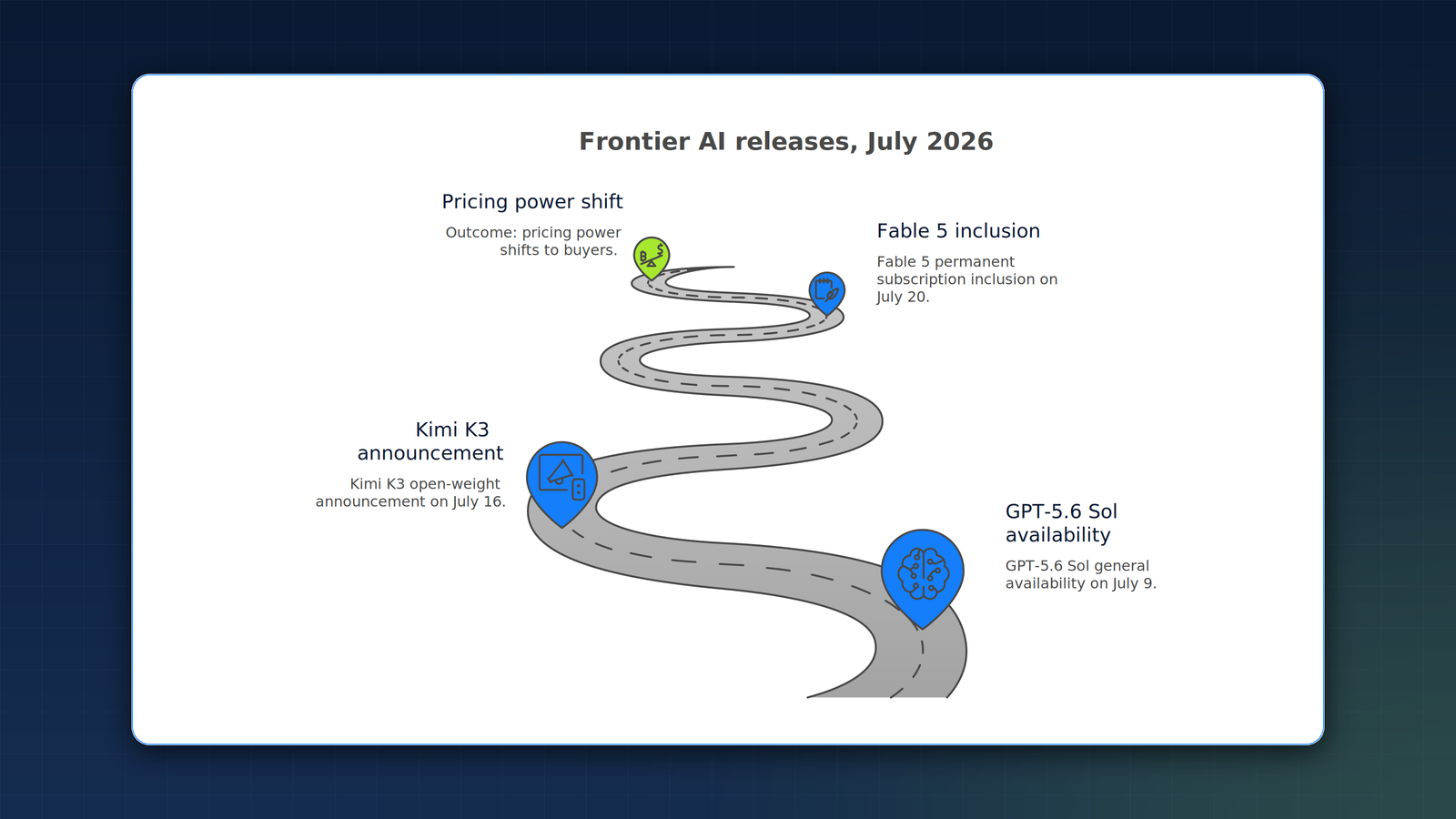
On July 20, Anthropic made Claude Fable 5, its most capable model, a permanent inclusion in Max and Team Premium subscriptions at 50 percent of plan limits. The decision closed out a month in which the model was scheduled to leave paid plans on three separate dates. And it did not happen in a vacuum. OpenAI shipped GPT-5.6 Sol on July 9. Moonshot AI announced Kimi K3, the largest open-weight model release to date, on July 16. Eleven days of frontier model competition just moved pricing power toward the buyer, and that changes how your organization should negotiate, evaluate, and plan AI capacity for the rest of 2026.
What Happened: Three Frontier Releases in Eleven Days
Three dated events, each confirmed by the vendor itself or by multiple independent outlets.
- July 9: OpenAI ships GPT-5.6 Sol. Sol is the flagship of the GPT-5.6 family, positioned by OpenAI as its strongest model for coding and long-running agentic work, meaning tasks where the model plans and executes multi-step work on its own, moving from a late-June preview to general availability.
- July 16: Moonshot AI announces Kimi K3. K3 is a 2.8 trillion parameter frontier model (a frontier model is one whose capability sits at or near the current state of the art) with a 1 million token context window. Moonshot committed to publishing the full model weights by July 27, which would make K3 the largest open-weight model ever released.
- July 20: Anthropic makes Fable 5 permanent on subscriptions. After twice extending included access past its original July 7 end date (first to July 12, then to July 19), Anthropic announced that Fable 5 is now a standing inclusion in Max and Team Premium plans at 50 percent of usage limits, with Pro and Team Standard customers able to reach it through usage credits, the pay-per-use billing that sits on top of plan limits.
The sequence matters more than any single release. A model that was scheduled to become a metered premium add-on is instead staying inside the subscription, and the strongest available explanation is the two releases that preceded the decision.
The Benchmark Picture: The Gap Is Now a Band
Kimi K3 is an open-weight model, meaning the trained parameters are published for anyone to download, inspect, and run on their own infrastructure, in contrast to closed models reachable only through a vendor API. Historically, open-weight models trailed the closed frontier by a comfortable margin. The K3 numbers narrow that margin to a band.
On the Arena Frontend Code leaderboard, which ranks models by blind head-to-head developer comparisons, K3 debuted at number one with a score of 1679, ahead of Claude Fable 5. On the Artificial Analysis Intelligence Index, K3 lands level with Claude Opus 4.8, while Fable 5 and GPT-5.6 Sol still rank above it. In short: the strongest closed models keep the overall lead, but an open-weight release now wins specific high-value workloads outright.
Pricing tells the same story. Moonshot lists K3 at 3 dollars per million input tokens and 15 dollars per million output tokens, comparable to mid-tier closed models rather than premium frontier rates, with one flat rate across the full context window.
What This Means for Your Organization
The operator consequence is leverage. For two years, frontier AI procurement has been a market that favors sellers: few substitutes, opaque roadmaps, and take-it-or-leave-it terms. Three releases in eleven days, from three different vendors on two different business models, is what the start of a substitutes market looks like.
- Your renewal conversation changes. When a vendor knows you have a credible second option benchmarked within a few points of their model, included-capacity terms, rate cards, and commitment tiers become negotiable. The Fable 5 decision is direct evidence: subscriber pressure plus competitive substitutes turned a planned meter into a permanent inclusion.
- Model evaluation becomes a standing capability, not a one-off. If the leaderboard reorders every few weeks, a single vendor bake-off from last quarter is stale. Organizations that maintain a repeatable evaluation harness, their own task set, their own pass criteria, can re-score the field in days and act on price or capability shifts while competitors schedule meetings. We covered the mechanics in our structured model evaluation playbook.
- Lock-in gets repriced. Deep single-vendor integration made sense when one lab was clearly ahead. With capability converging into a band, architecture that keeps model choice swappable (routing through an abstraction layer rather than hard-coding one API) preserves the leverage the market just handed you.
- Self-hosting enters the serious conversation. An open-weight model at near-frontier capability gives regulated and data-sensitive organizations an option that did not exist at this level before: run the model inside your own perimeter, on your own terms. That is an engineering decision with real infrastructure and governance costs, and it deserves a real evaluation rather than a reflexive yes or no.
Two Development Models, One Buyer Outcome
It is worth naming the structural pattern without the geopolitics. The leading US labs, Anthropic and OpenAI among them, develop closed models and monetize capability through subscriptions, usage credits, and API rates. The leading Chinese labs, Moonshot among them, increasingly publish weights and compete on distribution, adoption, and price. These are business model choices, and they are converging on comparable capability from opposite directions.
For a buyer, the divergence itself is the benefit. Closed vendors must now defend subscription value against a downloadable alternative, which is exactly the pressure that keeps top models inside plans rather than behind meters. Open-weight vendors must post credible benchmark results to earn enterprise trust, which is why K3 shipped with published scores on independent leaderboards. Each model disciplines the other, and the discipline shows up in your contract terms.
What to Watch
- July 27: the K3 weights release. Announced scores become independently verifiable once the weights are public. Watch whether third-party evaluations reproduce the leaderboard results before treating K3 as procurement-ready.
- Whether permanence spreads. Anthropic just set a precedent: the best model stays in the subscription. Watch whether OpenAI and Google match the posture on their own flagships. If they do, included-capacity economics improve across the board.
- The fine print on limits. Included at 50 percent of plan limits is a real constraint for heavy agentic workloads. Model the credit spend you would incur past the inclusion before assuming the permanent tier covers your usage.
- Your next renewal date. That is the concrete trigger. Before it arrives, run a structured cross-model evaluation on your own workloads so you negotiate from data rather than from a vendor benchmark slide.
Sources
- Anthropic, "Redeploying Claude Fable 5," 2026. Link.
- Simon Willison, "Claude make Fable 5 permanent," 2026. Link.
- The New Stack, "Anthropic gives Claude subscribers five more days with Fable 5," 2026. Link.
- Simon Willison, "Kimi K3, and what we can still learn from the pelican benchmark," 2026. Link.
- BenchLM, "Kimi K3: The Open Model Closing the Gap," 2026. Link.
- CNBC, "Chinese AI has leveled up, and brought renewed focus on the open weight model shift," 2026. Link.
- TechCrunch, "OpenAI launches its new family of models with GPT-5.6," 2026. Link.
Next Steps
The question is no longer which single vendor to bet on, but whether your organization can evaluate and switch fast enough to capture a market that now favors buyers. Stable Solutions builds the evaluation harnesses, model-agnostic architectures, and self-hosting assessments that turn vendor competition into contract leverage. Explore our AI Automation services or contact our team to pressure-test your model strategy before your next renewal.