

In August 2026, one investment firm signed a single agreement to put a frontier AI platform in front of more than fifty operating companies at once. The contract took months to assemble. The adoption will take years, and it will not land evenly. That gap is the whole problem of enterprise AI adoption across business units, and it is where multi-entity AI programs quietly stall.
The Contract Is Not the Adoption
On 4 August 2026, Clearlake Capital and OpenAI announced a partnership to accelerate AI adoption across Clearlake portfolio companies, giving more than fifty businesses access to frontier models. A frontier model is one of the largest and most capable general-purpose AI systems available, the tier that sets what is currently possible rather than what is merely cheap.
The access is the least interesting part of that announcement. Any group with a treasury can buy access. What Clearlake also did was staff a function: Clearlake AI Labs, described as an in-house team "supporting management teams to evaluate AI opportunities, prioritize use cases, make build-versus-buy decisions, and accelerate implementation across products, operations, and customer-facing functions."
Read that list again. Every item on it happens inside an operating company, not at the group level. The agreement is centralized. The work is not. If your organization runs multiple business units, several acquired brands, or a portfolio of operating companies, you face the same split the moment you sign anything enterprise-wide.
What the Readiness Data Actually Shows
Publicis Sapient surveyed 1,550 AI decision-makers between 29 April and 14 May 2026, all at organizations with at least 500 employees and 100 million dollars in annual revenue. The headline pair is the part worth taking to a board meeting: 73 percent said AI is used regularly or across most business processes, while only 10 percent said AI is core to how their business operates.
Deployment is nearly universal. Dependence is rare. The distance between those two numbers is not a technology problem, and the same survey says so directly.
42 percent say AI is capable, but their organizations are not set up to capture its value.
A separate question in the same survey found 22 percent naming the way their organization operates as the primary barrier to AI success. The two figures measure different things and should not be added, but they point the same direction. The model works. The company is not arranged to use it.
Why Central Buying Stalls at the Operating Unit
A group-level agreement solves procurement, pricing, and security review once. It solves nothing below that line, for three reasons.
The binding constraint is different in every unit. One business is held back by data it is not contractually allowed to move. Another is held back by a regulator. A third has clean data and no one with time to define what good output looks like. A central rollout plan assumes a shared bottleneck that does not exist.
The unit owns the outcome without owning the decision. When the platform is chosen above them, unit leaders inherit a tool and a target they did not set. They will comply, run a pilot, and report participation. Participation is not adoption, and it is exactly what a 73 percent usage figure measures.
The real use cases are found locally, late. At Alteryx, a Clearlake portfolio company, AI use moved past engineering into the legal team, which now uses it for contract negotiation and AI risk assessments. Nobody writes that into a master agreement. It surfaces because someone inside that function went looking. Multiply by fifty companies and the discovery work, not the license, is the expensive part.
Four Questions That Decide Enterprise AI Adoption Across Business Units
Before a central platform reaches an operating unit, four answers determine whether anything durable comes out of it. They are worth asking per unit, in writing, and they take days rather than quarters.
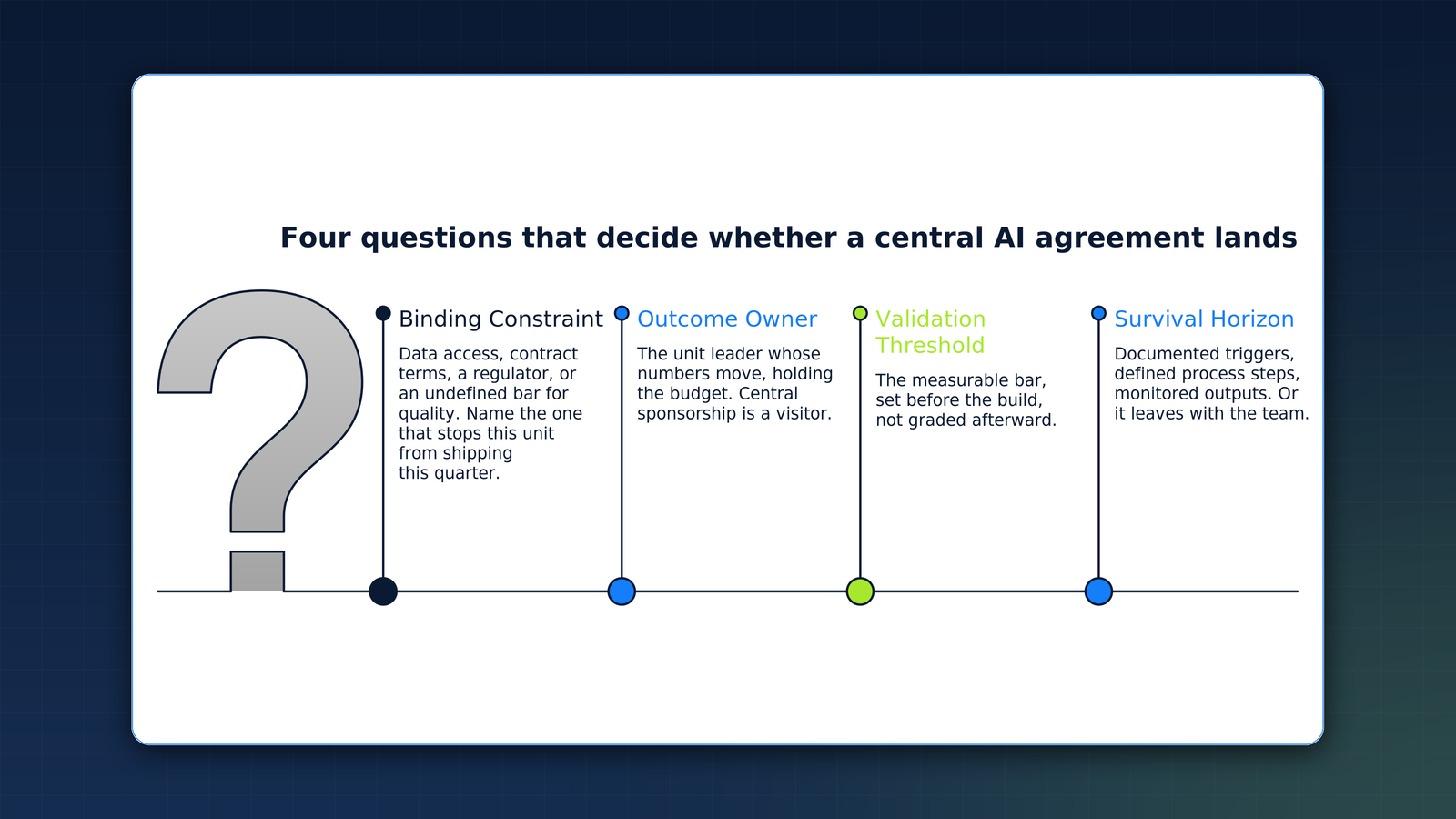
- Which constraint actually binds here? Name the one thing that stops this unit from putting a model into a real workflow this quarter. Data access, a contract term, a regulator, or an unowned definition of quality. If the answer is generic, the assessment has not been done.
- Who owns the outcome, and do they hold the budget? An initiative sponsored centrally and paid for centrally will be treated as a visitor. The unit leader whose numbers move needs to be the person accountable for whether it moves.
- What does validated mean in this unit? Define the measurable threshold before the build. In a claims operation that might be the share of files closed without rework. In a sales organization it might be quote turnaround. Without a threshold set in advance, the pilot is graded on enthusiasm.
- What survives the pilot team leaving? If the workflow depends on the two people who prompted it into existence, it is a demonstration. Documented triggers, defined process steps, and monitored outputs are what convert it into operations.
These questions are deliberately unglamorous. They are also the difference between a group that reports fifty deployments and a group that can point at fifty changed processes.
What the Next Twelve Months Look Like
The same Publicis Sapient research found that among United States respondents, 71 percent expect significant progress in scaling AI over the next 12 to 24 months, while only 20 percent say their organizations are fully equipped today. That is a stated intention to scale, on an admitted structural deficit, inside a two-year window.
The buying phase of enterprise AI is closing. Access to capable models is becoming a commodity line item, negotiated once and pushed down. The phase that follows is unglamorous integration work performed unit by unit, and it does not benefit from the same economies of scale the contract did. Groups that staff for that work, as Clearlake did, will convert their agreements. Groups that treat the signature as the milestone will hold a very good license and a 10 percent core-operations rate.
Sources
- Publicis Sapient, "2026 Global Enterprise AI Report Reveals Gap Between AI Adoption and Enterprise Readiness," 2026. Link.
- Las Vegas Sun, "OpenAI and Clearlake Capital Partner to Accelerate AI Adoption Across Clearlake's Portfolio," 2026. Link.
Next Steps
If your organization has bought AI centrally and cannot yet say which constraint binds each operating unit, the license is ahead of the structure. Stable Solutions runs that assessment and builds the workflows that come out of it, unit by unit, with the measurement defined before the build. Explore our Digital Growth Strategies or contact our team to scope a readiness assessment for your business units.