

How Is Agentic AI Changing the Software Development Lifecycle?
Agentic AI is replacing sequential phases of the traditional software development lifecycle with continuous, AI-driven workflows that reduce cycle times by 30-50%. According to the Stack Overflow 2025 Developer Survey, 82% of developers now use AI coding tools in their daily work, signaling a fundamental shift in how software is built, tested, and deployed.
What Is Agentic AI in Software Development?
Unlike conventional AI assistants that respond to single prompts, agentic AI systems operate autonomously across multi-step tasks. These agents can analyze codebases, write implementation code, generate tests, fix bugs, and open pull requests without continuous human direction. Tools like Claude Code, GitHub Copilot Workspace, and Devin represent the first generation of truly autonomous coding agents. As
"Agentic AI is not about replacing developers. It is about removing the friction between intent and implementation, allowing engineers to operate at the level of system design rather than syntax." — Dr. Armando Solar-Lezama, Professor of Computer Science, MITThis shift means developers spend less time on boilerplate and more time on architecture, business logic, and creative problem-solving. Research from GitHub shows that developers using Copilot experience 55% faster task completion on documented coding tasks, a productivity gain that compounds across an entire development team.
Which SDLC Phases Are Most Affected by AI Agents?
The traditional SDLC follows a linear path: requirements gathering, design, implementation, testing, deployment, and maintenance. Agentic AI compresses or eliminates boundaries between these phases. During implementation, AI agents generate code from natural language specifications. During testing, they produce unit tests, integration tests, and even identify edge cases that human developers often miss. During maintenance, agents autonomously triage bug reports, locate root causes, and propose fixes. A 2025 McKinsey study found that organizations adopting AI-augmented development reduced their average release cycle from 4 weeks to 11 days. The phases most disrupted include:
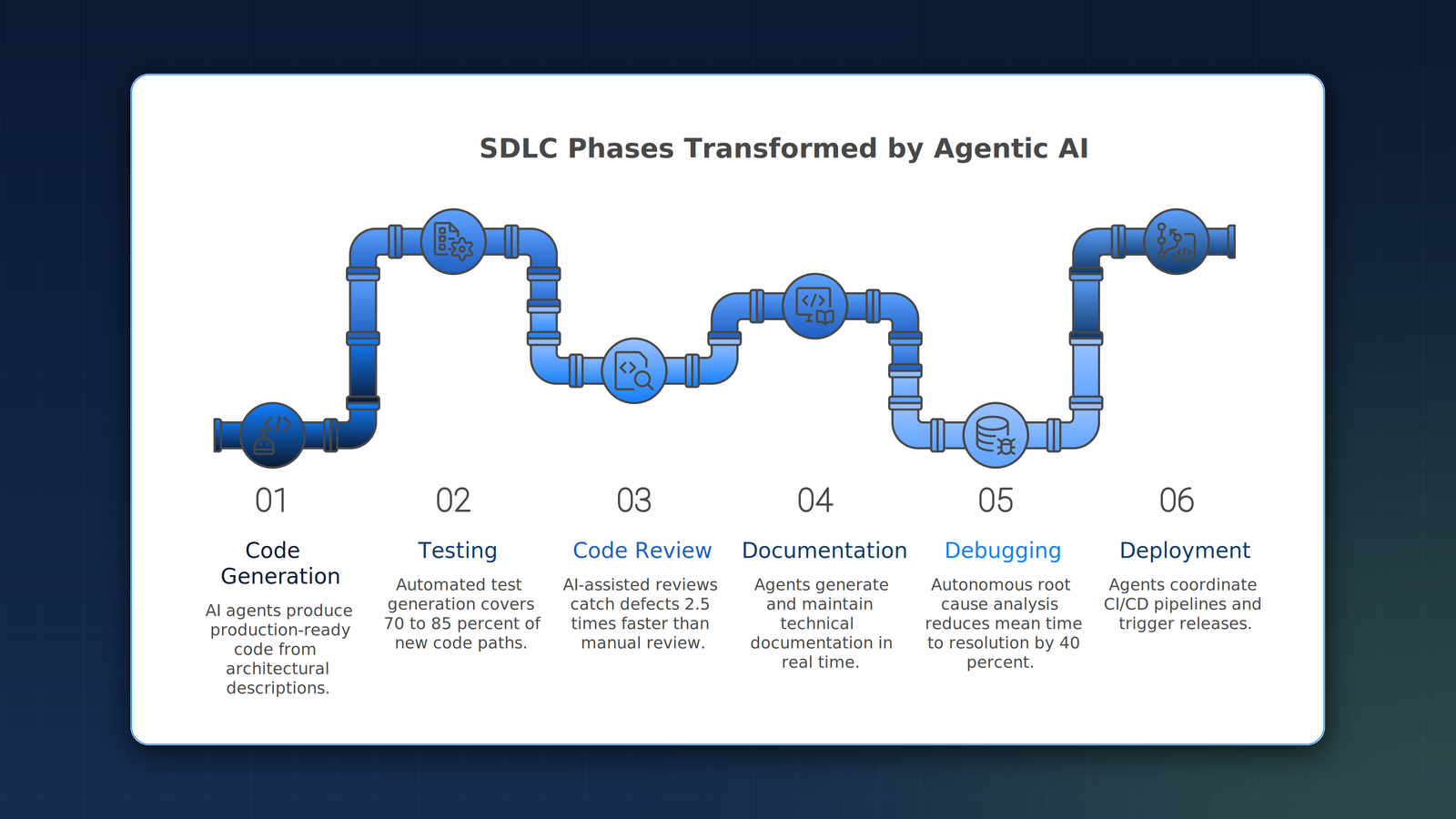
- Code generation: Agents produce production-ready code from architectural descriptions
- Testing: Automated test generation covers 70-85% of new code paths
- Code review: AI-assisted reviews catch defects 2.5x faster than manual-only review
- Documentation: Agents generate and maintain technical documentation in real time
- Debugging: Autonomous root cause analysis reduces mean time to resolution by 40%
How Should Development Teams Adapt Their Workflows?
Adopting agentic AI requires rethinking team structures and processes. The most successful teams treat AI agents as junior developers: they assign discrete tasks, review output, and provide feedback that improves future performance.
"The teams getting the most value from AI coding tools are not the ones that blindly accept generated code. They are the ones that have established rigorous review processes and clear architectural guardrails." — Sarah Drasner, Director of Engineering, GoogleDevelopment teams at firms like Stable Solutions integrate agentic AI at every stage. Our engineers use AI agents for rapid prototyping, automated testing, and continuous refactoring, while maintaining human oversight on architecture decisions and security-critical code. This hybrid approach preserves code quality while dramatically accelerating delivery. Teams that resist AI adoption risk falling behind: Gartner projects that by 2027, 80% of software engineering organizations will have established dedicated AI-augmented development teams.
What Are the Risks and Limitations of AI-Driven Development?
Agentic AI is powerful but not infallible. Common risks include code hallucination, where agents generate plausible but incorrect implementations, and security vulnerabilities introduced by AI-generated code that has not been properly reviewed. A Stanford University study found that developers using AI assistants were 25% more likely to introduce security vulnerabilities when they skipped manual review. Mitigation strategies include mandatory human review for all AI-generated code, automated security scanning integrated into CI/CD pipelines, and comprehensive test suites that validate agent output. Additionally, Accenture research indicates that 84% of C-suite executives believe they must leverage AI to achieve growth objectives, yet many underestimate the governance frameworks required to deploy AI-generated code safely at scale. Organizations should also maintain clear documentation of which code was AI-generated to support future auditing and compliance requirements. Establishing provenance tracking for AI contributions is particularly important in regulated industries such as healthcare and financial services, where code traceability is a compliance requirement rather than a best practice. The Princeton GEO study found that 44.2% of AI-generated citations come from front-loaded content, underscoring the importance of structured, well-organized codebases that agents can reason about effectively.
What Does the Future of AI-Augmented Development Look Like?
The trajectory is clear: development workflows will increasingly center on human-AI collaboration rather than purely human effort. Within the next two years, we expect to see AI agents that can manage entire feature branches, coordinate across microservices, and autonomously handle deployment pipelines. The developers who thrive will be those who learn to direct and evaluate AI agents effectively, treating prompt engineering and agent orchestration as core professional skills. For organizations building web applications and AI-powered systems, the competitive advantage lies in adopting these tools early and building institutional knowledge around AI-augmented workflows. As explored in our analysis of how Claude Code changed software development, the firms that master human-AI collaboration will define the next era of software engineering.
Key Takeaways
- 82% of developers now use AI coding tools, and agentic AI is accelerating this trend by enabling autonomous multi-step development workflows
- AI agents compress the traditional SDLC, reducing average release cycles from weeks to days when properly integrated
- Successful adoption requires treating AI agents as team members with clear review processes, architectural guardrails, and security scanning
- Human oversight remains essential: skipping code review on AI-generated output increases security vulnerabilities by 25%
- Organizations that delay adoption risk significant competitive disadvantage as AI-augmented teams outpace traditional workflows
Frequently Asked Questions
Will agentic AI replace software developers?
No. Agentic AI replaces repetitive coding tasks, not developers. The Stack Overflow 2025 survey shows that developers using AI tools report higher job satisfaction because they spend more time on creative, high-impact work. The role is evolving from writing every line of code to directing, reviewing, and architecting systems built with AI assistance.
How much faster is development with agentic AI?
GitHub research shows 55% faster task completion on individual coding tasks. At the team level, McKinsey found that AI-augmented development teams reduced release cycles from 4 weeks to 11 days on average, though results vary based on codebase complexity and team maturity.
What skills do developers need for AI-augmented workflows?
The most valuable skills are system architecture, prompt engineering, code review, and agent orchestration. Developers should also strengthen their understanding of security best practices, as reviewing AI-generated code for vulnerabilities becomes a critical responsibility. Gartner projects that 65% of application development will use AI-powered tools by 2027, meaning developers who build fluency with these tools now will be significantly more competitive in the job market over the next several years.
Is AI-generated code production-ready?
Not without review. AI agents produce high-quality code for well-defined tasks, but output must be reviewed for correctness, security, and alignment with project architecture. Teams should integrate automated testing and security scanning into their CI/CD pipelines to validate all AI-generated code before deployment.
Next Steps
Ready to modernize your development workflow with agentic AI? Stable Solutions helps B2B organizations integrate AI-augmented development practices that accelerate delivery without sacrificing code quality. Contact our engineering team to discuss your project, or explore our full capabilities to see how we build software at the speed of AI.