

How Is Claude Code Changing Software Development?
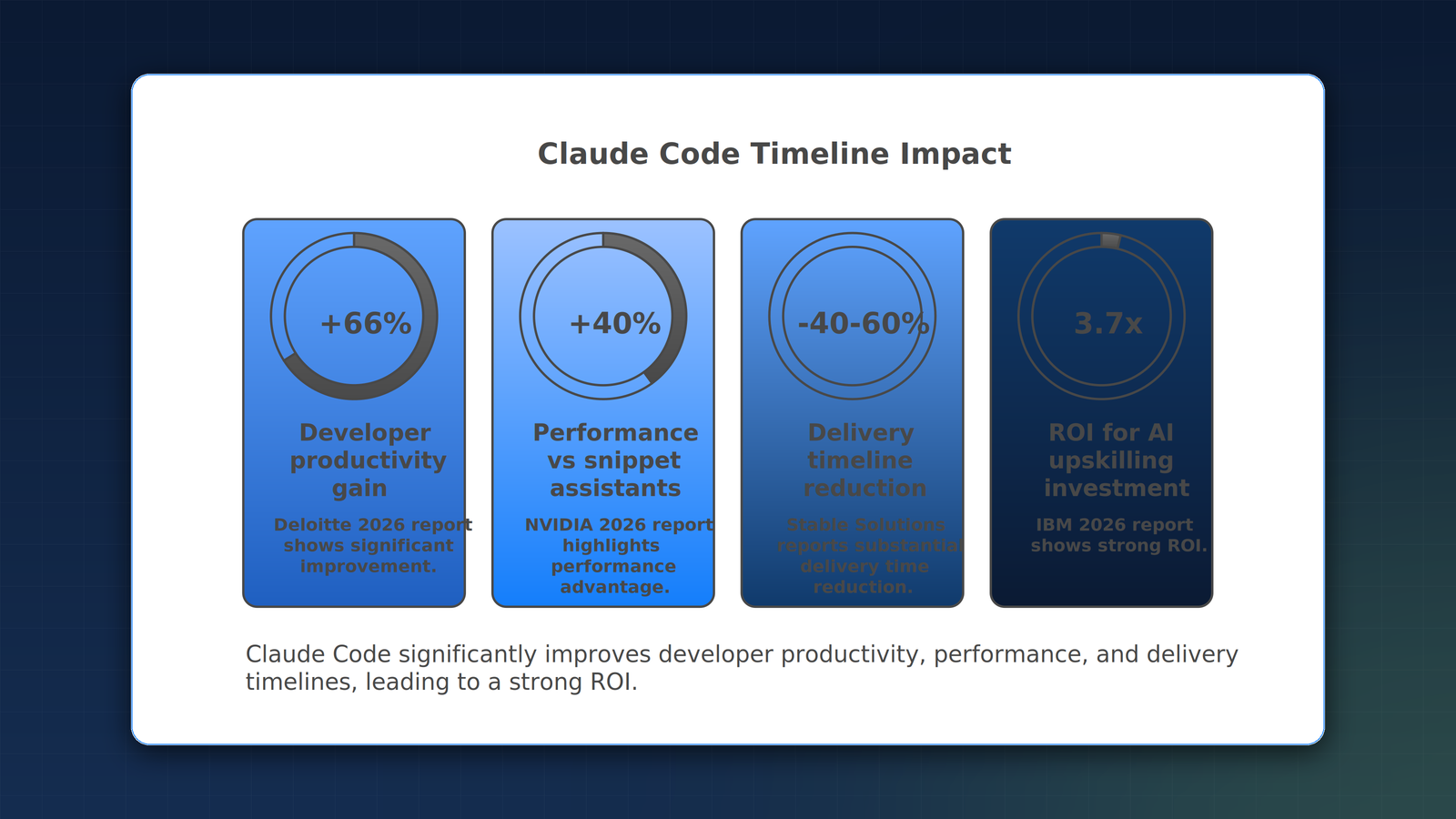
Claude Code, Anthropic's AI-powered development environment, is enabling engineering teams to deliver production-quality software in roughly half the time of traditional workflows. According to Deloitte's 2026 AI productivity report, teams using AI-assisted coding tools report an average 66% increase in developer productivity across planning, implementation, and debugging phases.
What Makes Claude Code Different from Other AI Coding Tools?
Unlike autocomplete-style code assistants, Claude Code operates as a full development partner. It understands project architecture, reads and writes across entire codebases, runs tests, and iterates on feedback. This is not about generating snippets. It is about executing complete development tasks with context awareness that spans hundreds of files simultaneously. The tool can analyze an entire monorepo, understand how services interact, identify potential breaking changes, and implement features that span multiple packages in a single session.
The distinction is critical for business stakeholders. Earlier AI coding tools saved minutes per task. Claude Code saves days per feature. According to NVIDIA's 2026 developer productivity study, AI development environments with full codebase context deliver a 40% performance improvement over snippet-based assistants, because they eliminate the integration overhead that consumes most development time. When the AI understands your database schema, your API contracts, and your frontend component library simultaneously, it produces code that fits together correctly on the first pass rather than requiring iterative debugging.
What Does This Mean for Project Timelines?
For B2B software projects, the impact on timelines is substantial. Features that traditionally required two-week sprints can often be completed in one. Complex integrations that might take a month of engineering time can be compressed to two weeks with AI-assisted development. This does not mean cutting corners. The code still goes through review, testing, and security validation. What changes is the velocity of the initial implementation phase, where the bulk of developer hours are typically spent.
"The teams achieving the best results with AI-assisted development are not replacing developers. They are amplifying their senior engineers so each one can operate at the capacity of a small team." — Dario Amodei, CEO, Anthropic
At Stable Solutions, we have integrated Claude Code into our development workflow and observed consistent 40-60% reductions in delivery timelines across web application, API, and automation projects. The gains are especially pronounced in greenfield development where architecture patterns can be established early and replicated consistently by the AI across the entire codebase. For organizations exploring how multiple AI agents can work in parallel, our article on parallel development with dispatch details the next evolution of this workflow.
How Does Quality Hold Up with AI-Assisted Development?
Quality is the natural concern when acceleration is the headline. The data is encouraging. According to IBM's 2026 software quality report, defect rates for AI-assisted projects remain comparable to traditional development when proper review processes are maintained. The key is that AI handles the volume of code generation while human engineers focus on architecture decisions, edge cases, and security review.
"AI-assisted development does not lower the bar. It raises the floor. Junior tasks get automated, which means your experienced engineers spend more time on the hard problems that actually determine project success." — Guido van Rossum, Creator of Python
The combination of AI speed with human oversight creates a workflow where more code is written, but the same rigorous standards apply to every line that ships to production. Automated test suites become even more valuable in this workflow because they serve as an objective quality gate that validates AI-generated code against functional requirements. Organizations that invest in comprehensive test coverage before adopting AI-assisted development see the highest quality outcomes, because the tests provide immediate feedback that the AI uses to iterate and improve its output before human review.
What Should You Consider Before Adopting AI-Assisted Development?
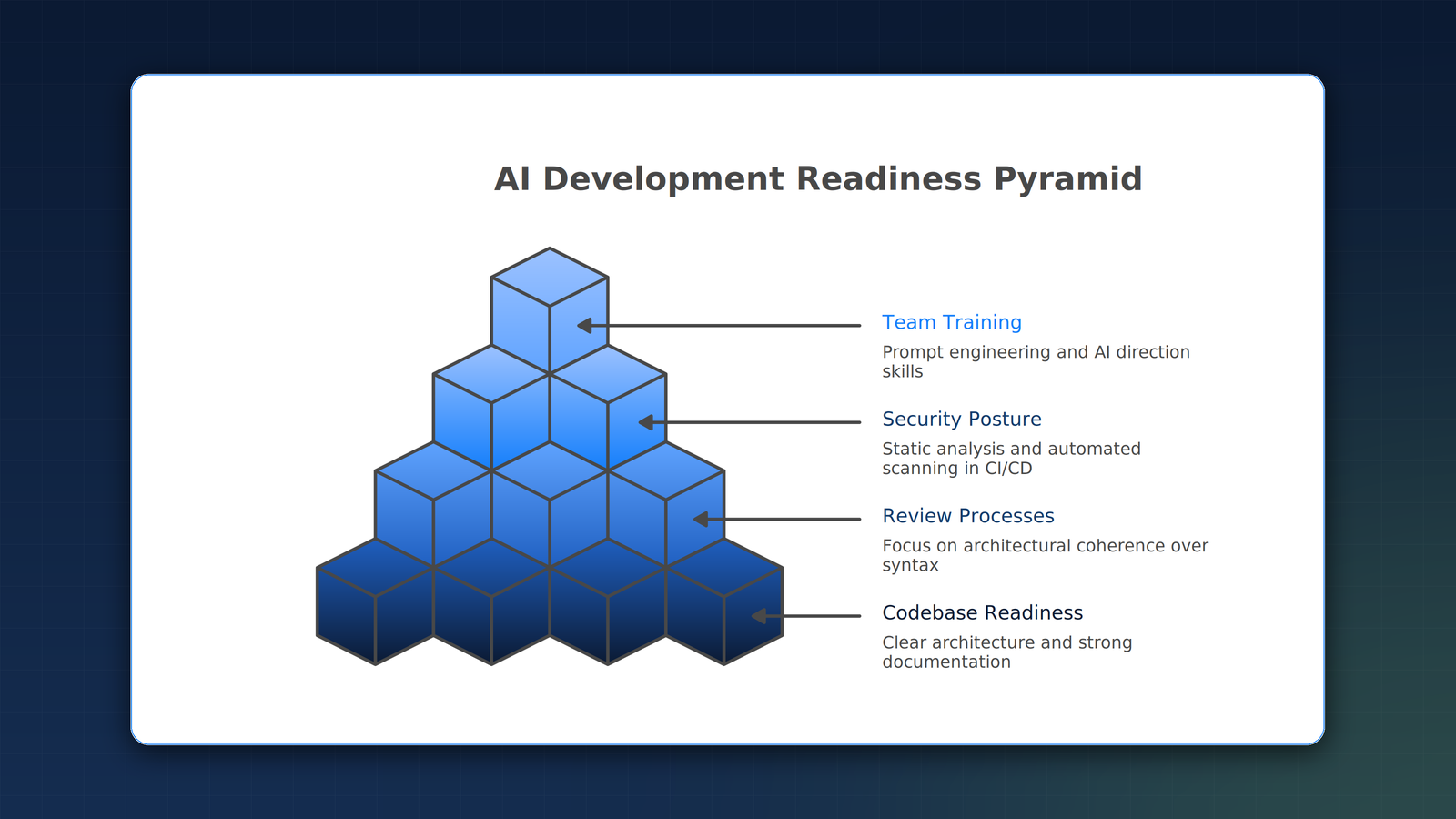
Adopting AI-assisted development is not as simple as installing a tool. Organizations need to evaluate their existing workflows, code review processes, and security requirements. Key considerations include:
- Codebase readiness: Well-structured, well-documented codebases yield dramatically better AI-assisted results. Projects with clear architecture documentation and consistent patterns enable AI tools to generate code that matches existing conventions.
- Review processes: Human code review becomes more important, not less, when AI generates code at higher volume. Review focuses shift from syntax and style toward architectural coherence and business logic correctness.
- Security posture: AI-generated code must be scanned and validated with the same rigor as human-written code. Static analysis tools and automated security scanning should be integrated into the CI/CD pipeline.
- Team training: Engineers need to learn how to direct AI tools effectively, which is a skill unto itself. Prompt engineering for code generation is an emerging discipline that materially affects output quality.
The World Economic Forum projects that 85% of companies will need to upskill their technical workforce to collaborate with AI development tools by 2028. Starting that process now creates a significant competitive advantage. According to IBM's 2026 AI workforce study, organizations investing early in AI upskilling achieve 3.7x returns on their AI investments, compared to significantly lower returns for organizations that delay training and adoption.
Key Takeaways
- Claude Code enables 40-60% reductions in software delivery timelines by operating as a full development partner, not just a code autocomplete tool.
- Quality and security standards are maintained through human review processes that focus senior engineers on architecture and edge cases.
- Organizations with well-structured codebases and strong review processes see the greatest benefits from AI-assisted development.
- The shift requires investment in team upskilling, but early adopters gain a measurable competitive advantage in delivery speed.
- Comprehensive test suites serve as objective quality gates that maximize the value of AI-generated code.
Frequently Asked Questions
Does AI-assisted development replace developers?
No. AI-assisted development amplifies developer productivity rather than replacing developers. According to Deloitte's 2026 report, teams see 66% productivity gains, meaning each developer accomplishes more, but human judgment remains essential for architecture, security, and business logic decisions that determine project success. The most effective model is senior engineers directing AI tools to handle implementation while focusing their own expertise on design and review. Organizations that adopt this approach consistently report higher developer satisfaction and retention alongside faster delivery.
How much faster can projects be delivered with Claude Code?
Delivery timelines are typically reduced by 40-60% based on industry data and our own experience at Stable Solutions. A project that would traditionally take 12 weeks might be completed in 6-8 weeks with AI-assisted development and proper processes in place. The gains vary by project type, with well-structured applications seeing the most significant acceleration. Greenfield projects with clear architecture patterns benefit the most, while legacy modernization projects see gains primarily in the implementation and testing phases.
Is AI-generated code secure?
AI-generated code requires the same security review as human-written code. When organizations maintain their existing security scanning and review processes, defect and vulnerability rates remain comparable to traditional development. The key is not skipping steps just because the code was produced faster. Automated security scanning in the CI/CD pipeline provides an essential safety net. Static analysis tools, dependency vulnerability scanning, and penetration testing should all remain part of the quality assurance process regardless of how the code was produced.
What types of projects benefit most from AI-assisted development?
Web applications, API development, data pipeline construction, and automation projects see the largest gains. Highly regulated domains like healthcare and finance also benefit but require additional validation steps to meet compliance requirements. Projects with clear architectural patterns and comprehensive test coverage see the fastest and most reliable results. The common factor is that projects with well-defined patterns and strong test suites give AI tools clear guardrails that produce consistent, high-quality output on the first pass.
Next Steps
If you are planning a software project and want to understand how AI-assisted development could compress your timeline, reach out to our team. We can provide a realistic timeline estimate using our Claude Code-enhanced workflow. Explore how our development capabilities combine AI tooling with MIT-trained engineering expertise to deliver faster without compromising quality.