

Which Departments Benefit Most from AI Automation?
Every department in a B2B organization can benefit from AI automation, but operations, finance, HR, and marketing see the most measurable results. Deloitte's 2026 enterprise AI survey found that organizations deploying AI across multiple departments report 66% average productivity gains, compared to 20-25% for single-department implementations.
How Is AI Transforming Operations?
Operations teams handle the highest volume of repetitive, process-driven tasks in most organizations, making them the natural starting point for AI automation. Supply chain optimization, inventory forecasting, quality control, and vendor management all contain patterns that AI systems can learn and automate. The structured nature of operational data, combined with well-defined processes and clear success metrics, creates ideal conditions for AI deployment.
A manufacturing company might use AI agents to monitor production line data in real time, predict equipment failures before they occur, and automatically reorder components when inventory drops below threshold levels. A services firm might use AI to optimize resource allocation, matching available staff to incoming projects based on skills, availability, and historical performance data. According to PwC's 2026 operational efficiency report, AI-powered operations teams achieve a 40% improvement in process performance, translating to measurable cost reductions and throughput increases. These gains compound over time as the AI systems learn from operational data and continuously refine their predictions.
"Operations is where AI delivers the fastest, most measurable ROI. The data is structured, the processes are well-defined, and the cost of manual execution is high. It is the perfect starting point for any AI initiative." — Thomas Davenport, Distinguished Professor, Babson College
What Are the Top AI Use Cases in Finance?
Finance departments benefit from AI in accounts payable and receivable automation, expense categorization, fraud detection, financial forecasting, and regulatory compliance monitoring. These tasks involve pattern recognition across large data sets, which is where AI excels.
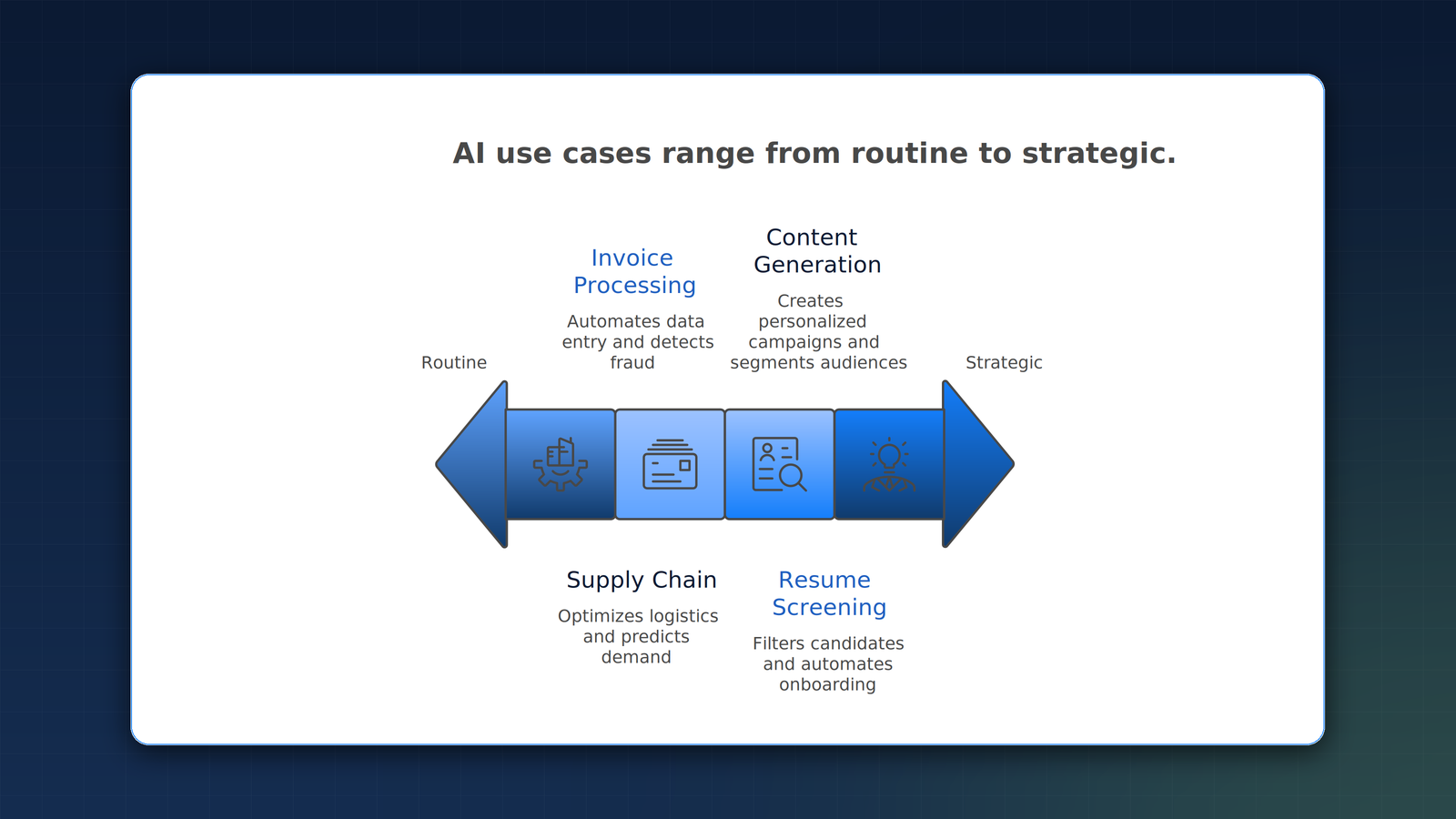
Invoice processing is a common entry point. An AI agent can read incoming invoices regardless of format, match them to purchase orders, flag discrepancies, and route approved invoices for payment without human intervention. Beyond accounts payable, AI transforms financial forecasting by analyzing historical trends, market conditions, and internal operational data to produce forecasts that update continuously rather than quarterly. According to IBM's 2026 AI ROI study, AI-powered finance operations achieve 3.7x ROI, with the highest returns coming from end-to-end process automation rather than isolated task automation. According to Goldman Sachs' 2026 economic impact analysis, AI could automate the equivalent of 300 million full-time jobs globally, with financial services among the most affected sectors.
How Can HR Departments Leverage AI?
HR teams use AI for resume screening, candidate matching, onboarding workflow automation, employee sentiment analysis, and benefits administration. The key benefit is not just speed but consistency. AI eliminates the unconscious biases that can affect human screening while ensuring every candidate is evaluated against the same criteria.
- Recruiting: AI screens resumes and matches candidates to roles based on skills, experience, and cultural fit indicators.
- Onboarding: Automated workflows guide new hires through documentation, training schedules, and system access provisioning.
- Employee engagement: Sentiment analysis of survey responses and communication patterns identifies retention risks early.
- Compliance: AI monitors regulatory changes and flags policy updates that require HR action.
"The HR teams that are getting the most from AI are using it to handle the administrative burden so their people can focus on the human side of human resources. That is where the real value lies." — Josh Bersin, Global Industry Analyst
The World Economic Forum estimates that 85% of companies will need to upskill their workforce to work alongside AI by 2028. HR departments are uniquely positioned to lead this transformation by using AI tools themselves while also developing the training programs that help other departments adopt AI effectively.
What Does AI-Powered Marketing Look Like?
Marketing departments use AI for content generation, audience segmentation, campaign optimization, lead scoring, and competitive analysis. The shift is from intuition-based marketing to data-driven marketing where AI continuously optimizes messaging, targeting, and budget allocation based on real-time performance data.
According to NVIDIA's 2026 marketing efficiency benchmarks, AI-optimized campaigns deliver 5-10% revenue uplift compared to manually managed campaigns. The gains come from AI's ability to process vastly more data points than human marketers, identifying patterns in customer behavior that inform more precise targeting and messaging. For B2B organizations, AI-powered lead scoring is particularly valuable, as it prioritizes sales team effort toward the prospects most likely to convert. Content generation is another high-impact area: AI agents can produce first drafts of blog posts, social media content, email sequences, and landing pages, which human marketers then refine for brand voice and strategic alignment. Learn more about how AI integrates with our AI automation services.
How Do You Get Started with Cross-Department AI?
The most successful multi-department AI deployments follow a phased approach. Start with a single department where the data is structured and the processes are well-defined, typically operations or finance. Demonstrate measurable ROI within that department, then use those results to build organizational confidence and executive sponsorship for expansion. IBM data shows that organizations taking this phased approach achieve 3.7x ROI compared to significantly lower returns for organizations that attempt enterprise-wide rollouts without first establishing proof points.
Cross-department coordination becomes critical as AI expands. Data that flows between departments, such as sales leads that inform marketing campaigns or financial forecasts that guide operational planning, creates opportunities for AI systems to optimize across organizational boundaries. This is where the compound gains emerge: AI agents that can see across departmental silos identify optimization opportunities that are invisible when each department operates independently. As we discuss in our analysis of industries leading AI adoption, the organizations seeing the highest returns are those that treat AI as an enterprise capability rather than a departmental tool.
Key Takeaways
- Multi-department AI deployment delivers 66% productivity gains versus 20-25% for single-department implementations, according to Deloitte.
- Operations is the ideal starting point due to structured data, defined processes, and high manual execution costs.
- Finance AI automation achieves 3.7x ROI through end-to-end process automation of invoice processing, forecasting, and compliance.
- HR benefits from consistent, unbiased screening and automated administrative workflows that free teams for strategic work.
- Marketing AI delivers 5-10% revenue uplift through data-driven campaign optimization and lead scoring.
Frequently Asked Questions
Which department should implement AI first?
Operations typically offers the fastest ROI due to high-volume, structured processes. However, the best starting point depends on your organization's specific pain points. Choose the department with the highest volume of repetitive tasks and the most structured data to work with. According to PwC's 2026 operational efficiency report, operations and finance departments achieve measurable results fastest because their workflows produce clear, quantifiable metrics that make ROI easy to demonstrate to executive stakeholders.
How much does cross-department AI implementation cost?
Costs vary widely based on scope and complexity, but the investment typically pays for itself quickly. According to IBM's 2026 AI ROI study, organizations investing in AI automation achieve 3.7x ROI on average. Starting with a single department pilot and expanding based on results is the most cost-effective approach for most B2B organizations. Cloud-based AI platforms have significantly reduced upfront costs, making enterprise-grade automation accessible to mid-market companies that previously could not afford custom solutions.
Do employees resist AI implementation in their departments?
Resistance is common but manageable with the right approach. The World Economic Forum recommends framing AI as a tool that eliminates tedious tasks rather than a replacement for workers. Organizations that invest in upskilling and involve employees in the AI implementation process see significantly higher adoption rates. Transparent communication about how automation will change roles — emphasizing that routine work decreases while strategic and creative responsibilities increase — builds trust and accelerates adoption across departments.
Can small businesses benefit from department-wide AI automation?
Yes. Cloud-based AI tools have made department-level automation accessible to organizations of all sizes. Small businesses often see proportionally larger gains because they have fewer resources to absorb the cost of manual, repetitive processes. A small firm that automates invoice processing, customer follow-ups, and HR onboarding can recover hundreds of hours annually — time that directly translates to revenue-generating capacity without adding headcount or increasing operational costs.
Next Steps
Ready to identify the highest-impact AI opportunities across your organization? Schedule a consultation with Stable Solutions for a department-by-department assessment. Our MIT-trained team will map your workflows, quantify automation potential, and recommend a phased implementation plan. Explore our full capabilities to see how we can help.