

Which Industries Are Leading AI Agent Adoption?
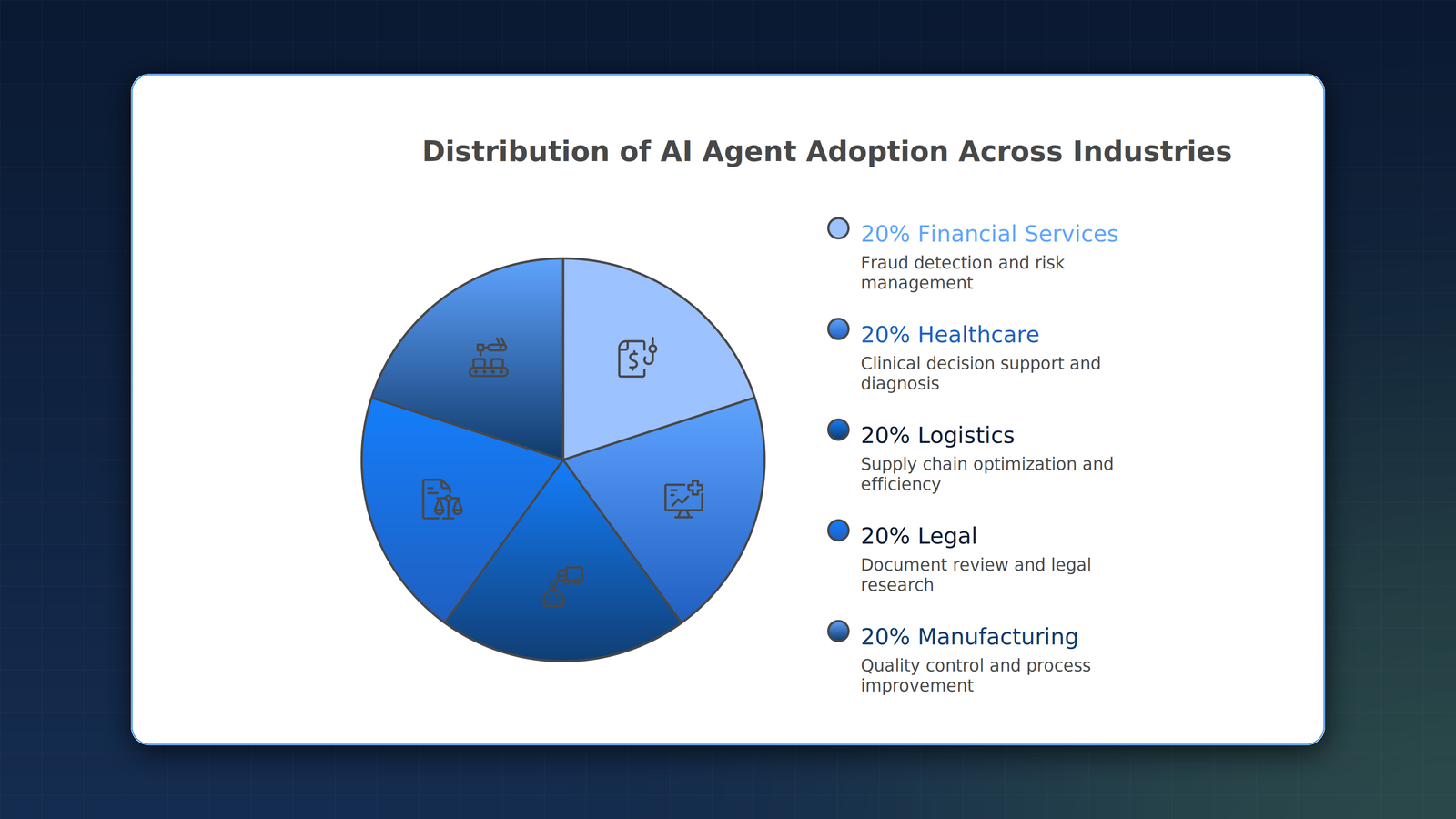
Financial services, healthcare, logistics, legal, and manufacturing are the five industries where AI agents are delivering the most measurable results in 2026. According to IBM's enterprise AI study, top-performing organizations across these sectors achieve 10.3x ROI on AI investments, with the average across all adopters at 3.7x.
Financial Services: Fraud Detection and Process Automation
Financial services was the earliest large-scale adopter of AI agents, and the results continue to compound. AI agents in banking handle fraud detection, credit risk assessment, regulatory compliance monitoring, and customer onboarding. The volume and structure of financial data make it ideally suited for agent-based automation.
According to Goldman Sachs' 2026 economic research, AI could automate the equivalent of 300 million full-time jobs globally, with financial services representing one of the most affected sectors. Banks using AI agents for fraud detection report 90% faster threat identification and 60% reductions in false positive rates. The impact on compliance is equally significant: AI agents continuously monitor transactions against evolving regulatory requirements, flagging potential violations in real time rather than during periodic manual reviews.
"In financial services, AI agents are not a competitive advantage anymore. They are table stakes. Every major institution is deploying them. The question is how effectively you orchestrate them." — Jamie Dimon, CEO, JPMorgan Chase
Healthcare: Clinical Decision Support and Administrative Automation
Healthcare AI agents are transforming both clinical and administrative workflows. On the clinical side, agents assist with diagnostic imaging analysis, drug interaction checking, treatment plan optimization, and patient risk stratification. On the administrative side, they handle scheduling, billing, insurance verification, and medical records management.
According to Deloitte's 2026 healthcare AI report, hospitals deploying AI agents for administrative tasks reduce processing costs by 40-50% while improving accuracy. The clinical applications are even more impactful: AI-assisted diagnostic tools have demonstrated accuracy rates comparable to specialist physicians in radiology, pathology, and dermatology. The key constraint is regulatory approval, but the FDA has cleared over 700 AI-enabled medical devices as of early 2026.
Logistics: Supply Chain Optimization and Predictive Maintenance
Logistics companies use AI agents for route optimization, demand forecasting, warehouse automation, and predictive maintenance. The industry generates massive volumes of real-time data from GPS trackers, IoT sensors, and transaction systems, which AI agents can process and act on far faster than human operators.
"AI agents in logistics do not just optimize individual routes. They optimize the entire network simultaneously, considering variables that no human planner could hold in their head. The result is 15-25% reductions in transportation costs." — Marc Lore, Former CEO, Walmart eCommerce
According to PwC's 2026 supply chain analysis, AI-optimized logistics operations achieve a 40% improvement in delivery performance. Predictive maintenance agents monitor equipment sensor data to forecast failures before they occur, reducing unplanned downtime by up to 50%. These gains are particularly significant in industries where downtime costs thousands of dollars per hour.
Legal: Document Review and Contract Analysis
The legal industry is experiencing one of the most dramatic AI transformations. AI agents can review contracts, analyze case law, identify regulatory risks, and draft standard legal documents at speeds that make traditional manual review impractical by comparison. A due diligence process that takes a legal team three weeks can be completed by AI agents in hours.
- Contract review: AI agents analyze hundreds of contracts simultaneously, flagging non-standard terms, missing clauses, and risk factors.
- Legal research: Agents search and synthesize relevant case law, statutes, and regulations across multiple jurisdictions.
- Compliance monitoring: Continuous scanning of regulatory updates with automated impact assessment for existing agreements.
- Document generation: Automated drafting of standard legal documents with jurisdiction-specific customization.
The results are measurable. According to NVIDIA's 2026 enterprise AI analysis, AI agents in legal services deliver a 40% performance improvement over manual processes, with accuracy rates that match or exceed junior associates on routine document review tasks. For B2B firms, this means faster deal closures and reduced legal costs.
Manufacturing: Quality Control and Production Optimization
Manufacturing AI agents monitor production lines in real time, detect quality defects using computer vision, optimize production schedules based on demand forecasts, and coordinate supply chain inputs. The industry's embrace of IoT sensors provides the data infrastructure that AI agents need to operate effectively.
According to Deloitte's 2026 manufacturing technology report, manufacturers using AI agents for quality control reduce defect rates by 30-50%, while production optimization agents increase throughput by 15-25%. The combination of predictive maintenance (preventing downtime) and quality control (reducing waste) creates compounding efficiency gains that significantly improve profit margins. These gains are particularly impactful in high-mix, low-volume manufacturing environments where traditional automation struggles to adapt to frequent product changeovers. AI agents learn from each production run and continuously optimize settings for quality and throughput across diverse product lines. Organizations interested in exploring AI agents for their industry can learn more about our industry-specific AI solutions.
What Do These Industries Have in Common?
The five industries leading AI agent adoption share three characteristics that make them particularly well-suited for agent-based automation. First, they generate large volumes of structured data that AI systems can analyze and learn from. Second, they have well-defined processes with clear rules and exceptions that agents can be trained to handle. Third, the cost of manual execution in these industries is high enough that even modest automation gains translate to significant financial returns. Deloitte's 2026 cross-industry analysis found that organizations in data-rich, process-heavy industries achieve 66% productivity gains from AI adoption, compared to 25-35% in industries with less structured workflows. The lesson for organizations in any industry is clear: the more structured your data and processes, the faster AI agents can deliver measurable results. For organizations looking to build the governance frameworks needed to deploy agents safely across any industry, our guide to AI governance and guardrails provides a comprehensive framework.
Key Takeaways
- Financial services, healthcare, logistics, legal, and manufacturing lead AI agent adoption with measurable ROI of 3.7x average and 10.3x for top performers.
- Financial services uses AI agents for fraud detection, compliance, and process automation with 90% faster threat identification.
- Healthcare AI agents reduce administrative costs by 40-50% while clinical applications match specialist-level diagnostic accuracy.
- Logistics AI delivers 15-25% transportation cost reductions and 50% less unplanned downtime through predictive maintenance.
- Legal AI agents compress multi-week due diligence processes to hours with accuracy matching junior associates.
Frequently Asked Questions
Which industry sees the fastest ROI from AI agents?
Financial services typically sees the fastest ROI due to the structured nature of financial data and the high cost of manual compliance and fraud detection processes. According to IBM's 2026 enterprise AI study, financial services AI implementations often achieve positive ROI within 6-12 months. Banks deploying AI agents for fraud detection report 90% faster threat identification and 60% reductions in false positive rates, which directly reduces operational costs while improving risk management outcomes.
Are AI agents replacing workers in these industries?
AI agents are augmenting workers rather than replacing them in the vast majority of deployments. According to Goldman Sachs' 2026 economic research, while AI could automate tasks equivalent to 300 million jobs globally, most implementations create new roles focused on AI oversight, strategy, and the complex judgment tasks that agents cannot handle independently. Workers who upskill to collaborate with AI tools become significantly more productive, making them more valuable to their organizations rather than less.
What is the biggest barrier to AI agent adoption in regulated industries?
Regulatory compliance and data privacy are the primary barriers to AI agent adoption in regulated sectors. Healthcare and financial services face strict regulations around data handling and algorithmic decision-making that require careful architecture and governance. Organizations that invest in AI governance frameworks upfront navigate these challenges more effectively. The EU AI Act and NIST AI Risk Management Framework are establishing standards that proactive organizations can use to build compliant AI deployments ahead of mandatory requirements.
Can mid-market companies in these industries afford AI agents?
Yes. Cloud-based AI platforms have dramatically reduced the cost of entry for AI agent deployment. Mid-market companies can start with focused use cases and scale based on results, often achieving positive ROI within the first quarter of deployment. The key is selecting high-impact, well-defined processes for initial automation rather than attempting enterprise-wide transformation immediately. A single successful pilot often generates enough cost savings to fund subsequent expansions without requiring additional budget approval.
Next Steps
If your organization operates in one of these industries and you want to explore AI agent opportunities, contact Stable Solutions for an industry-specific assessment. Our MIT-trained team has experience deploying AI agents across multiple sectors. Explore our full capabilities to see how we can accelerate your AI adoption.