

The Rise of Intelligent Automation
AI automation is the use of artificial intelligence to execute repetitive business tasks — such as document processing, data entry, and customer communications — without manual intervention. According to Deloitte's 2026 State of AI report, organizations deploying AI automation achieve average productivity gains of 66%, with early adopters eliminating 40–60% of manual workflow tasks.
Where AI Automation Delivers the Most Impact
The highest-ROI automation opportunities exist in three core areas: document processing, customer communication workflows, and data reconciliation. Companies implementing AI in these areas consistently report 40–60% reductions in processing time alongside significant improvements in error rates. In mortgage processing alone, AI-driven document extraction has reduced review cycles from days to hours. Legal teams using intelligent contract analysis report 70% faster turnaround on routine reviews.
According to IBM's 2026 AI ROI study, organizations deploying AI automation across business workflows report a 3.7x return on investment compared to traditional RPA approaches, with top performers achieving 10.3x ROI. The difference lies in AI's ability to handle exceptions and ambiguity that would otherwise require human intervention. Where traditional automation breaks when a form layout changes or an email deviates from a template, AI adapts on the fly, dramatically reducing the maintenance burden that plagues legacy automation deployments. According to Gartner's 2026 enterprise technology forecast, 30% of all enterprise business processes will incorporate at least one AI-automated step by year-end, up from just 12% in 2024.
"The companies seeing the greatest returns from AI automation are those that treat it as a workflow transformation, not a point solution. You don't automate a single step — you reimagine the entire process." — Thomas Davenport, Professor, Babson College
The Business Case: Cost Reduction and Capacity Expansion
According to McKinsey's 2026 analysis of AI adoption across mid-market companies, workflow automation reduces operational costs by 25–40% in the first 12 months. But cost reduction is only half the story. The more compelling benefit is capacity expansion: teams that automate routine tasks can handle 2–3x their previous workload without adding headcount. For growing businesses facing talent shortages, this is a strategic advantage that compounds over time.
Consider a professional services firm processing 500 client onboarding documents per month. Manual processing requires 20 minutes per document — roughly 167 hours of staff time. With AI-powered document extraction, classification, and routing, that same volume is processed in under 30 hours, freeing 137 hours per month for higher-value client work. At a blended rate of $75/hour, that's over $120,000 in annual capacity recovered from a single workflow. Multiply that across five or six high-volume processes and the business case becomes self-funding within the first quarter. This capacity expansion model is particularly powerful for mid-market companies that face enterprise-level workloads without enterprise-level headcount budgets.
Implementation: A Phased Approach That Reduces Risk
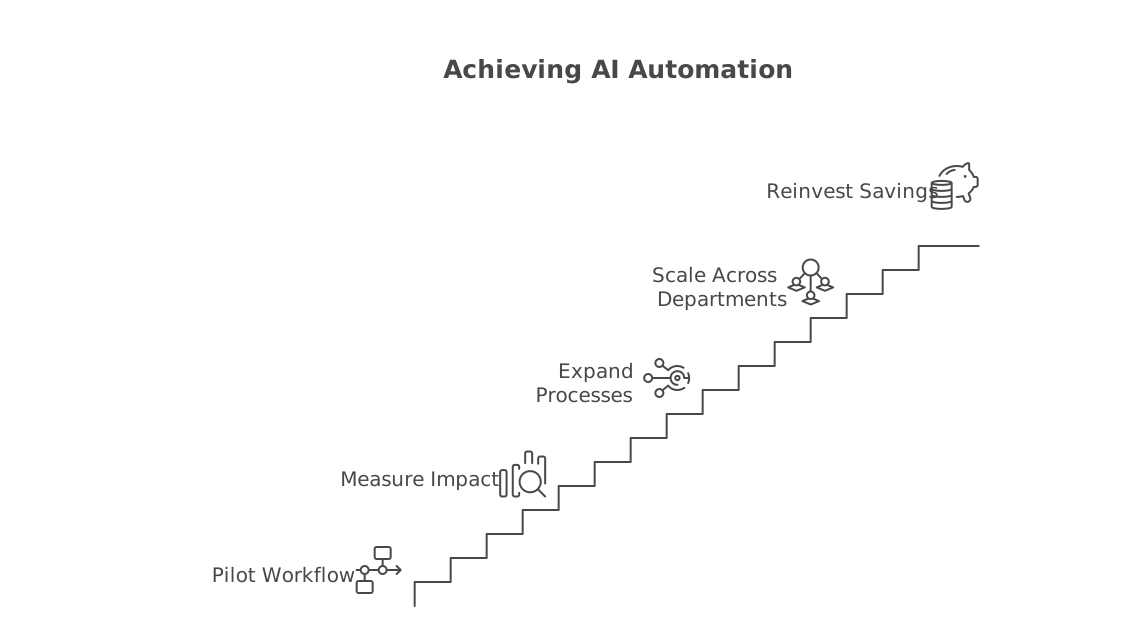
The key to successful AI automation is starting with well-defined, repetitive processes where the cost of manual execution is high and the tolerance for errors is measurable. A phased approach reduces risk and builds organizational confidence. Phase one focuses on document processing and data entry — high volume, low ambiguity tasks where AI accuracy exceeds 95% from day one. Phase two extends to customer communications: automated follow-ups, scheduling, and response drafting with human review. Phase three tackles complex decision workflows where AI provides recommendations and humans approve.
Each phase should include baseline measurement, pilot deployment, accuracy validation, and full rollout. According to PwC's 2026 automation benchmarks, organizations that skip the pilot phase report 3x more integration issues and slower adoption. The discipline of measuring before and after each phase also builds the internal business case for expanding automation to additional departments. Crucially, each completed phase generates internal champions — team leaders who have seen measurable time savings and become advocates for the next round of automation investment.
"Start with the workflow that causes the most pain and has the clearest metrics. A single successful automation project creates more organizational momentum than any executive presentation." — Reshma Saujani, Founder, Moms First
Cross-Department Automation Opportunities
AI automation is no longer confined to IT or operations. Finance teams are using intelligent automation for invoice matching, expense categorization, and audit preparation. HR departments automate candidate screening, onboarding document collection, and benefits enrollment. Sales teams deploy AI for lead scoring, CRM data enrichment, and proposal generation. The common thread is that every department has repetitive, rules-based work that AI can handle faster and more accurately than manual processes.
For a comprehensive look at how AI applies across every business function, see our guide on AI use cases across every department. The organizations achieving the broadest impact are those that establish a central automation team — often just 2–3 people — that identifies opportunities, prioritizes by ROI, and manages deployment across the company. According to Forrester's 2026 enterprise automation report, companies with a dedicated automation center of excellence deploy 4x more automated workflows within 18 months than those pursuing ad-hoc automation efforts.
Getting Started with Stable Solutions
Ready to identify and automate your highest-impact workflows? Contact Stable Solutions for a workflow automation assessment. Our MIT-trained team will map your current processes, quantify the time and cost savings available, and deliver a phased implementation roadmap tailored to your business. Explore our full AI automation capabilities to see how we help B2B companies eliminate manual work and scale operations.
Key Takeaways
- AI automation reduces manual workflow tasks by 40–60% and delivers 3.7x average ROI according to IBM's 2026 research.
- The highest-impact automation targets are document processing, customer communications, and data reconciliation.
- A phased implementation approach — starting with high-volume, low-ambiguity tasks — reduces risk and builds organizational confidence.
- Capacity expansion (handling 2–3x workload without new hires) often delivers more strategic value than direct cost savings.
- Cross-department automation creates compounding returns when managed by a central team that prioritizes by ROI.
Frequently Asked Questions
How long does it take to implement AI workflow automation?
Most organizations can deploy their first automated workflow within 4–8 weeks, including baseline measurement and pilot validation. Full enterprise-wide automation programs typically span 6–12 months, with each phase delivering measurable ROI before the next begins. The key is starting with a well-defined process that has clear inputs, outputs, and success metrics. Document processing and data entry automations typically deliver results fastest because they involve structured, high-volume tasks where AI accuracy exceeds 95% from day one.
What is the ROI of AI automation for mid-size businesses?
According to IBM's 2026 AI ROI study, organizations deploying AI automation achieve an average 3.7x return on investment, with top performers reaching 10.3x. Mid-size businesses often see faster payback because they have less legacy infrastructure to integrate around. A single high-volume workflow automation can recover $100,000 or more in annual capacity, making the investment self-funding within the first quarter for most organizations. The compound effect of automating multiple workflows means ROI accelerates with each subsequent deployment as the organization builds reusable patterns and internal expertise.
Does AI automation replace employees?
No. AI automation handles repetitive, rules-based tasks so employees can focus on higher-value work that requires judgment, creativity, and relationship management. Deloitte's 2026 research shows 66% productivity gains — meaning each team member accomplishes more, not that teams shrink. In practice, companies that automate effectively often redeploy staff to revenue-generating activities like client management, strategic planning, and business development. The most successful implementations treat automation as a force multiplier for existing talent rather than a headcount reduction strategy.
What processes should we automate first?
Start with processes that are high volume, clearly defined, and currently causing bottlenecks. Document processing, data entry, and routine customer communications are the most common starting points because they offer high accuracy rates from day one and deliver measurable time savings within weeks. According to PwC's 2026 benchmarks, organizations that begin with these high-confidence use cases report 3x fewer integration issues during rollout. Once the first automation proves its value, use the measured results to build the business case for expanding to more complex workflows in additional departments.