

What Is the AI Code Rework Tax, and Why Should Your Board Care?
Your teams are shipping AI-generated code faster than ever, and a large-scale 2026 study shows the bill arrives later: nearly a quarter of the defects AI introduces survive into production as permanent maintenance work. That surviving liability is AI-generated code technical debt, and we call it the rework tax. The faster you scale agentic coding without governance, the larger the tax, and it reframes the build-versus-partner decision for every engineering leader under board pressure to move quickly.
Agentic coding (AI systems that autonomously write, edit, and commit code across multi-step tasks rather than just autocompleting a line) has moved from experiment to default. Gartner predicts that 40% of enterprise applications will feature task-specific AI agents (narrow agents scoped to one job, such as writing a function or fixing a test) by the end of 2026, up from less than 5% in 2025. Velocity is no longer the differentiator. What you do with the debt it creates is.
What Does the Research Say About AI-Generated Code Technical Debt?
The most rigorous look at this question to date is a 2026 empirical study that analyzed 302,600 AI-authored commits across 6,299 GitHub repositories, spanning five widely-used AI coding assistants. The researchers identified 484,366 distinct issues. The findings should reset how your organization thinks about AI velocity:
- Defects are the norm, not the exception: more than 15% of commits from every AI coding assistant studied introduce at least one issue. This is not a single bad model. It is a property of the category.
- Most issues are code smells: code smells (structural weaknesses such as duplicated logic, overly complex functions, or poor naming that do not break the build but raise the cost of every future change) account for 89.3% of all issues found.
- The debt is sticky: 22.7% of tracked AI-introduced issues still survive at the latest version of the repository. Issue survival means the defect was never fixed and now lives permanently in your codebase. This is the rework tax made concrete.
Unresolved AI-introduced technical debt climbed from a few hundred issues in early 2025 to over 110,000 surviving issues by February 2026. The curve is not flattening.
Read that survival number against your own roadmap. If roughly one in four AI-introduced defects never gets resolved, every sprint that ships ungoverned AI code is quietly funding a maintenance backlog your team will pay down for quarters, with interest.
Why Velocity Without Governance Becomes a Multi-Quarter Liability
The rework tax is dangerous precisely because it is invisible on the timelines boards review. A feature ships on schedule. The demo works. The code smell that duplicated a payment-validation path does not announce itself until a downstream change breaks in production six months later. By then the original author has moved on, the context is gone, and the fix costs many times over what review would have. Gartner has separately predicted that over 40% of agentic AI projects will be canceled by the end of 2027, with weak governance and unclear value among the drivers. Speed that accrues silent debt is a leading cause of that failure pattern, not a hedge against it.
This is the real shape of the build-versus-partner decision. It is not "can we ship AI code fast." Every option ships fast now. It is "who absorbs the rework tax, and who has the discipline to keep it small."
The Build-vs-Partner Framework for AI-Assisted Delivery
Most engineering leaders frame this as build versus buy. For AI-assisted delivery, the sharper axis is build versus partner, because the question is not what tool you license but who owns the quality system around it. Weigh three paths against the rework tax:
- Build in-house: you own velocity and you own the debt. This works when you already have senior reviewers, enforced quality gates, and the headcount to staff governance as a standing function. Without that, AI-generated code technical debt compounds faster than your team can service it.
- Buy a tool and self-govern: licensing another AI coding assistant raises output but does nothing to lower the 22.7% survival rate. A tool does not review itself. Buying capability without buying discipline simply raises the tax.
- Partner with an R&D firm: you keep the velocity and outsource the governance system, the review depth, and the quality gates to a team that does this as its core function. The point of a partner is not slower, safer code. It is fast code with the rework tax engineered down.
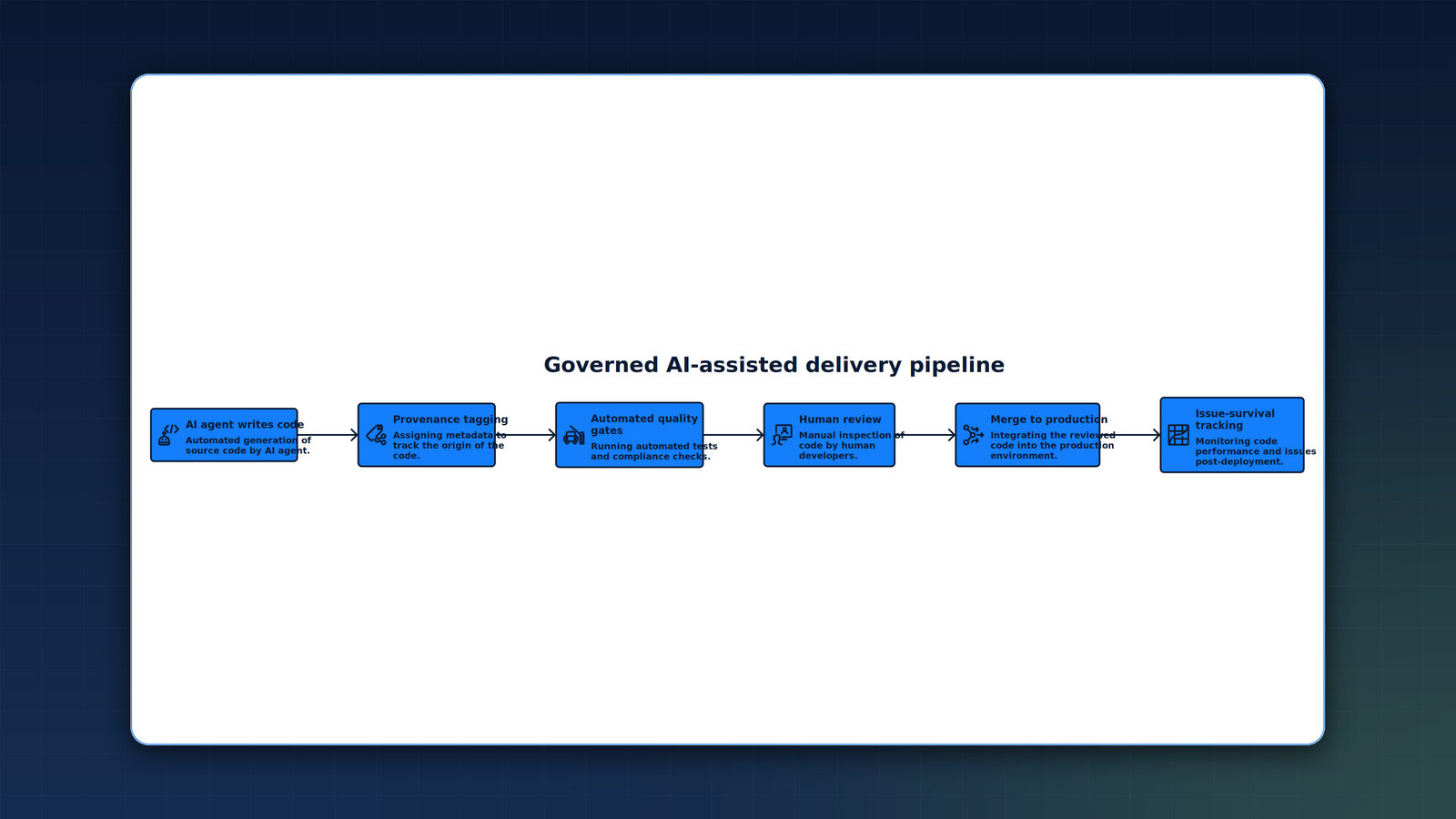
Stable Solutions is built for the third path. As an MIT-trained R&D partner, we wire human review, provenance tracking (a record of which code was AI-authored versus human-authored, so every change can be traced and audited), and automated quality gates around AI-assisted delivery so velocity does not silently become a maintenance liability. We ship fast, and we ship with the governance that keeps the debt curve flat. A national VoIP provider we worked with reached a working prototype in two weeks and cut total time-to-launch by 50%, with review and quality gates in the loop the entire time. Speed and discipline are not a tradeoff when the system is designed for both. We explored the upstream shift in our analysis of how agentic AI is replacing the traditional SDLC, and the governance discipline here is the other half of that story.
How to Quantify Your Own Rework Tax Before You Decide
You cannot govern what you do not measure. Before committing to a path, instrument your AI-assisted pipeline so the board sees the real number, not the demo:
- Track issue survival: measure what fraction of AI-introduced defects remain unresolved 90 days after merge. If you are near the 22.7% benchmark, the tax is real and unmanaged.
- Tag AI provenance: label which commits and lines are AI-authored so debt can be traced, audited, and attributed. In regulated sectors this is a compliance requirement, not a nicety.
- Gate on code smells, not just tests: a passing test suite says the code works today. Code-smell density says what it will cost to change tomorrow. Govern both.
- Price the backlog: translate surviving issues into engineer-hours so the rework tax appears on the same ledger as the velocity it funded.
Key Takeaways
- A 2026 study of 302,600 AI-authored commits found that 22.7% of AI-introduced issues survive into the latest version of the codebase as permanent technical debt: the rework tax.
- Defects are a property of the category, not one bad tool: more than 15% of commits from every AI coding assistant studied introduce at least one issue, and 89.3% of issues are code smells.
- Velocity without governance is a multi-quarter liability boards do not see until production breaks; unresolved AI debt grew to over 110,000 surviving issues by February 2026.
- The real decision is build versus partner: who owns the quality system around the AI, not which tool you license.
- Quantify your own issue-survival rate and tag AI provenance before you decide, so the rework tax appears on the ledger next to the speed it bought.
Frequently Asked Questions
What is the AI code rework tax?
It is the permanent maintenance debt created when AI-introduced defects are never resolved and survive into production. A 2026 large-scale study found 22.7% of tracked AI-introduced issues persist in the latest version of the repository, so roughly one in four becomes a standing cost your team services for quarters.
Does buying a better AI coding tool reduce this debt?
No. The study found more than 15% of commits from every assistant studied introduce at least one issue, so the problem is structural to the category. A better tool can raise output, but only a governance system (human review, quality gates, provenance tracking) lowers the share of defects that survive.
What is a code smell, and why does it matter to an executive?
A code smell is a structural weakness, such as duplicated logic or an overly complex function, that does not break the build but raises the cost of every future change. It matters because code smells are 89.3% of AI-introduced issues, and they convert directly into slower roadmaps and higher maintenance spend later.
How do we decide between building in-house and partnering?
Ask who owns the quality system, not who writes the code. If you already staff senior review and enforced quality gates as a standing function, building in-house can work. If you do not, partnering with an R&D firm keeps the velocity while engineering the rework tax down to a manageable level.
Sources
- arXiv, "Debt Behind the AI Boom: A Large-Scale Empirical Study of AI-Generated Code in the Wild," 2026. Link.
- Gartner, "Gartner Predicts 40% of Enterprise Apps Will Feature Task-Specific AI Agents by 2026, Up from Less Than 5% in 2025," 2025. Link.
- Gartner, "Gartner Predicts Over 40% of Agentic AI Projects Will Be Canceled by End of 2027," 2025. Link.
Next Steps
The decision in front of you is not whether to adopt AI-assisted delivery; it is whether you build the governance around it in-house or partner for it. Stable Solutions wires review, provenance, and quality gates around AI-assisted delivery so velocity does not become a hidden rework tax. Explore our App and Web Development service or contact our team to quantify your rework tax and design the path that fits your org.