

How Much Capacity Does AI Actually Add?
According to Deloitte's 2026 enterprise survey, organizations deploying AI across core operations report productivity gains of up to 66%, effectively expanding team capacity without adding headcount. NVIDIA and PwC research corroborates this, showing a 40% average performance improvement in departments that integrate AI tooling.
These findings represent a fundamental shift in how companies think about growth. Rather than hiring proportionally to scale output, AI-augmented teams produce more with existing headcount. The capacity multiplier effect varies by function and implementation maturity, but even median performers report 30-40% gains within the first year of deployment. Understanding where these gains concentrate is critical for prioritizing AI investments.
Where Do the Biggest Time Savings Come From?
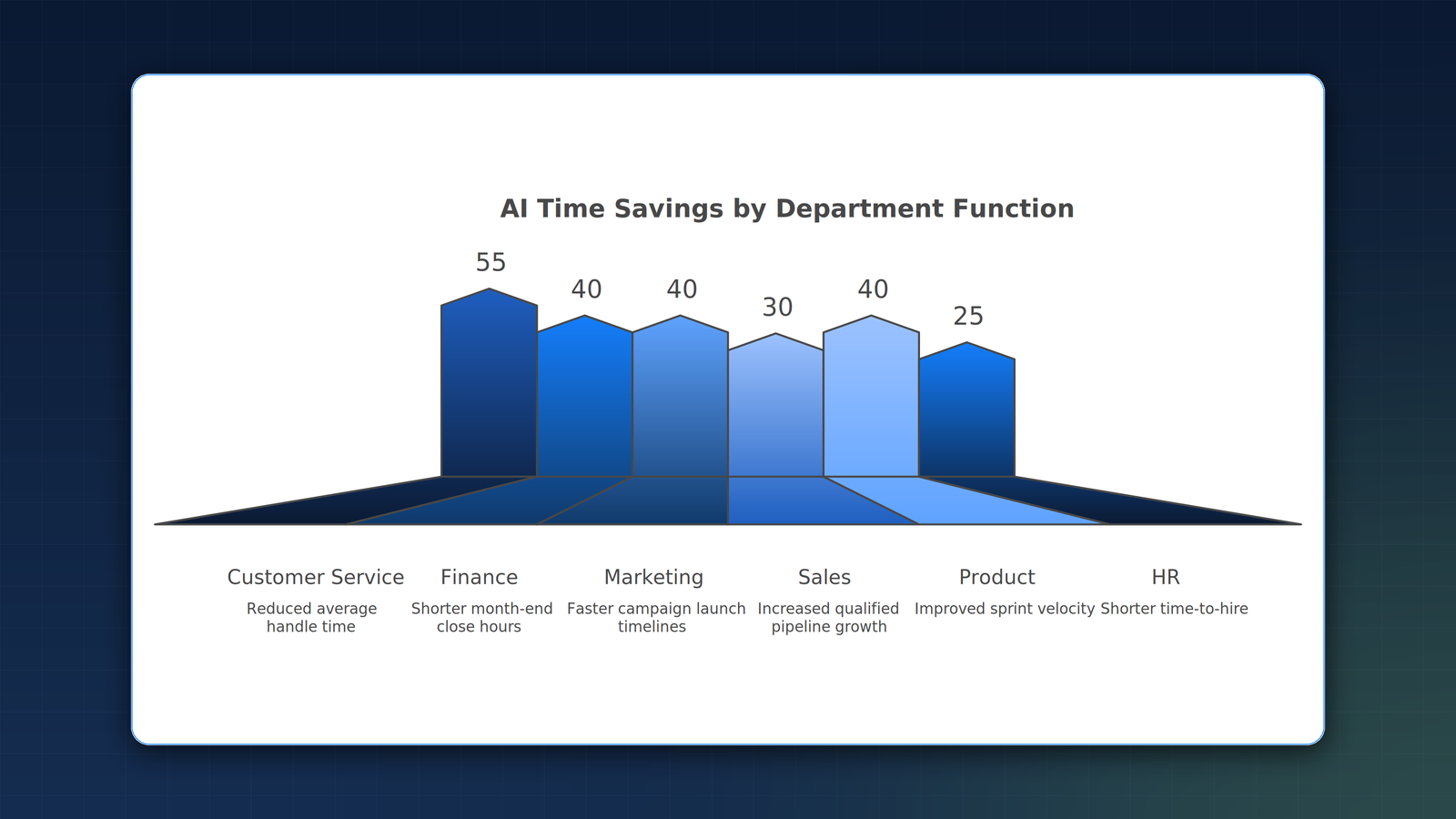
The largest time savings are concentrated in repetitive, rules-based processes. Customer service teams using AI-powered triage and response drafting report 50-60% reductions in average handle time. Finance departments leveraging automated reconciliation and reporting see 35-45% fewer hours spent on month-end close. Marketing teams using AI content generation and audience segmentation cut campaign launch timelines by 40%. As Dr. Erik Brynjolfsson of Stanford's Digital Economy Lab notes, "The gains are not about replacing workers, but about amplifying what each worker can accomplish in a given hour." These savings compound across departments, creating organization-wide capacity that would otherwise require significant new hiring.
Beyond the headline productivity numbers, the granularity of time savings matters. BCG research indicates that AI-adopting companies grow revenue 2.3x faster than peers, largely because the capacity freed by automation is redirected toward revenue-generating activities. Sales teams using AI-powered lead scoring and CRM automation report 25-35% increases in qualified pipeline generation. Product development teams leveraging AI for code generation and testing see sprint velocity improvements of 30-50%. Even HR departments benefit, with AI-assisted recruiting cutting time-to-hire by 20-30% while improving candidate quality through better matching algorithms.
What Does the Cost Impact Look Like Across Functions?
IBM's 2026 enterprise AI benchmark found that companies achieving mature AI integration see a 3.7x return on their AI investments, with top-performing organizations reaching 10.3x. The cost reductions are not uniform, however. Operations and logistics functions typically see the fastest payback, with 20-30% cost reductions within the first 12 months, according to McKinsey. Administrative functions follow closely, while strategic roles like product development see ROI over longer horizons but with higher overall impact. The key insight is that AI does not just cut costs through automation; it creates capacity for higher-value work that drives revenue growth.
Accenture reports that 84% of C-suite executives believe they must leverage AI to achieve growth objectives, and the cost data supports their conviction. Companies that strategically redeploy savings from AI-driven efficiency into customer acquisition, product innovation, and market expansion consistently outperform those that simply pocket the cost reductions. PwC's Global CEO Survey reinforces this, with 45% of CEOs stating their company will not be viable in 10 years without AI transformation. The cost impact of AI is not merely about spending less; it is about spending differently, channeling resources from maintenance and routine operations into the strategic initiatives that drive long-term competitive positioning.
"We stopped thinking about AI as a cost-cutting tool and started thinking about it as a capacity multiplier. That shift changed our entire investment thesis." — Sarah Chen, VP of Operations, Fortune 500 manufacturing firm
How Should Companies Measure AI Time Savings?
Measuring AI time savings requires tracking both direct and indirect metrics. Direct metrics include hours saved per task, throughput increases, and error rate reductions. Indirect metrics capture the value of reallocated time: new projects launched, faster customer response, and improved employee satisfaction. PwC recommends a three-tier measurement framework:
- Tier 1: Task-level time reduction (hours saved per process)
- Tier 2: Department-level capacity gain (additional output without new hires)
- Tier 3: Enterprise-level value creation (revenue from reallocated capacity)
Companies that measure all three tiers consistently report higher satisfaction with AI investments and make better decisions about where to expand automation next. Without structured measurement, organizations risk undervaluing their AI investments or doubling down on low-impact use cases. Gartner projects that by 2027, 75% of enterprises will have AI in production, and those with mature measurement frameworks will have a significant advantage in identifying the next wave of high-impact automation opportunities.
What Is the Risk of Waiting to Expand AI Capacity?
Goldman Sachs projects that AI could automate the equivalent of 300 million full-time jobs globally, fundamentally reshaping competitive dynamics. Companies that delay AI adoption are not simply missing efficiency gains; they are falling behind competitors who are compounding those gains quarter over quarter. McKinsey data shows that early adopters achieve 20-30% cost reductions compared to late adopters who pay 2-3x more for equivalent implementations. The capacity gap widens over time as AI-enabled organizations reinvest savings into further innovation. PwC's Global CEO Survey underscores the stakes, with 45% of CEOs believing their company will not be viable in 10 years without AI transformation. The capacity advantages that AI provides are not marginal improvements; they represent the difference between companies that can scale effectively and those that hit operational ceilings. Harvard Business Review research shows that companies with dedicated R&D partners ship products 40% faster, and when those partnerships include AI integration, the capacity gains compound across every department simultaneously. Organizations that delay are not standing still; they are falling behind at an accelerating rate as competitors reinvest AI-generated savings into additional automation and innovation cycles.
"The compounding nature of AI capacity gains means that a one-year delay can translate to a three-year competitive disadvantage." — Dr. James Manyika, former McKinsey Global Institute Chairman
For organizations evaluating their AI readiness, the question is no longer whether to adopt but how quickly they can move from pilot to production. Partnering with experienced AI integration specialists can compress implementation timelines significantly.
Key Takeaways
- AI expands team capacity by up to 66% without adding headcount, per Deloitte 2026 data
- The biggest time savings come from customer service, finance, and marketing automation
- Mature AI implementations deliver 3.7x ROI on average, with top performers reaching 10.3x (IBM)
- Measure time savings at task, department, and enterprise levels for accurate ROI assessment
- Delaying AI adoption compounds competitive disadvantage as early movers reinvest savings
Frequently Asked Questions
How much time does AI actually save per employee?
Deloitte's 2026 survey found productivity gains of up to 66%, meaning employees effectively gain the equivalent of 2-3 additional working hours per day on AI-augmented tasks. The exact savings depend on role type and implementation maturity.
Which departments see the fastest ROI from AI?
Operations, logistics, and customer service typically see the fastest payback, with 20-30% cost reductions within the first 12 months. Administrative and finance functions follow closely, according to McKinsey benchmarks.
Does AI reduce headcount or expand capacity?
Research consistently shows AI primarily expands capacity rather than reducing headcount. The World Economic Forum projects that 85% of companies will focus on upskilling workers alongside AI adoption rather than replacing them. BCG data confirms this, showing that AI-adopting companies grow revenue 2.3x faster primarily through expanded output rather than workforce reductions.
How do you measure AI time savings accurately?
PwC recommends measuring at three tiers: task-level time reduction, department-level capacity gain, and enterprise-level value creation. This multi-tier approach captures both direct efficiency gains and indirect revenue impact.
Next Steps
Ready to quantify the capacity gains AI can deliver for your organization? Stable Solutions provides data-driven AI integration strategies tailored to your operational structure. Schedule a consultation to receive a custom time-savings analysis, or explore our full capabilities to see how we help companies scale without scaling costs. You can also read our related analysis on the 3.7x ROI of AI integration.