

What Is the Actual ROI of AI Integration in 2026?
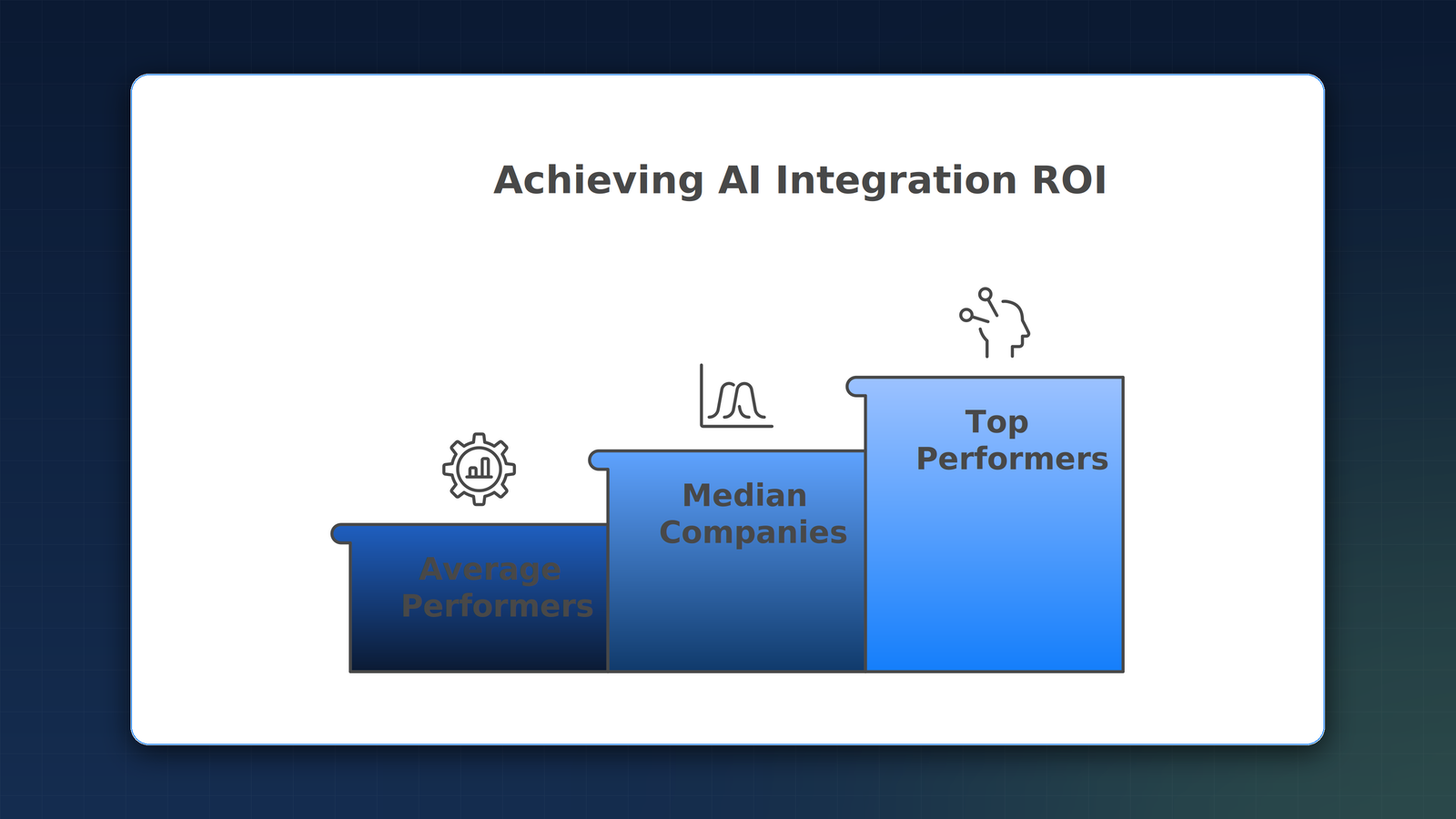
IBM's 2026 enterprise AI benchmark reveals an average return of 3.7x on AI investments across industries, with the top quartile of performers achieving 10.3x returns. This data, drawn from over 3,000 enterprise deployments, represents the most comprehensive measure of AI ROI available today.
The gap between average and top-tier performers underscores a critical insight: AI returns are not determined by technology alone but by how thoughtfully organizations implement and integrate AI into core operations. Companies that treat AI as a strategic capability rather than a point solution consistently outperform peers, and understanding the drivers behind that divergence is essential for maximizing investment returns.
What Drives the Gap Between Average and Top Performers?
The 6.6x gap between average (3.7x) and top-performing (10.3x) organizations is not random. IBM's analysis identifies three primary differentiators. First, top performers invest in data infrastructure before deploying AI models, ensuring clean, accessible, and well-governed datasets. Second, they focus on high-impact use cases rather than experimenting broadly. Third, they integrate AI into existing workflows rather than building standalone tools. As Thomas Davenport, professor at Babson College and author of "Competing on Analytics," notes:
"The companies seeing the highest returns from AI are not the ones with the most sophisticated models. They are the ones with the most disciplined approach to identifying where AI creates measurable business value." — Thomas Davenport, Professor of IT and Management, Babson College
Deloitte's parallel research confirms this pattern, finding that 86% of enterprises are increasing their AI budgets in 2026, but those with structured implementation frameworks see returns 2-4x higher than those taking ad hoc approaches. Accenture adds further dimension, reporting that 84% of C-suite executives believe they must leverage AI to achieve growth objectives. The convergence of these data points reveals a market where AI investment is near-universal, but the quality of implementation determines whether that investment generates top-quartile or below-average returns.
Which Industries See the Highest AI ROI?
Financial services leads with an average 4.8x return, driven by fraud detection, risk modeling, and automated compliance. Healthcare follows at 4.2x, primarily through diagnostic support and administrative automation. Manufacturing achieves 3.9x through predictive maintenance and quality control optimization. Retail and e-commerce average 3.5x through personalization and demand forecasting. NVIDIA and PwC research shows that companies in these sectors report 40% average performance improvements in AI-augmented processes, with some achieving 5-10% revenue uplift directly attributable to AI integration.
- Financial services: 4.8x average ROI (fraud detection, compliance)
- Healthcare: 4.2x average ROI (diagnostics, administration)
- Manufacturing: 3.9x average ROI (predictive maintenance)
- Retail: 3.5x average ROI (personalization, demand forecasting)
PwC's Global CEO Survey provides important context for these industry-level returns. With 45% of CEOs believing their company will not remain viable in 10 years without AI transformation, the competitive pressure to achieve strong AI ROI is intensifying across all sectors. Companies that achieve above-average returns gain not just financial advantages but also talent attraction benefits, as top professionals increasingly seek organizations with mature AI capabilities and proven implementation track records.
How Long Does It Take to See Returns on AI Investment?
The timeline to positive ROI varies significantly by use case and implementation approach. According to McKinsey, companies that start with well-defined, high-impact use cases typically reach break-even within 6-12 months. Broader transformation initiatives may take 18-24 months to show full returns but generate significantly higher long-term value. The critical factor is implementation velocity. Gartner projects that by 2027, 75% of enterprises will have AI in production, up from just 5% in 2023. Organizations that reach production faster gain compounding advantages as they reinvest early returns into expanded capabilities.
"The difference between a 6-month and an 18-month time-to-value on AI projects often comes down to whether an organization built or partnered. Partnering with specialists compresses timelines dramatically." — Dr. Priya Sharma, AI Strategy Lead, Deloitte Consulting
What Are the Hidden Costs That Erode AI ROI?
Enterprise data reveals several cost categories that organizations frequently underestimate. Data preparation and cleaning typically consume 40-60% of total project effort. Change management and training account for 15-25% of costs. Integration with legacy systems can add 20-40% to initial estimates. Technical debt from rushed implementations creates ongoing maintenance burdens that erode long-term returns. Organizations that account for these costs upfront consistently achieve higher ROI because they set realistic expectations and allocate resources appropriately. Working with an experienced R&D partner helps identify and mitigate these hidden costs before they impact project economics.
How Can Companies Maximize Their AI Integration ROI?
The enterprise data points to a clear playbook for maximizing returns. Start with a thorough assessment of data readiness and organizational capability. Prioritize use cases by potential impact and implementation feasibility. Build measurement frameworks before deployment so ROI can be tracked from day one. Invest in change management alongside technology. And consider partnering with specialists rather than building entirely in-house, as organizations using external AI integration partners report 30-40% faster time-to-value according to Deloitte. The most successful organizations treat AI integration as an ongoing capability-building exercise rather than a one-time technology purchase. BCG data validates this approach, showing that AI-adopting companies grow revenue 2.3x faster than peers, with the fastest growth occurring in organizations that treat AI as a continuous improvement discipline. Harvard Business Review research further confirms that companies with dedicated R&D partners ship products 40% faster, suggesting that the partnership model accelerates not just initial implementation but the ongoing optimization cycle that drives top-quartile returns.
Key Takeaways
- Enterprise AI delivers 3.7x average ROI, with top performers reaching 10.3x (IBM 2026)
- Data infrastructure, focused use cases, and workflow integration separate top performers from average
- Financial services and healthcare lead industry ROI at 4.8x and 4.2x respectively
- Time-to-value ranges from 6-24 months depending on use case scope and implementation approach
- Hidden costs in data prep, change management, and legacy integration must be planned for upfront
Frequently Asked Questions
Is 3.7x ROI realistic for mid-market companies?
Yes. While IBM's 3.7x figure spans all enterprise sizes, mid-market companies often see comparable or higher returns because they have less legacy complexity. McKinsey data shows companies with under 1,000 employees frequently achieve break-even within 6 months on targeted AI deployments.
What is the minimum investment needed to see AI ROI?
Effective AI integration projects range from $50,000 for targeted automation to $500,000+ for enterprise-wide transformation. The key is matching investment to use case impact. Even modest investments in high-value processes can generate 3-5x returns within the first year.
Why do some companies see negative ROI on AI?
IBM's data shows that organizations with poor data quality, unclear success metrics, or insufficient change management are most likely to see below-average returns. The common thread is underinvestment in preparation and overinvestment in technology alone without corresponding organizational readiness.
How does AI ROI compare to other technology investments?
At 3.7x average, AI outperforms most enterprise technology investments. ERP implementations typically deliver 1.5-2.5x, CRM systems 2-3x, and cloud migration 2-4x. AI's higher ceiling (10.3x for top performers) reflects its ability to create entirely new revenue streams.
Should companies build AI in-house or partner with specialists?
Deloitte reports that organizations using external AI integration partners achieve 30-40% faster time-to-value. In-house teams excel when the organization has deep AI talent and strong data infrastructure. Most growth-stage companies benefit from a partnership model. See our analysis on Build vs. Buy vs. Partner for a detailed decision framework.
Next Steps
Want to understand what AI ROI looks like for your specific business? Stable Solutions provides enterprise-grade AI integration with measurable ROI frameworks built in from day one. Contact our team for a complimentary ROI assessment, or review our full capabilities to see how we help companies achieve top-quartile AI returns.