

How Should Growth-Stage Companies Approach the Build vs. Buy vs. Partner Decision?
Deloitte reports that companies using external R&D partners achieve 30-40% faster time-to-value compared to building in-house, while IBM data shows that structured partnerships correlate with top-quartile ROI (10.3x vs. 3.7x average). The optimal choice depends on three factors: strategic importance, internal capability, and time-to-value requirements.
Getting this decision wrong costs companies years of competitive positioning and millions in misallocated resources. This framework provides a data-driven approach to making the right choice for each R&D initiative.
What Are the Real Costs of Each Approach?
The true costs of build, buy, and partner strategies extend well beyond initial investment. Building in-house requires recruiting specialized talent (6-12 months to hire and onboard), infrastructure investment, and ongoing maintenance. For AI capabilities, McKinsey estimates the fully loaded cost of building an in-house AI team at $1.5-3 million annually for a mid-size operation. Buying off-the-shelf solutions offers lower upfront costs ($50,000-$500,000 annually for enterprise AI tools) but limited customization and vendor dependency. Partnering with specialized R&D firms typically costs $150,000-$750,000 per project but includes methodology transfer, faster timelines, and access to capabilities that would cost 3-5x to build internally. The hidden cost often overlooked is opportunity cost: the time spent building could be spent competing.
"Growth-stage companies make their biggest strategic errors in the build vs. buy decision. They overestimate their ability to build and underestimate the value of speed. In a market where Gartner projects 75% of enterprises will have AI by 2027, time-to-value is the most important variable." — Marc Andreessen, General Partner, Andreessen Horowitz
When Is Building the Right Choice?
Building in-house is the right choice when three conditions are met simultaneously. First, the capability is a core differentiator that directly drives competitive advantage. If your AI system is what customers buy, it should be built internally. Second, you have access to top-tier talent in the relevant domain. Without researchers who understand both the technology and your business context, in-house projects have a 70-85% failure rate according to Gartner. Third, you have the runway to absorb 12-24 months of development before seeing returns. Building is the slowest path to value but creates the deepest moat when successful. Companies like Google and Tesla build core AI because it defines their product. Most growth-stage companies are better served by partnering for AI capabilities while building their core product. PwC's Global CEO Survey underscores this urgency, with 45% of CEOs acknowledging their company will not be viable in 10 years without AI transformation. For growth-stage companies, the build path's 12-24 month timeline may be too slow given this competitive pressure. Accenture data showing 84% of C-suite executives committed to AI adoption means the talent and resource competition for in-house builds is intensifying rapidly.
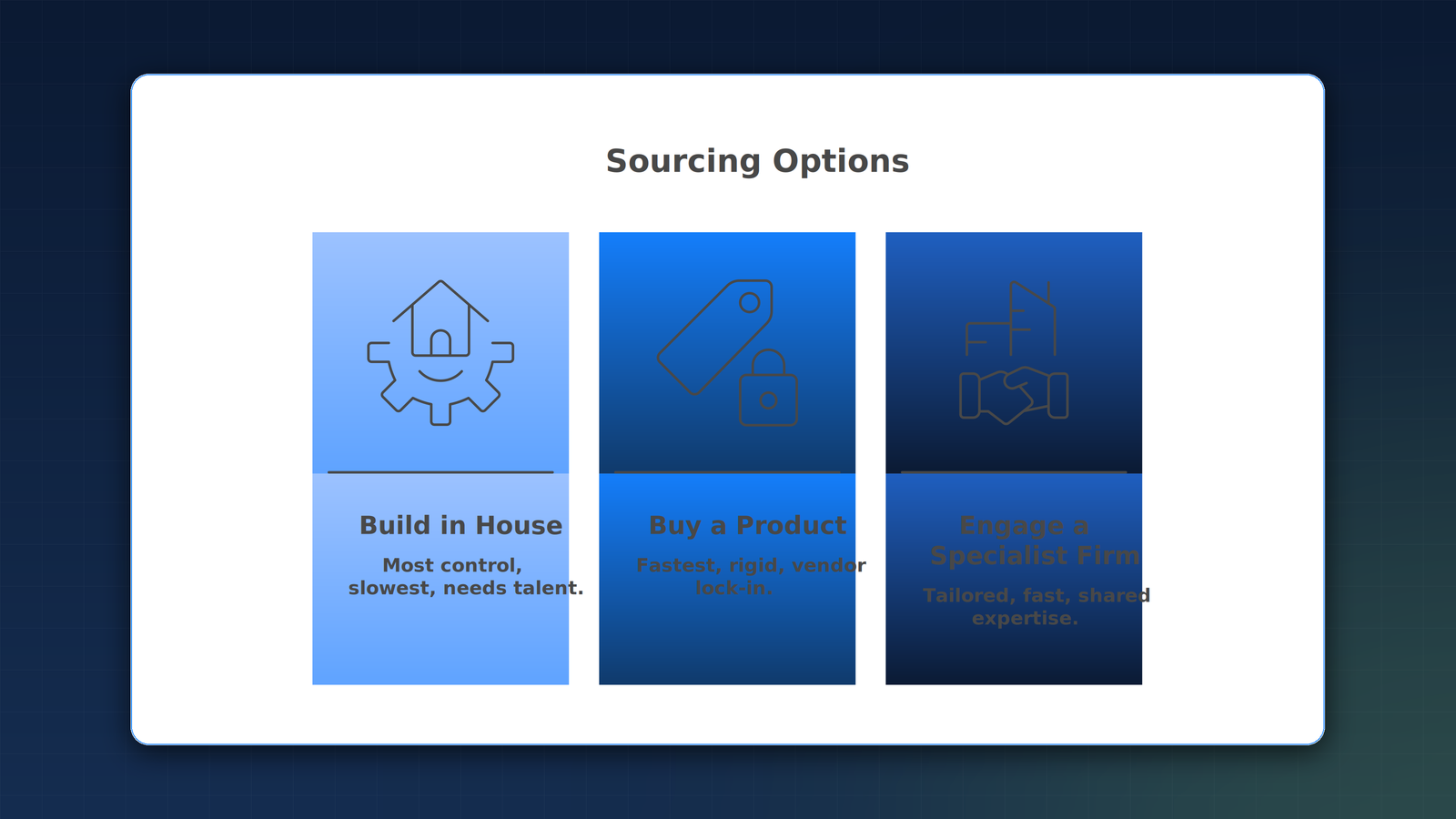
- Build when: Capability is a core differentiator, talent is available, and runway allows 12-24 month timelines
- Buy when: Need is standardized, customization is low-priority, and speed matters most
- Partner when: Capability is important but not core, speed matters, and knowledge transfer is valued
When Does Partnering Deliver the Best Outcomes?
Partnering delivers superior outcomes in the majority of growth-stage R&D scenarios. Deloitte's 30-40% faster time-to-value data reflects the fundamental advantage: partners bring pre-built methodology, cross-industry experience, and specialist talent that would take years to develop internally. The ideal partnership scenarios include AI integration (where methodology determines success more than technology), market research and validation (where cross-industry perspective prevents blind spots), and platform development (where reusable infrastructure expertise accelerates delivery). The key distinction between a vendor relationship and a true R&D partnership is knowledge transfer. The best partners, like Stable Solutions, build internal capability while delivering external results, creating a transition path from partnership to in-house competency.
"The smartest growth-stage companies treat R&D partnerships as capability accelerators, not outsourcing. They partner to learn faster, not to avoid building. The best partnerships make the partner progressively less necessary." — Reid Hoffman, Co-Founder, LinkedIn
How Do You Evaluate Potential R&D Partners?
Evaluating R&D partners requires assessing five dimensions. Technical depth: do they have genuine expertise or just familiarity? Look for research credentials, published work, and verifiable case studies. Methodology: do they follow structured research approaches or ad hoc experimentation? MIT-trained partners bring the rigor that separates 3.7x average from 10.3x top-quartile ROI (IBM data). Knowledge transfer: will they build your internal capability or create dependency? The best partners have explicit plans for transitioning knowledge. Cultural fit: can they integrate with your team and communication style? Partnership fails when collaboration is friction-heavy. Track record: have they delivered measurable results for companies at your stage? References from growth-stage companies are more relevant than enterprise logos.
What Does the Decision Framework Look Like in Practice?
Apply this decision framework to each R&D initiative independently. Score each option (build, buy, partner) on five criteria using a 1-5 scale: strategic importance (how core is this to your competitive advantage), internal capability (do you have or can you recruit the needed talent), time-to-value (how quickly do you need results), budget efficiency (total cost of ownership over 3 years), and knowledge retention (how much organizational learning does each option create). In practice, most growth-stage companies find that 20-30% of R&D initiatives should be built in-house, 30-40% should leverage partnerships, and 20-30% should use purchased solutions. The remaining 10-20% benefit from hybrid approaches. This portfolio approach maximizes speed, capability, and cost efficiency simultaneously. Explore how AI integration partnerships fit within this framework.
Key Takeaways
- Partners deliver 30-40% faster time-to-value than building in-house (Deloitte) and correlate with top-quartile ROI
- Building in-house is optimal only when the capability is a core differentiator and talent and runway are available
- The hidden cost of building is opportunity cost: 12-24 months of development while competitors move faster
- Evaluate R&D partners on five dimensions: technical depth, methodology, knowledge transfer, cultural fit, and track record
- Most growth-stage companies optimize with a portfolio: 20-30% build, 30-40% partner, 20-30% buy
Frequently Asked Questions
At what company size does building in-house become viable?
Building a full in-house R&D capability typically becomes viable at $20-50M in revenue, when the company can sustain $1.5-3M annually in R&D team costs. Below this threshold, partnerships deliver better economics. Above it, a hybrid model (in-house core + partnerships for specialized work) optimizes for both depth and breadth.
How do you prevent vendor lock-in with R&D partners?
Insist on knowledge transfer provisions in partnership agreements. The best partners document methodology, train internal teams, and use open standards. Stable Solutions builds explicit capability transfer into every engagement, ensuring clients can eventually operate independently. Harvard Business Review research shows that companies with dedicated R&D partners ship products 40% faster while building internal capability, demonstrating that good partnerships accelerate independence rather than creating dependency.
What is the typical ROI timeline for R&D partnerships?
Based on Deloitte data, well-structured R&D partnerships achieve break-even within 6-9 months, with full ROI materializing over 12-18 months. The 30-40% time-to-value advantage means partnerships reach profitability faster than equivalent in-house builds.
Can you switch from buy to partner or build later?
Yes, and this is a common maturation path. Companies often start by buying solutions to learn the domain, partner with specialists to build customized capabilities, and eventually bring core competencies in-house. The key is treating each phase as building toward the next rather than as isolated decisions. See our related article on why resilient companies invest heavily in R&D.
Next Steps
Need help navigating the build vs. buy vs. partner decision for your R&D initiatives? Stable Solutions provides objective R&D strategy assessments that help growth-stage companies allocate innovation budgets for maximum impact. Contact us for a complimentary strategy session, or explore our full capabilities.