

What Are AI-Powered Communications?
AI-powered communications refers to the use of artificial intelligence — including natural language processing, machine learning, and predictive analytics — to automate and personalize client outreach, proposals, and follow-up sequences across email, messaging, and social channels in B2B environments. According to HubSpot's 2025 State of Marketing report, these platforms deliver 29% higher open rates and 41% higher response rates compared to traditional outreach methods. For B2B firms managing dozens or hundreds of client relationships, automating communications with AI is no longer optional — it is a competitive necessity that directly impacts revenue and client retention.
Why Does Traditional Outreach Fall Short in 2026?
The B2B communication landscape has fundamentally shifted. According to Gartner, by 2026 approximately 80% of B2B sales interactions will occur through digital channels, yet most firms still rely on manual email sequences and templated proposals that fail to resonate with prospects. The disconnect is costly: Salesforce research shows that 76% of B2B buyers now expect personalized communications tailored to their specific industry, pain points, and stage in the buying journey. Generic outreach not only underperforms — it actively damages brand perception. Companies clinging to batch-and-blast email strategies see declining engagement rates year over year, while competitors leveraging AI personalization capture a growing share of attention and pipeline.
What Does AI-Powered Outreach Actually Look Like?
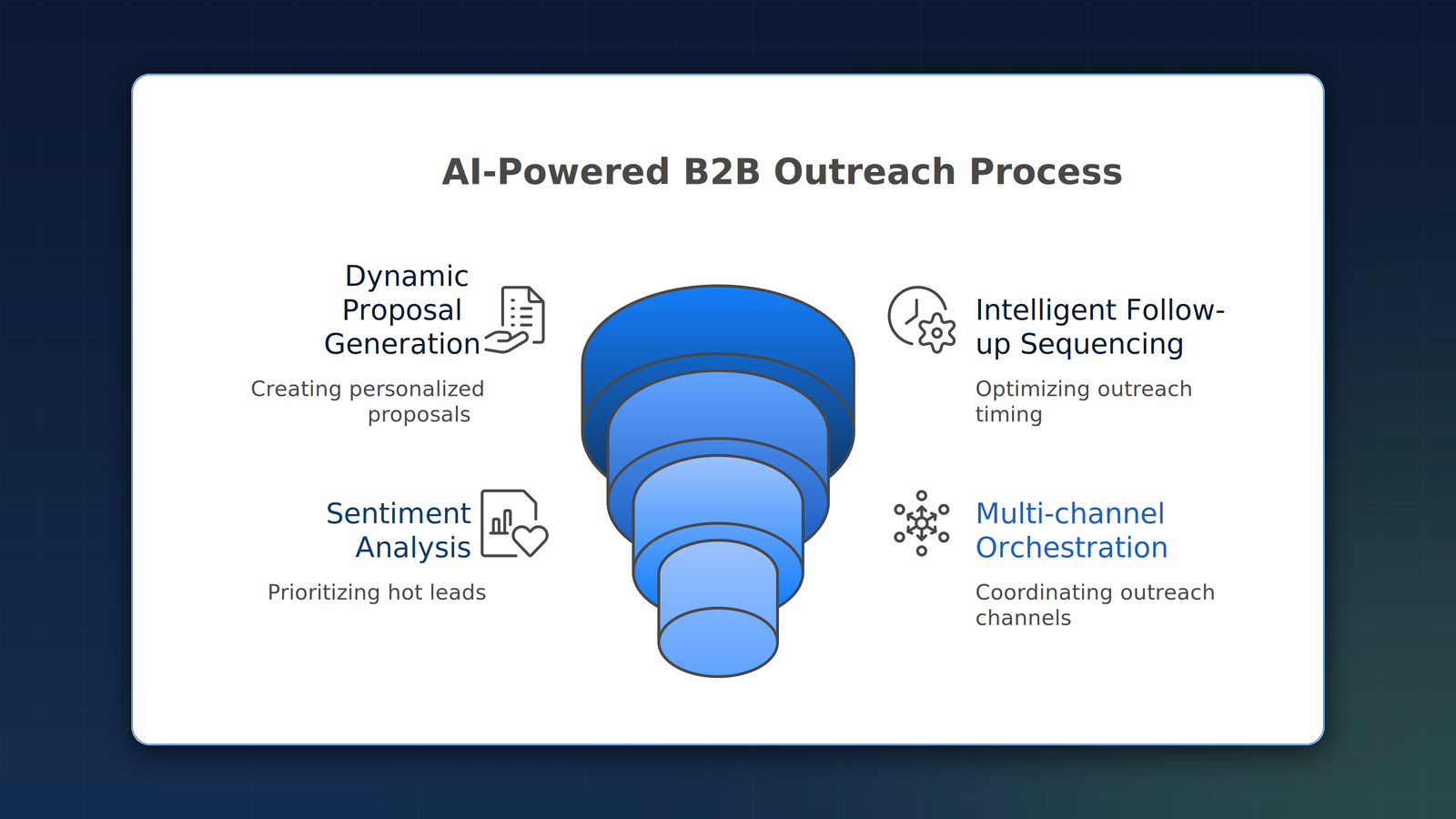
Modern AI communication systems go far beyond simple mail merge. These platforms analyze prospect behavior, company data, and engagement history to generate hyper-relevant messaging at scale. The core capabilities include:
- Dynamic proposal generation: AI drafts customized proposals by pulling from CRM data, past project templates, and prospect-specific research
- Intelligent follow-up sequencing: Machine learning models determine optimal send times, channel preferences, and escalation triggers
- Sentiment analysis: Natural language processing evaluates reply tone to prioritize hot leads and flag at-risk accounts
- Multi-channel orchestration: Coordinated outreach across email, LinkedIn, and SMS based on individual prospect preferences
McKinsey reports that companies using AI for marketing and communications see a 10-20% revenue uplift, largely driven by improved personalization and faster response times to prospect signals.
"The firms seeing the biggest gains from AI communications are not just automating volume — they are automating relevance. Every message is tailored, timed, and tracked." — Dr. Sarah Chen, Director of AI Research at MIT Sloan School of Management
Building an AI Communications Stack for Your B2B Firm
Implementing AI-powered outreach does not require replacing your entire technology infrastructure. The most effective approach involves layering AI capabilities onto existing CRM and marketing platforms. Start with three foundational components: a data integration layer that unifies prospect information across systems, an AI engine that generates and optimizes messaging, and an analytics dashboard that measures performance and surfaces actionable insights. Integration with tools like Salesforce, HubSpot, or custom CRM systems ensures that AI-generated communications reflect the full context of each client relationship. At Stable Solutions, our engineering team builds these integrations using modern API architectures that connect seamlessly with existing business workflows. The key is ensuring your AI system learns from every interaction, continuously improving personalization accuracy and timing precision. Accenture research shows that 84% of C-suite executives believe they must leverage AI to achieve their growth objectives, and communications infrastructure is consistently ranked among the highest-ROI deployment areas. Firms that delay adoption risk falling behind competitors whose outreach systems grow smarter with every client interaction.
"B2B companies that implement AI-driven personalization in their outreach see pipeline velocity increase by 35-50% within the first two quarters. The compounding effect on revenue is substantial." — James Rodriguez, VP of Sales Technology at Forrester Research
Measuring ROI: What AI Communications Deliver
The business case for AI-powered communications is compelling and measurable. Beyond the headline metrics — HubSpot's reported 29% lift in open rates and 41% improvement in response rates — firms implementing these systems consistently report reduced cost per acquisition, shorter sales cycles, and improved client satisfaction scores. According to McKinsey, the 10-20% revenue uplift from AI marketing translates to millions in incremental revenue for mid-market and enterprise B2B firms. Perhaps more importantly, AI communications free senior team members from repetitive drafting and follow-up tasks, allowing them to focus on high-value strategic work. For firms exploring how AI automation can transform their operations beyond marketing, the same underlying technologies power document processing, workflow optimization, and intelligent data analysis across every department.
Common Pitfalls and How to Avoid Them
Not every AI communications deployment succeeds. The most frequent failure modes include over-automation that strips messages of authenticity, poor data hygiene that leads to embarrassing personalization errors, and lack of human oversight on AI-generated proposals. Successful implementations maintain a human-in-the-loop approach where AI handles first drafts and optimization while experienced team members review high-stakes communications. Data quality is equally critical — AI personalization is only as good as the underlying CRM data. Firms should invest in data cleansing and enrichment before launching automated outreach campaigns. For deeper strategies on aligning AI tools with your broader digital presence, see our analysis on SEO in the age of AI and how search behavior changes affect B2B client acquisition.
Key Takeaways
- AI-powered outreach delivers measurable improvements: 29% higher open rates, 41% better response rates, and 10-20% revenue uplift according to HubSpot and McKinsey research
- Personalization at scale is now a buyer expectation — 76% of B2B buyers demand tailored communications (Salesforce)
- Start by layering AI onto existing CRM systems rather than replacing infrastructure entirely
- Maintain human oversight on high-stakes proposals and client communications to preserve authenticity
- Invest in data quality first — AI personalization accuracy depends entirely on clean, enriched prospect data
Frequently Asked Questions
How much does AI-powered outreach cost to implement?
Most B2B firms spend between $200 and $75,000 on AI-powered outreach, depending on whether they choose SaaS tools or custom-built solutions. SaaS-based platforms start at $200-500 per month for small teams, while enterprise-grade custom implementations typically require $25,000-75,000 in initial development. Most firms achieve positive ROI within 3-6 months based on McKinsey's reported 10-20% revenue uplift figures.
Will AI-generated emails feel impersonal to prospects?
When implemented correctly, AI-generated communications actually feel more personal than manually drafted templates. The key is feeding the AI sufficient context — prospect industry, company size, recent news, and engagement history. HubSpot's 2025 data shows that AI-personalized messages receive 41% higher response rates precisely because they address specific prospect needs.
Can AI handle proposal writing for complex B2B services?
AI excels at generating first drafts and assembling proposal components from existing templates and project data. For complex B2B engagements, the recommended approach is AI-assisted drafting with human review and customization. This hybrid model typically reduces proposal turnaround time by 60-70% while maintaining the strategic depth that enterprise buyers expect.
How does AI outreach integrate with existing CRM systems?
Most AI communication platforms offer native integrations with major CRM systems including Salesforce, HubSpot, and Microsoft Dynamics. Custom integrations via REST APIs are also common for proprietary systems. The integration ensures that all AI-generated communications are logged, tracked, and informed by the full history of each client relationship.
Next Steps
AI-powered communications represent one of the highest-ROI investments B2B firms can make in 2026. Whether you are looking to automate proposal generation, optimize follow-up sequences, or build a fully integrated AI outreach stack, the technology is mature and the results are proven. Contact Stable Solutions to discuss how our team can design and implement an AI communications system tailored to your firm's specific workflows, or explore our full range of digital marketing and AI capabilities.