

How Is AI Changing Organizational Structure?
The World Economic Forum reports that 85% of companies will upskill workers alongside AI adoption, fundamentally reshaping traditional organizational structures. Rather than simply automating existing roles, AI is creating entirely new team configurations where human-AI collaboration replaces rigid hierarchies with flexible, data-driven decision-making units.
This transformation extends beyond individual job descriptions to the very architecture of how companies organize, communicate, and make decisions. The shift from hierarchical, function-based structures to smaller, AI-augmented cross-functional teams represents the most significant change in organizational design since the adoption of matrix management in the 1970s.
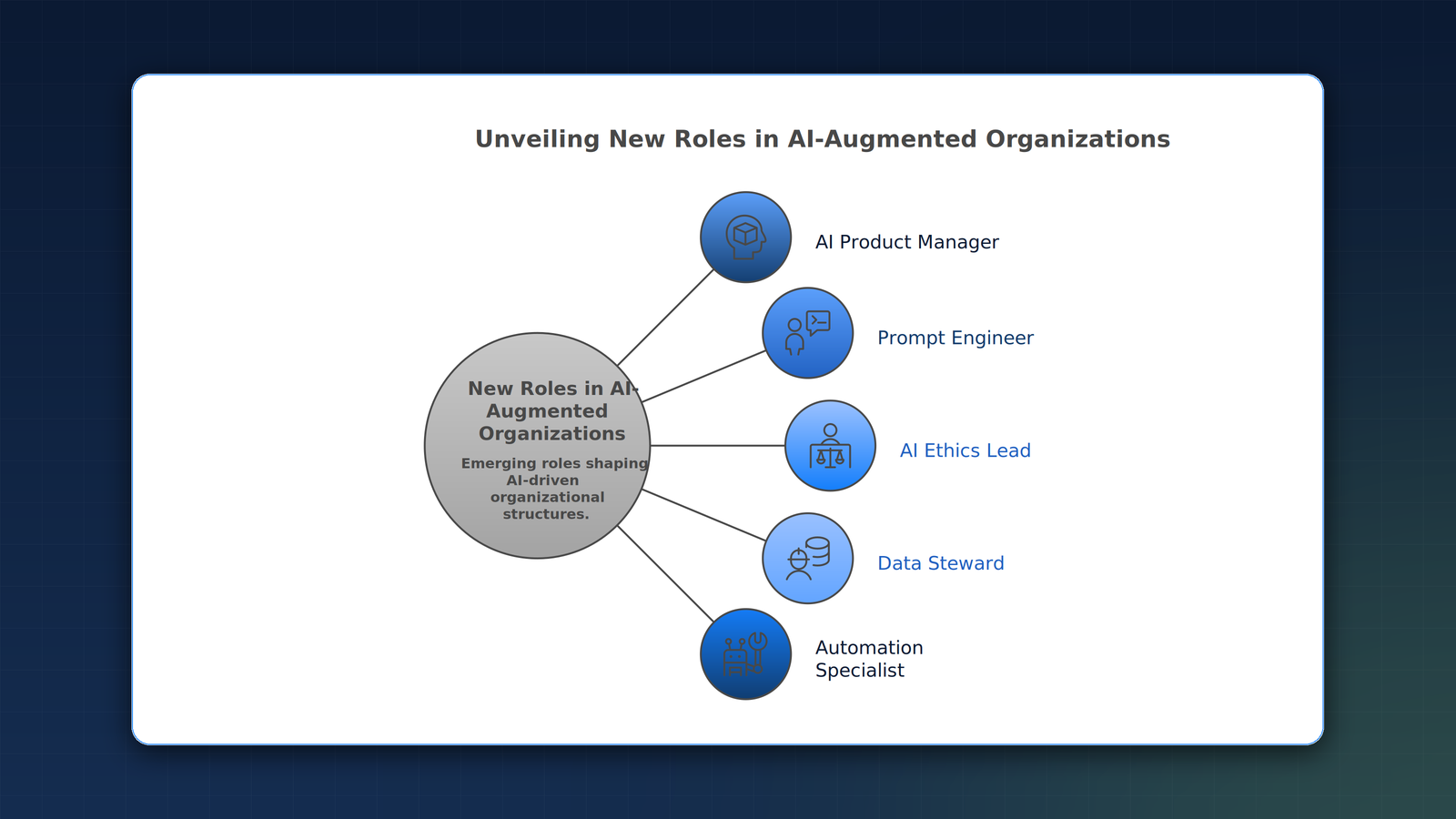
What New Roles Are Emerging in AI-Augmented Organizations?
The traditional org chart of directors, managers, and individual contributors is evolving into a more fluid structure. New roles emerging across industries include AI Operations Managers who oversee human-AI workflows, Prompt Engineers who optimize AI system performance, and Data Stewards who ensure AI training data quality and governance. Goldman Sachs estimates AI could automate 300 million full-time jobs globally, but the WEF simultaneously projects that AI will create 97 million new roles. The net effect is not fewer jobs but fundamentally different ones. Organizations that proactively design for these new roles are capturing the transition advantage, while those reacting to change are losing talent to more forward-thinking competitors. Accenture reports that 84% of C-suite executives believe they must leverage AI to achieve growth objectives, and the organizational structures that support those objectives are fundamentally different from traditional hierarchies. PwC's Global CEO Survey adds urgency, with 45% of CEOs acknowledging their company will not remain viable in 10 years without AI transformation, making organizational redesign for AI not just an optimization exercise but a survival imperative.
"The companies winning the AI talent war are not the ones offering the highest salaries. They are the ones offering the most compelling human-AI collaboration models. Top talent wants to work with AI, not be replaced by it." — Lynda Gratton, Professor of Management Practice, London Business School
How Does AI Change Team Structure and Collaboration?
AI is flattening organizational hierarchies by giving individual contributors access to analytical capabilities previously reserved for management. Teams are becoming smaller and more autonomous. Where a marketing team previously needed a data analyst, a strategist, and a content creator, an AI-augmented team of two can cover all three functions. Deloitte's 2026 data shows 66% productivity gains in AI-augmented teams, but the gains are not evenly distributed. Cross-functional teams that integrate AI tools into collaborative workflows see 2-3x the productivity improvement of teams that use AI as an individual tool. The most effective AI-augmented organizations structure teams around outcomes rather than functions, with AI serving as a shared capability layer.
- Traditional structure: Large functional teams with specialized roles and managerial oversight
- AI-augmented structure: Small cross-functional pods with shared AI capabilities and autonomous decision-making
- Key shift: From role-based to capability-based team design
How Is AI Changing Decision-Making Processes?
AI is transforming decision-making from hierarchical approval chains to data-driven, distributed models. PwC and NVIDIA research shows 40% performance improvements in organizations that embed AI into decision-making workflows. The change is structural, not incremental. In traditional organizations, decisions flow upward through management layers, each adding latency. In AI-augmented organizations, data flows to the point of decision, and AI provides real-time analysis that enables faster, more informed choices at every level. This does not eliminate the need for human judgment; it amplifies it. Strategic decisions still require human context, ethics, and creativity, but AI removes the information bottlenecks that previously slowed decision-making.
"AI does not make decisions for us. It makes us better decision-makers by removing information asymmetry. The best AI-augmented organizations give every team member the analytical power that previously only the C-suite had." — Ajay Agrawal, Professor, Rotman School of Management, University of Toronto
What Does the Upskilling Imperative Look Like in Practice?
The WEF's finding that 120 million workers need reskilling represents both a challenge and an opportunity. Companies that invest in AI upskilling see faster adoption, higher employee retention, and stronger innovation culture. The most effective upskilling programs are structured in three tiers. Foundational AI literacy for all employees (understanding what AI can and cannot do) takes 20-40 hours. Applied AI skills for power users (prompt engineering, data interpretation, AI workflow design) requires 80-120 hours. Technical AI competency for builders (model fine-tuning, system integration, evaluation) demands 200+ hours. IBM data suggests that companies investing in upskilling alongside AI deployment see 30-50% higher ROI than those deploying AI without workforce preparation. The investment in people is not separate from the AI investment; it is a critical component of it. BCG data reinforces this connection, showing that AI-adopting companies grow revenue 2.3x faster than peers, with the fastest growth in organizations that invest equally in technology and workforce development.
How Should Companies Prepare Their Org Chart for AI?
Preparing for AI-driven organizational change requires a structured approach. Start by auditing current roles against AI augmentation potential, identifying which tasks within each role can be enhanced by AI. Then redesign team structures around outcomes rather than functions, creating small cross-functional pods with shared AI tools. Invest in tiered upskilling programs that build AI literacy at every level of the organization. Finally, establish governance frameworks for AI-assisted decision-making that clarify when human judgment must override AI recommendations. Working with an experienced R&D partner can accelerate this transformation by providing both the technology and the organizational change management expertise needed. Explore how AI integration can reshape your team structure for competitive advantage.
Key Takeaways
- 85% of companies will upskill workers for AI, creating new roles like AI Operations Manager and Prompt Engineer (WEF)
- AI is flattening hierarchies and enabling smaller, autonomous cross-functional teams with 2-3x productivity gains
- Decision-making shifts from hierarchical approval chains to distributed, data-driven models with 40% performance improvement
- Effective upskilling programs operate at three tiers: foundational literacy, applied skills, and technical competency
- Companies investing in upskilling alongside AI see 30-50% higher ROI than those deploying technology alone (IBM)
Frequently Asked Questions
Will AI eliminate middle management?
AI is more likely to transform middle management than eliminate it. The WEF projects that managerial roles will shift from information aggregation and approval to strategic coaching, cross-functional coordination, and AI governance. Managers who adapt to this model become more valuable, not less.
How long does organizational AI transformation take?
Most organizations require 12-24 months for meaningful structural change. Quick wins (automating specific workflows) can be achieved in 3-6 months, but the deeper shifts in team structure, decision-making, and culture require sustained commitment. Deloitte recommends an 18-month transformation roadmap. Harvard Business Review data shows that companies with dedicated R&D partners complete organizational transformation 40% faster by leveraging cross-industry best practices.
What is the biggest risk in AI-driven organizational change?
The biggest risk is deploying AI technology without corresponding organizational adaptation. IBM data shows that companies seeing below-average AI ROI typically invested in technology without changing workflows, roles, or decision-making processes. Technology alone delivers a fraction of the potential value.
How do you maintain company culture during AI transformation?
Successful organizations frame AI as augmentation, not replacement. Companies that involve employees in AI implementation decisions, invest in transparent upskilling programs, and celebrate human-AI collaboration achievements maintain stronger culture and lower attrition during transformation.
Next Steps
Ready to redesign your organization for the AI era? Stable Solutions helps companies navigate the structural changes that maximize AI's impact on team performance and decision-making. Contact us for an organizational readiness assessment, or review our capabilities. For related insights, see our article on whether AI will replace roles or augment them.