

Will AI Actually Replace Jobs or Augment Them?
Goldman Sachs estimates that AI could automate 300 million full-time jobs globally. However, the World Economic Forum projects that AI will create 97 million new roles and that 85% of companies plan to upskill workers rather than replace them. The reality is nuanced: a window exists, roughly 2024-2030, where AI augments human work before automating it.
Understanding the timeline and dynamics of this augmentation window is critical for both professionals and organizations seeking to position themselves on the right side of the transition.
What Does the Augmentation Window Look Like?
The augmentation window is the period during which AI enhances human productivity rather than replacing human roles. During this window, professionals who learn to work alongside AI tools become dramatically more productive. Deloitte's 2026 data shows 66% productivity gains in AI-augmented roles, meaning a professional using AI effectively produces the output of 1.66 people. This window exists because current AI systems excel at specific tasks, such as data analysis, content generation, and pattern recognition, but still require human judgment for context, strategy, ethics, and complex reasoning. The professionals who use this window to develop AI collaboration skills will position themselves as indispensable, regardless of how AI evolves. Those who ignore it risk being caught in the transition without the skills needed for the AI-augmented workforce.
"AI will not replace you. A person using AI will replace you. The question is whether you are the person using AI or the person being replaced." — Karim Lakhani, Professor, Harvard Business School
Which Roles Are Most at Risk and Which Are Most Enhanced?
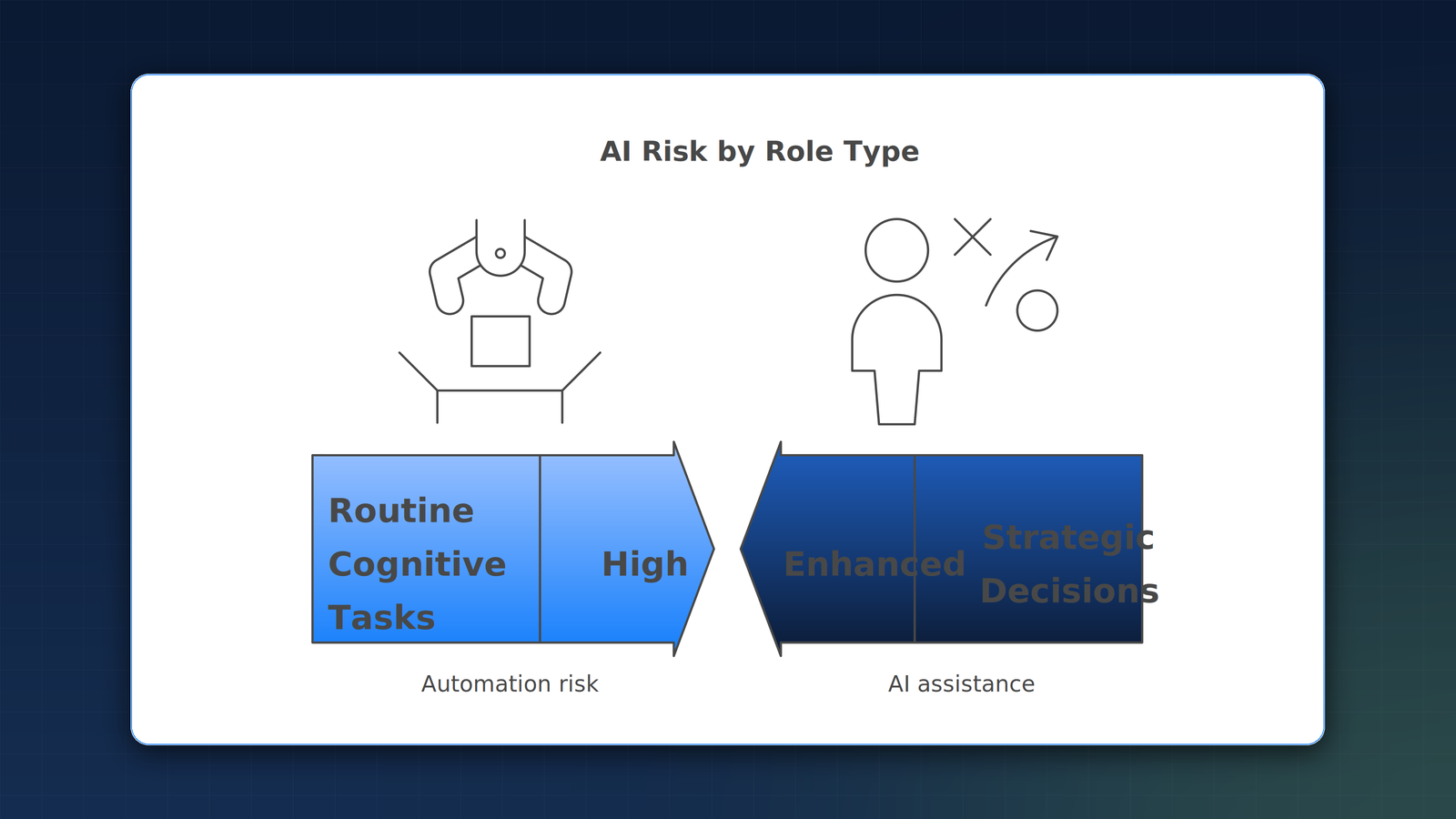
Goldman Sachs' analysis identifies administrative, legal support, and data entry roles as having the highest automation exposure, with 60-80% of tasks potentially automatable. However, roles requiring creativity, complex problem-solving, and human relationship management see the opposite effect: AI amplifies these capabilities rather than replacing them. NVIDIA and PwC research shows 40% performance improvements in roles that integrate AI tooling, with the highest gains in strategic planning, creative production, and customer-facing positions. The pattern is clear: routine cognitive tasks are most vulnerable, while tasks requiring judgment, empathy, and creative synthesis become more valuable when AI handles the routine work surrounding them. BCG data confirms this bifurcation, finding that AI-adopting companies grow revenue 2.3x faster than peers, with the growth concentrated in roles that combine human judgment with AI-augmented analytical power. Accenture reports that 84% of C-suite executives believe they must leverage AI for growth, reinforcing that the demand for AI-augmented professionals will only accelerate during the window.
- High automation risk: Data entry, basic legal research, routine financial analysis, administrative scheduling
- High augmentation value: Strategic planning, creative direction, complex sales, leadership, research synthesis
- Transition roles: Customer service, marketing operations, technical writing (augmented first, potentially automated later)
How Can Professionals Use the Augmentation Window?
The professionals benefiting most from the augmentation window follow three strategies. First, they develop AI fluency, understanding what AI tools can and cannot do, and how to direct them effectively. This is not about becoming an AI engineer; it is about becoming an effective AI collaborator. Second, they double down on uniquely human skills: strategic thinking, relationship building, ethical judgment, and creative problem-solving. These skills become more valuable as AI handles routine work. Third, they build a track record of AI-augmented performance, demonstrating measurably higher output and quality through human-AI collaboration. The WEF estimates that 120 million workers need reskilling for the AI economy. Those who reskill proactively command premium compensation and career security.
"The augmentation window is the most important career opportunity of this generation. Professionals who invest 100 hours in AI skill development now will see career returns for the next 20 years." — Andrew Ng, Founder, DeepLearning.AI
What Should Companies Do During the Augmentation Window?
Companies face a parallel strategic choice. Organizations that invest in AI augmentation during this window build three durable advantages. First, they develop proprietary workflows that combine human expertise with AI capabilities in ways that are difficult for competitors to replicate. Second, they accumulate organizational knowledge about effective human-AI collaboration that compounds over time. Third, they attract and retain top talent by offering AI-augmented work environments. IBM data shows that companies investing in AI alongside workforce development see 3.7x average returns, with top performers reaching 10.3x. The investment in AI integration during the augmentation window is simultaneously a technology investment, a workforce investment, and a competitive positioning strategy.
What Happens After the Augmentation Window Closes?
As AI capabilities advance, the augmentation window will gradually narrow. Gartner's projection that 75% of enterprises will have AI in production by 2027 marks an inflection point. After this mainstream adoption threshold, AI begins to set the baseline for performance rather than providing a competitive advantage. Professionals and companies without AI capabilities will not just be less efficient; they will be fundamentally uncompetitive. The transition from augmentation to automation will not happen overnight, but it will accelerate. McKinsey estimates that early AI adopters will have locked in 20-30% cost advantages, creating structural barriers for late entrants. The message is clear: the time to invest in AI capabilities is during the augmentation phase, not after it transitions to the automation phase.
Key Takeaways
- AI could automate 300M jobs globally (Goldman Sachs), but will create 97M new roles (WEF) during the transition
- The augmentation window (roughly 2024-2030) is when AI enhances rather than replaces human work
- Professionals using AI during this window see 66% productivity gains, making them dramatically more valuable (Deloitte)
- Routine cognitive tasks face highest automation risk; strategic, creative, and relationship roles gain the most value
- Companies investing in AI augmentation now build irreplicable advantages in workflows, knowledge, and talent attraction
Frequently Asked Questions
How long does the augmentation window last?
Current projections suggest the augmentation window runs from approximately 2024 to 2030, with significant variation by industry and role type. Creative and strategic roles will see a longer augmentation phase, while routine cognitive tasks may transition to automation faster. Gartner's 2027 milestone marks a key inflection point.
What skills should professionals develop during the augmentation window?
Focus on AI collaboration (prompt engineering, workflow design), uniquely human skills (strategic thinking, relationship building, ethical judgment), and domain expertise that provides context AI cannot replicate. The WEF recommends 80-120 hours of applied AI training for professional-level competency.
Can companies that miss the augmentation window catch up?
Partial catch-up is possible but increasingly expensive. McKinsey data shows late adopters pay 2-3x more for equivalent implementations, and they cannot replicate the organizational learning and data advantages that early movers accumulate. PwC's Global CEO Survey confirms that 45% of CEOs view this as an existential issue for their companies. See our analysis on the cost of waiting.
Is AI augmentation different across company sizes?
The augmentation opportunity exists for companies of all sizes, but SMBs often see faster results because they have less organizational complexity and can adapt more quickly. The key difference is access to implementation expertise, which R&D partnerships can effectively provide regardless of company size or budget.
Next Steps
Make the most of the augmentation window while it is open. Stable Solutions helps companies and teams develop AI capabilities that compound over time, creating durable competitive advantages. Contact us to discuss your AI augmentation strategy, or explore our capabilities to see how we help organizations thrive in the AI transition.