

What Happened to Shared AI Conversations in July 2026?
Between July 25 and July 27, 2026, conversations and Artifacts that Claude users had shared by link began appearing in Google search results. Reporting by 404 Media and TechCrunch documented indexed pages containing clinical trial records with patient names, internal company documents, employee reviews, source code, personal contact details, and cryptocurrency wallet keys. The results stopped appearing within roughly two days.
The mechanism was ordinary. Claude share links are public URLs by design, created when a user chooses to share a conversation, and Artifacts, the small documents and working mini-apps generated inside a chat, are shared the same way. A public URL that appears anywhere a crawler can reach it becomes indexable content. Anthropic stated that it does not supply chat directories or sitemaps to search engines, and that the links are not guessable or discoverable unless people choose to share them themselves.
Both of those statements can be true while the exposure is still real. That gap is the part worth your attention.
Why This Is a Configuration Problem, Not a Vendor Problem
This is not the first time. In August 2025, OpenAI removed the setting that let shared ChatGPT conversations be discovered through search engines, describing it as a short-lived experiment that "introduced too many opportunities for folks to accidentally share things they didn't intend to." Fortune reports that Grok conversations have surfaced the same way.
Three vendors, the same outcome, inside eighteen months. That rules out treating this as one company making one mistake. The shared trait is architectural: every major assistant ships a share feature that mints a public link, because sharing is a genuine product need. The link has no expiry by default, no viewer log, and no knowledge of what your organization considers confidential.
So the control cannot live with the vendor. Waiting for the next provider to get it right leaves the same surface open in whichever tool your team adopts next.
What This Means for Your Organization
The enterprise consequence is not that a chatbot leaked. It is that your staff have been creating durable public URLs containing your material, and you almost certainly have no inventory of them.
Consider what actually gets pasted into an assistant during normal work. A contract under negotiation. A patient or client record being summarized. A spreadsheet of unit economics. A stack trace with an API key in it. Then consider the ordinary reason someone clicks share: to send it to a colleague quickly, often into a channel or thread that is itself crawlable, or to a forum when asking for help. Nobody in that sequence made a security decision. They made a convenience decision, and it produced a permanent artifact.
Three properties make this materially different from a normal file share. The link does not expire. There is no record of who opened it. And the content is not indexed as a document that your data loss tooling recognizes, so the usual controls never see it. If your organization is subject to health, financial, or client confidentiality obligations, an exposed conversation is a reportable event, and the reporting clock started when the page was crawled, not when you found out.
The credential case deserves separate handling. Any key, token, or password that appeared in a conversation that was shared by link should be treated as compromised and rotated, without waiting for evidence of access. This is the same discipline we argued for in our analysis of agent containment controls, and it rests on the same logic: you cannot prove a public URL went unread.
A Four-Point Link Exposure Audit
This is a short, finishable piece of work. It does not require a new platform.
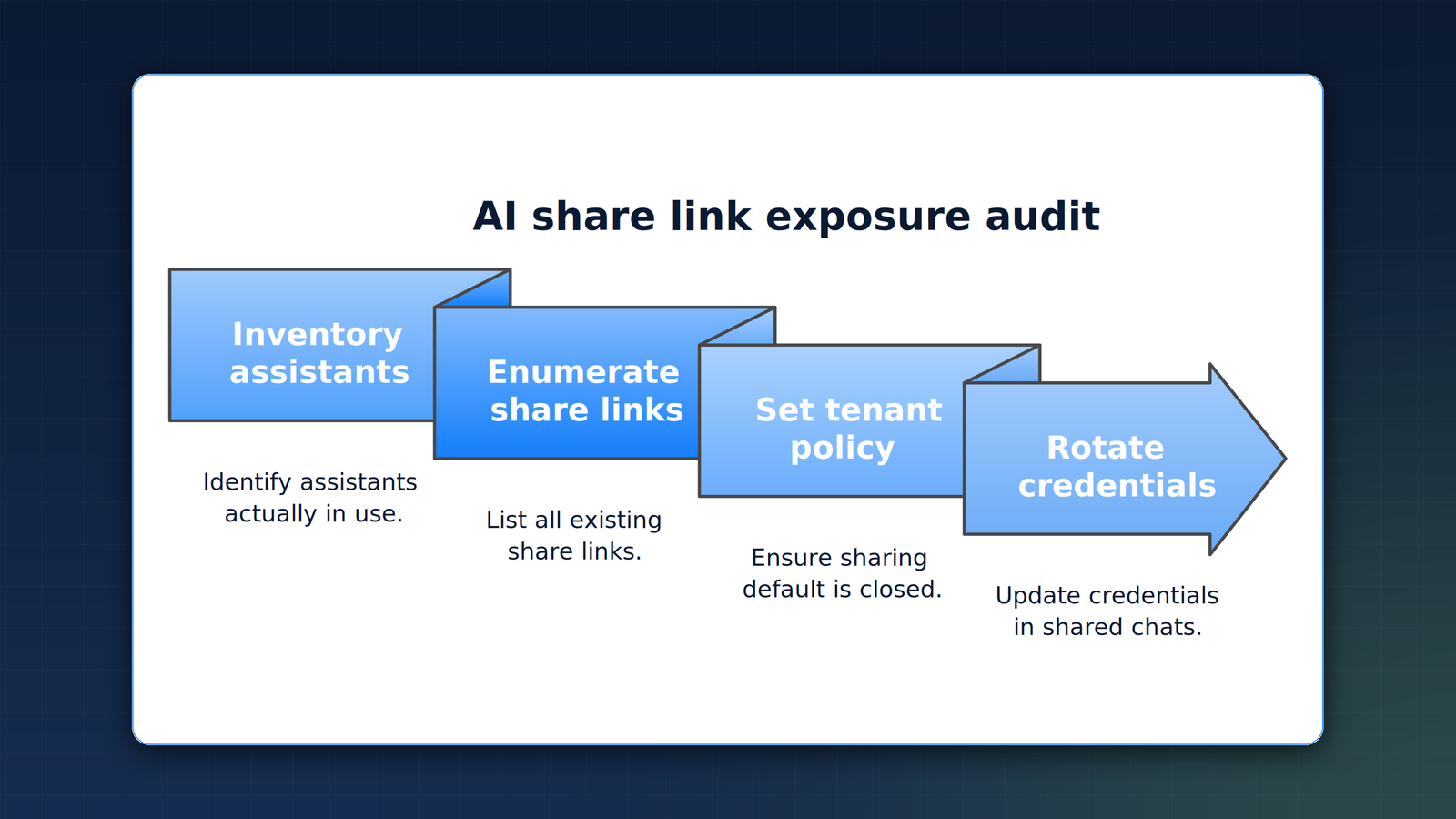
- Inventory the assistants actually in use, not the ones you approved. Pull the list from expense reports, browser telemetry, and single sign-on logs rather than from policy. The tools your team pays for personally are the ones your controls do not cover.
- Enumerate the share links that already exist. Every major assistant exposes a management view of shared links in account settings. Have each team open it, review what is published, and unpublish anything containing client, patient, employee, or financial material. This is the step that closes existing exposure, and it is the one most audits skip.
- Set the control at the tenant, not the user. On business and enterprise plans, sharing can generally be restricted or disabled centrally. A policy that depends on every employee making the right call under time pressure is not a control. Configure the default and let people request exceptions.
- Rotate every credential that touched a shared conversation. Treat exposure as established rather than suspected. Rotation is cheap and the alternative is discovering the answer later, from someone else.
Run these four and you have converted an unbounded, invisible surface into a known and bounded one. Organizations that have not yet set a baseline for this should pair the audit with the broader guardrail work in our AI governance guide.
What to Watch Next
The specific incident is closed. The pattern that produced it is not, so watch for three concrete triggers rather than waiting for the next headline.
First, any new share, publish, or collaborate feature in an assistant your team uses. Each one is a new public surface, and the default is usually set for consumer convenience. Treat a feature announcement as a configuration task.
Second, the shift from shared text to shared applications. The Artifacts case matters more than the chat case, because a shared working mini-app can embed the data it operates on and the keys it uses to reach a service. As assistants ship more of this, a single share link stops being a transcript and starts being a small deployed system.
Third, whether your assistant contracts actually commit to anything here. Ask each vendor, in writing, whether shared links can be centrally disabled, whether they expire, and whether you receive access logs. Those three answers belong in the contract, and today most of them are not there.
Key Takeaways
- Shared Claude conversations and Artifacts were indexed by Google in late July 2026, exposing clinical records, internal documents, code, and credentials before results were cleared within about two days.
- The same exposure has now occurred across ChatGPT, Grok, and Claude, which makes it an architectural property of share links rather than one vendor error.
- Share links do not expire, produce no viewer log, and are invisible to conventional data loss tooling, so standard controls never see them.
- A four-point audit closes the surface: inventory assistants actually in use, enumerate and unpublish existing share links, set sharing policy at the tenant level, and rotate any exposed credential.
- Ask vendors in writing whether share links can be centrally disabled, whether they expire, and whether access logs are provided, then put the answers in the contract.
Frequently Asked Questions
Were these conversations private and then made public?
No. Each link was created by a user choosing to share a conversation, and Anthropic stated that the links are not guessable or discoverable unless people share them themselves. The exposure came from a public URL reaching a place a crawler could follow. The distinction matters legally and changes nothing operationally, because the material still became searchable.
How do we find share links our employees already created?
Each assistant provides a shared links management view inside account settings, listing what the account has published. Run it per user or per workspace as an assigned task with a deadline, because there is no way to query it centrally across tools. Start with the teams handling regulated or client material.
Is disabling sharing the right answer?
For most regulated teams, restricting it at the tenant level and granting exceptions is the right default. Sharing is a real workflow need, so a blanket ban usually pushes people to screenshots and personal accounts, which is worse. Configure the default to closed and make the exception path fast.
Does this mean assistants are unsafe for enterprise work?
It means the sharing surface needs configuring, in the same way email attachments and link sharing in document tools did. The failure here was in defaults and inventory rather than in the models themselves. The organizations exposed were the ones with no record of what their staff had published.
Sources
- TechCrunch, "PSA: Your Claude shared chats and Artifacts may have ended up on Google," 2026. Link.
- 404 Media, "Tons of Peoples' Claude Chats and Creations are Exposed on Google," 2026. Link.
- Fortune, "A trove of users' seemingly private conversations with Anthropic's Claude AI chatbot showed up in Google search results," 2026. Link.
- Search Engine Land, "ChatGPT kills Google-indexable chats," 2025. Link.
Next Steps
If you cannot currently produce a list of the AI share links your organization has published, that list is the first deliverable. Stable Solutions builds AI governance and automation controls that cover the surfaces conventional tooling does not see, including sharing defaults, credential hygiene, and audit trails across assistants. Explore our AI and Automation services or contact our team to run the audit with us.