

Why Does AI Governance Matter for B2B Organizations?
AI governance is the framework of policies, processes, and controls that ensures AI systems operate safely, ethically, and in compliance with regulations. According to IBM's 2026 AI ROI study, organizations with mature AI governance frameworks achieve 3.7x average return on investment, while those without governance report significantly lower returns and higher rates of costly incidents.
What Happens When Organizations Scale AI Without Governance?
The consequences of scaling AI without governance are well-documented. The OpenClaw vulnerability exposed 40,000 unsecured AI agent instances, as detailed in our OpenClaw security analysis. Beyond security breaches, ungoverned AI creates compliance violations, biased decision-making, data privacy incidents, and reputational damage that can take years to recover from.
According to Deloitte's 2026 enterprise AI survey, 86% of organizations are increasing their AI budgets, but only 35% have formal governance frameworks in place. This gap between adoption speed and governance readiness is the single largest risk factor in enterprise AI. Goldman Sachs warns that AI could automate 300 million full-time jobs globally, and without governance, the displacement will happen in ways that create legal liability and regulatory exposure for the organizations deploying these systems.
"Governance is not the opposite of innovation. It is what makes innovation sustainable. The companies that will lead in AI five years from now are the ones building governance frameworks today." — Timnit Gebru, Founder, Distributed AI Research Institute
What Should an AI Governance Framework Include?
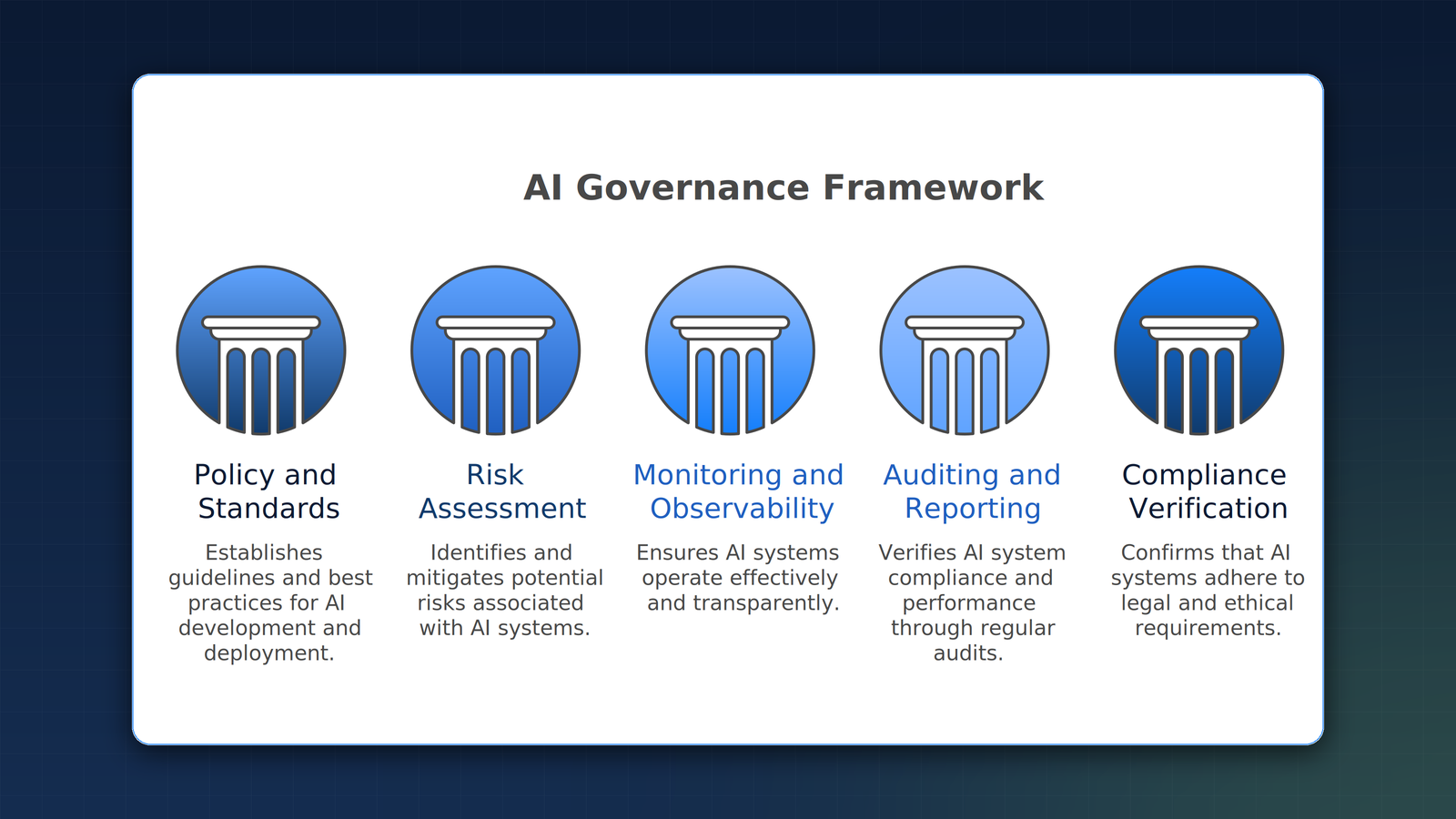
A comprehensive AI governance framework for B2B organizations should address five domains: accountability, transparency, security, compliance, and ethics. Each domain requires specific policies, processes, and technical controls.
- Accountability: Clear ownership of AI systems, defined escalation paths, and documented decision-making authority for AI-related actions.
- Transparency: Explainable AI outputs, audit trails for all agent actions, and clear documentation of how AI systems make decisions.
- Security: Authentication, authorization, input validation, output filtering, network isolation, and continuous monitoring as outlined in security best practices.
- Compliance: Mapping AI activities to regulatory requirements, automated compliance monitoring, and regular audits.
- Ethics: Bias testing, fairness metrics, human oversight requirements, and clear boundaries for AI decision-making authority.
According to PwC's 2026 governance benchmark, organizations implementing all five domains achieve a 40% improvement in AI performance compared to those addressing only technical controls. The reason is that governance creates the organizational trust and clarity needed for teams to deploy AI confidently and at scale.
How Do You Build Guardrails Without Slowing Down Innovation?
The most common objection to AI governance is that it slows down deployment. The data says otherwise. Organizations with mature governance frameworks actually deploy AI faster because they have pre-approved patterns, clear risk thresholds, and streamlined review processes. The alternative, ad-hoc deployment followed by incident response, is what actually slows organizations down.
"The fastest path to AI at scale is not skipping governance. It is automating governance. Build the guardrails into your deployment pipeline so they execute automatically. Then governance becomes an accelerator, not a brake." — Andrew Ng, Founder, DeepLearning.AI
Practical guardrails include automated security scanning in the deployment pipeline, pre-approved agent templates with appropriate permissions, automated bias testing for AI models, real-time compliance monitoring, and incident response playbooks specifically designed for AI systems. At Stable Solutions, we build these guardrails into every AI deployment from day one, ensuring our clients can scale without accumulating governance debt.
What Regulations Are Shaping AI Governance?
The regulatory landscape for AI is evolving rapidly. The EU AI Act establishes risk-based requirements for AI systems, with the highest scrutiny applied to systems that make consequential decisions about people. In the United States, NIST's AI Risk Management Framework provides voluntary guidelines that are increasingly being adopted as de facto standards. Industry-specific regulations in healthcare (HIPAA), financial services (SOX, GDPR), and government contracting add additional layers of compliance requirements.
The World Economic Forum estimates that 85% of companies will need to upskill workers to comply with emerging AI regulations by 2028. Organizations that build governance frameworks now will be significantly better positioned to meet these requirements when they become mandatory. Those that wait will face expensive retrofitting of systems and processes that were designed without regulatory compliance in mind. According to Goldman Sachs' 2026 regulatory impact analysis, compliance costs for organizations that delay AI governance will be 3-5 times higher than for early adopters, because retrofitting governance into existing systems requires re-architecting data pipelines, access controls, and audit mechanisms that should have been built in from the start. Beyond regulatory compliance, governance frameworks also protect organizations from reputational risks. A single incident of biased AI decision-making or data mishandling can damage client relationships and brand trust in ways that take years to rebuild. Proactive governance prevents these incidents while demonstrating to clients, partners, and regulators that your organization takes AI responsibility seriously. For a broader view of which industries face the most AI regulatory pressure, see our analysis of industries leading AI adoption.
Key Takeaways
- AI governance frameworks correlate with 3.7x ROI on AI investments, per IBM research, because they prevent costly incidents and build organizational trust.
- Only 35% of organizations have formal AI governance despite 86% increasing AI budgets, creating a dangerous adoption-governance gap.
- Effective frameworks address five domains: accountability, transparency, security, compliance, and ethics.
- Automated guardrails in the deployment pipeline accelerate rather than slow AI adoption by providing pre-approved patterns and streamlined reviews.
- Emerging regulations like the EU AI Act and NIST AI Risk Management Framework are making governance a legal requirement, not just a best practice.
Frequently Asked Questions
Is AI governance only for large enterprises?
No. Any organization deploying AI systems that affect business decisions, customer interactions, or employee processes needs governance regardless of its size. The scope and complexity of the framework should match the organization's size and risk profile, but the core principles of accountability, transparency, security, compliance, and ethics apply at every scale. Small and mid-market companies can implement lightweight governance frameworks that provide essential protections without the overhead of enterprise-scale compliance programs.
How much does it cost to implement an AI governance framework?
Implementation costs vary based on scope and complexity, but the investment pays for itself quickly. According to IBM's 2026 AI ROI study, organizations with governance frameworks achieve 3.7x ROI on their AI investments. The cost of not having governance, measured in security breaches, compliance fines, and reputational damage, typically far exceeds the investment in building guardrails proactively. Most organizations can establish foundational governance policies and automated guardrails within 4-8 weeks of focused effort.
Can we retrofit governance onto existing AI systems?
Yes, but it is significantly more expensive and disruptive than building governance in from the start. Retrofitting requires auditing existing systems, identifying gaps, and implementing controls that may require architectural changes. Starting with governance from day one is always more cost-effective. According to Goldman Sachs' 2026 regulatory impact analysis, organizations that retrofit governance spend 3-5 times more than those who build it in from the beginning, because retrofitting often requires re-architecting data pipelines, access controls, and audit mechanisms.
Who should own AI governance in a B2B organization?
AI governance typically requires a cross-functional team including technology, legal, compliance, and business leadership. Many organizations are creating dedicated AI governance roles or committees with direct reporting to executive leadership. The key is ensuring that governance is not siloed within IT but has executive sponsorship and enterprise-wide scope. Effective governance teams include representatives from every department deploying AI, ensuring that policies reflect real operational needs rather than abstract compliance requirements.
How often should we review our AI governance framework?
At minimum, quarterly reviews are recommended, with immediate reviews triggered by regulatory changes, security incidents, or significant expansions in AI scope. The regulatory landscape is evolving rapidly, and governance frameworks must evolve with it. Organizations should also conduct reviews whenever deploying AI in a new department or use case, as each expansion introduces unique risk factors that may require updated policies, access controls, and monitoring configurations.
Next Steps
Building an AI governance framework before you scale is the most important investment you can make in your AI strategy. Contact Stable Solutions for a governance readiness assessment. Our MIT-trained team will evaluate your current AI deployments, identify governance gaps, and design a framework that enables safe, compliant scaling. Explore our full AI and automation capabilities.