

How Do AI Subagents Compress Project Timelines?
AI-powered subagents decompose complex projects into independent workstreams and execute them in parallel, compressing multi-week timelines into hours or days. IBM's 2026 AI ROI study found that organizations using orchestrated AI agent teams achieve 3.7x return on investment, with top performers reaching 10.3x ROI through effective parallelization of knowledge work.
What Are AI Subagents and How Do They Work?
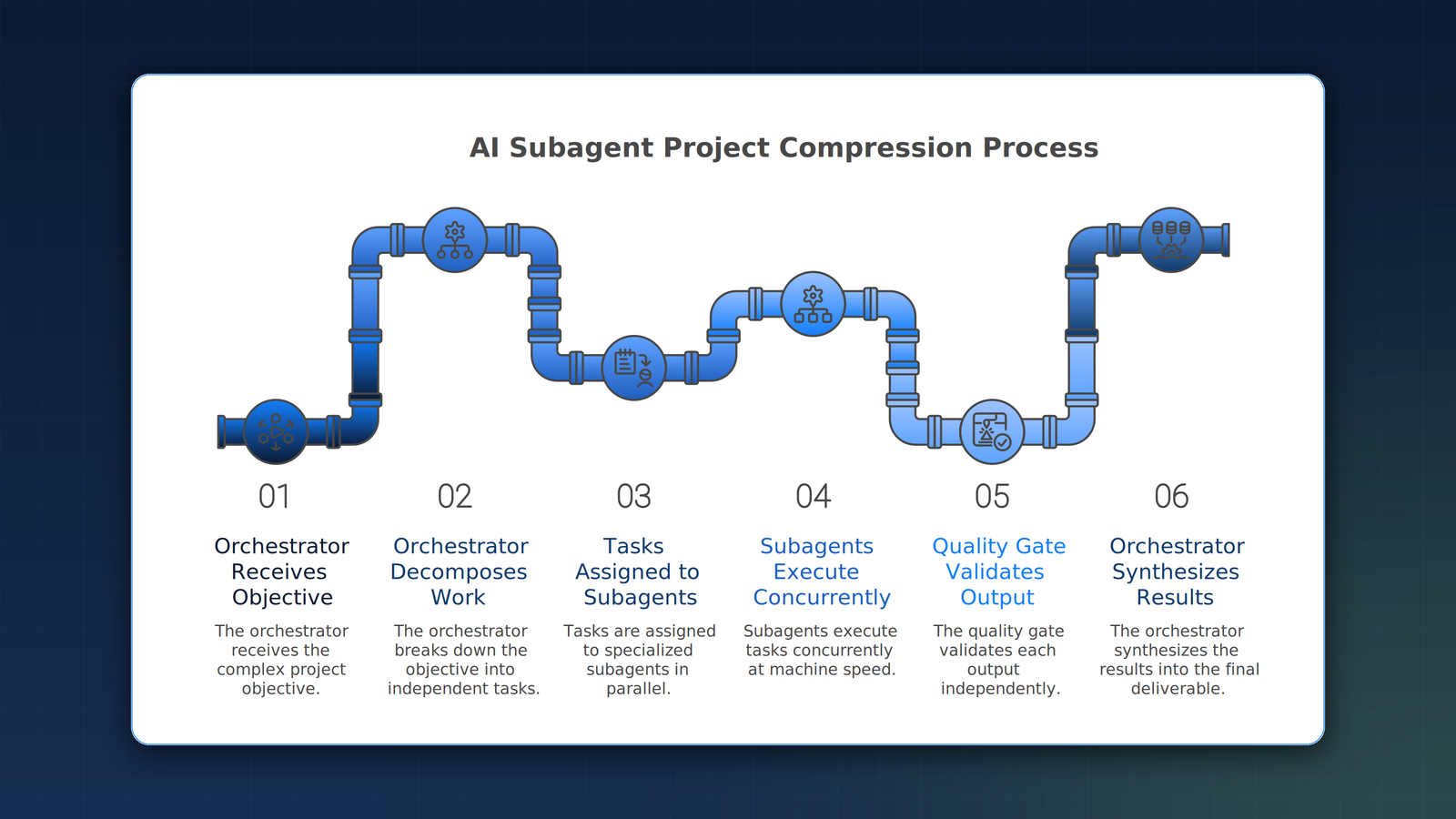
A subagent is a specialized AI instance that handles one piece of a larger project. An orchestrator agent breaks down the overall objective into discrete tasks, assigns each task to a subagent with the appropriate skills and context, and coordinates the results. This mirrors how a senior project manager delegates to specialists, but at machine speed and without the communication overhead that slows human teams.
The orchestration layer is what separates effective subagent systems from simple task queues. A well-designed orchestrator understands task dependencies, manages shared resources, handles failures gracefully, and synthesizes outputs from multiple subagents into a coherent deliverable. According to NVIDIA's 2026 performance benchmarks, orchestrated subagent systems deliver 40% better outcomes than sequential single-agent approaches. The orchestrator maintains a global view of the project state, enabling it to dynamically reassign resources, adjust priorities, and resolve conflicts that arise during parallel execution.
"The shift from single-agent to multi-agent systems is the most significant architectural evolution in AI since the transformer. It mirrors how human organizations work: specialized roles, clear coordination, shared goals." — Andrew Ng, Founder, DeepLearning.AI
Where Do Subagents Deliver the Greatest Impact?
Subagents excel in projects with natural decomposition points. Software development is the most obvious example, where different modules, services, and components can be built simultaneously. But the pattern extends far beyond code. Content production, market research, financial analysis, and compliance review all contain independent subtasks that can be parallelized effectively.
Consider a due diligence process that traditionally takes a legal team three weeks. An orchestrated subagent system can assign financial analysis, regulatory review, contract examination, and IP assessment to separate subagents running concurrently. The orchestrator ensures that cross-cutting findings from one workstream inform the others, while the quality gate validates each output before synthesis. Goldman Sachs estimates that AI could automate tasks equivalent to 300 million full-time jobs globally, and orchestrated subagents are the mechanism that makes that automation practical for complex, multi-faceted work where quality and completeness are non-negotiable.
What Does the Architecture Look Like?
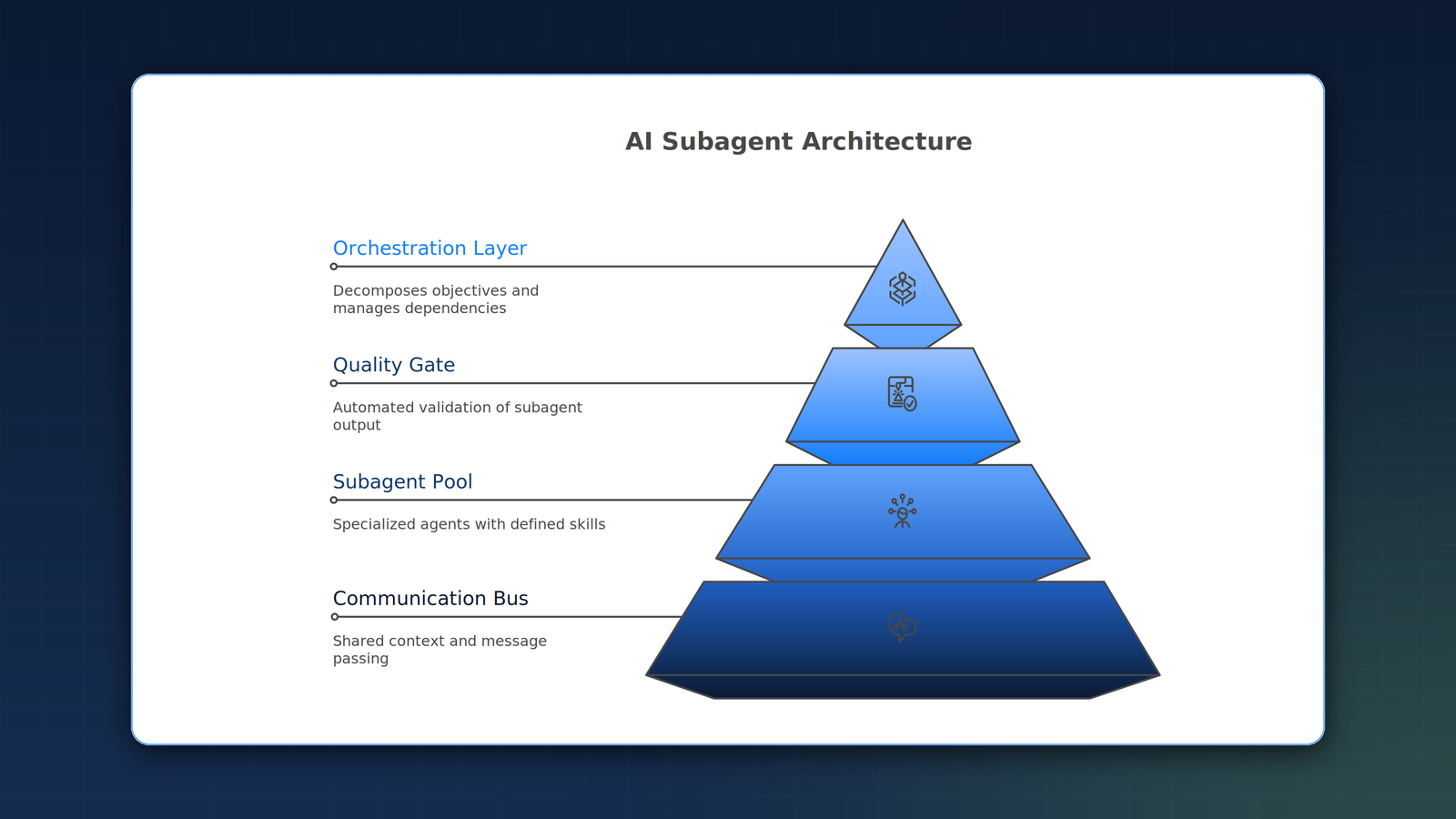
A production subagent architecture has four layers that work together to ensure reliable, high-quality parallel execution:
- Orchestration layer: Decomposes objectives into tasks, manages dependencies, synthesizes results, and handles dynamic re-planning when conditions change.
- Subagent pool: Specialized agents with defined skills, resource limits, output formats, and quality thresholds that determine when escalation is needed.
- Communication bus: Shared context and message passing between agents for coordination, enabling subagents to access findings from other workstreams when relevant.
- Quality gate: Automated validation of each subagent's output before integration into the final deliverable, including format compliance, factual accuracy checks, and consistency verification.
At Stable Solutions, we implement this architecture using a combination of Claude Code dispatch for development tasks and custom orchestration layers for business process automation. The result is a system where complex projects can be parallelized without sacrificing quality or coherence. Each layer is instrumented for observability, providing real-time visibility into task progress, agent performance, and system health. This observability is not optional. It is what enables continuous improvement: by tracking which subagents perform best on which task types, the orchestrator can optimize task assignment over time, routing work to the agents most likely to produce high-quality results on the first attempt.
How Do You Ensure Quality When Multiple Agents Work in Parallel?
Quality in multi-agent systems depends on three factors: clear specifications, automated validation, and human oversight at integration points. Each subagent receives a detailed brief including expected inputs, output format, quality criteria, and boundary conditions. Automated tests verify each output before it enters the integration pipeline. This structured approach to quality assurance scales naturally with the number of parallel agents because each quality gate operates independently.
"In multi-agent systems, the quality of the decomposition determines the quality of the output. Spend 80% of your design time on task definition and interface contracts. The execution is the easy part." — Jeff Dean, Chief Scientist, Google DeepMind
Human review remains essential at the integration layer, where outputs from multiple subagents must be synthesized into a coherent whole. This is where experienced engineers and domain experts add the most value, as described in our guide to AI agents and progressive disclosure. The combination of machine parallelism with human synthesis produces results that neither could achieve alone. Deloitte's 2026 analysis confirms that human-in-the-loop multi-agent systems consistently outperform fully autonomous systems on complex tasks requiring judgment and contextual understanding. The optimal division of labor assigns computation-heavy parallel tasks to subagents while reserving integration decisions, quality judgments, and strategic direction for human experts who understand the broader business context. This model scales naturally: as organizations develop more sophisticated decomposition strategies, they can parallelize increasingly complex projects while maintaining the quality standards their clients and stakeholders expect. The initial investment in orchestration architecture and quality gate design pays dividends across every subsequent project.
Key Takeaways
- AI subagents enable parallel execution of complex project components, compressing multi-week timelines into hours or days.
- Orchestrated multi-agent systems deliver 3.7x ROI on average, with top performers achieving 10.3x according to IBM research.
- Effective subagent architectures require four layers: orchestration, specialized agents, communication, and quality gates.
- The critical human skill is decomposition, breaking complex objectives into well-specified, independent tasks with clear interfaces.
- Quality is maintained through automated validation at the subagent level and human review at the integration layer.
Frequently Asked Questions
How is this different from traditional project management?
Traditional project management parallelizes by assigning tasks to human team members, which introduces communication overhead, availability constraints, and coordination delays. AI subagents execute concurrently at machine speed with zero communication latency, while the orchestrator handles coordination automatically. The result is parallel execution without the overhead that typically limits human team parallelism to 60-70% efficiency. Standup meetings, status updates, and handoff documentation are replaced by automated orchestration that keeps every workstream aligned without consuming human time.
What types of projects can be parallelized with subagents?
Any project with naturally independent subtasks benefits from subagent parallelization. Software development, content production, research, financial analysis, compliance review, and data processing are all strong candidates. The key requirement is that tasks can be defined with clear inputs, outputs, and quality criteria that enable automated validation. Projects with tightly coupled components require more careful decomposition before parallelism can be effective, but experienced engineers can usually identify independent work units within any complex project.
What happens when a subagent fails or produces low-quality output?
Production orchestration systems include comprehensive failure handling. If a subagent fails, the orchestrator can retry the task with modified parameters, assign it to a different subagent with alternative capabilities, or escalate to a human operator. Quality gates catch substandard output before integration, preventing cascading quality issues across the final deliverable. Comprehensive logging captures every decision and output, providing full visibility for debugging and continuous improvement of the orchestration system over time.
How much does subagent orchestration cost compared to traditional approaches?
AI compute costs for subagent systems are typically a fraction of the human labor costs they replace. According to Deloitte's 2026 analysis, organizations save 40-60% on project delivery costs while simultaneously reducing timelines by 50% or more through effective subagent deployment. The cost advantage grows with project complexity, as the coordination overhead savings compound. For a project that would require a four-person team for a month, subagent orchestration can often deliver equivalent results in under two weeks at a fraction of the total cost.
Next Steps
If you have complex projects that could benefit from AI-powered parallel execution, contact Stable Solutions for an assessment. Our MIT-trained team will analyze your project for parallelization opportunities and design a subagent architecture tailored to your domain. Explore our full range of AI and automation capabilities.