

What Are AI Agents and Why Do They Matter?
AI agents are autonomous software systems that perceive their environment, make decisions, and take actions to achieve defined goals. According to Deloitte's 2026 State of AI report, 86% of enterprises are increasing their AI agent budgets this year, driven by average productivity gains of 66% in early adopter organizations.
How Do AI Agents Differ from Traditional Automation?
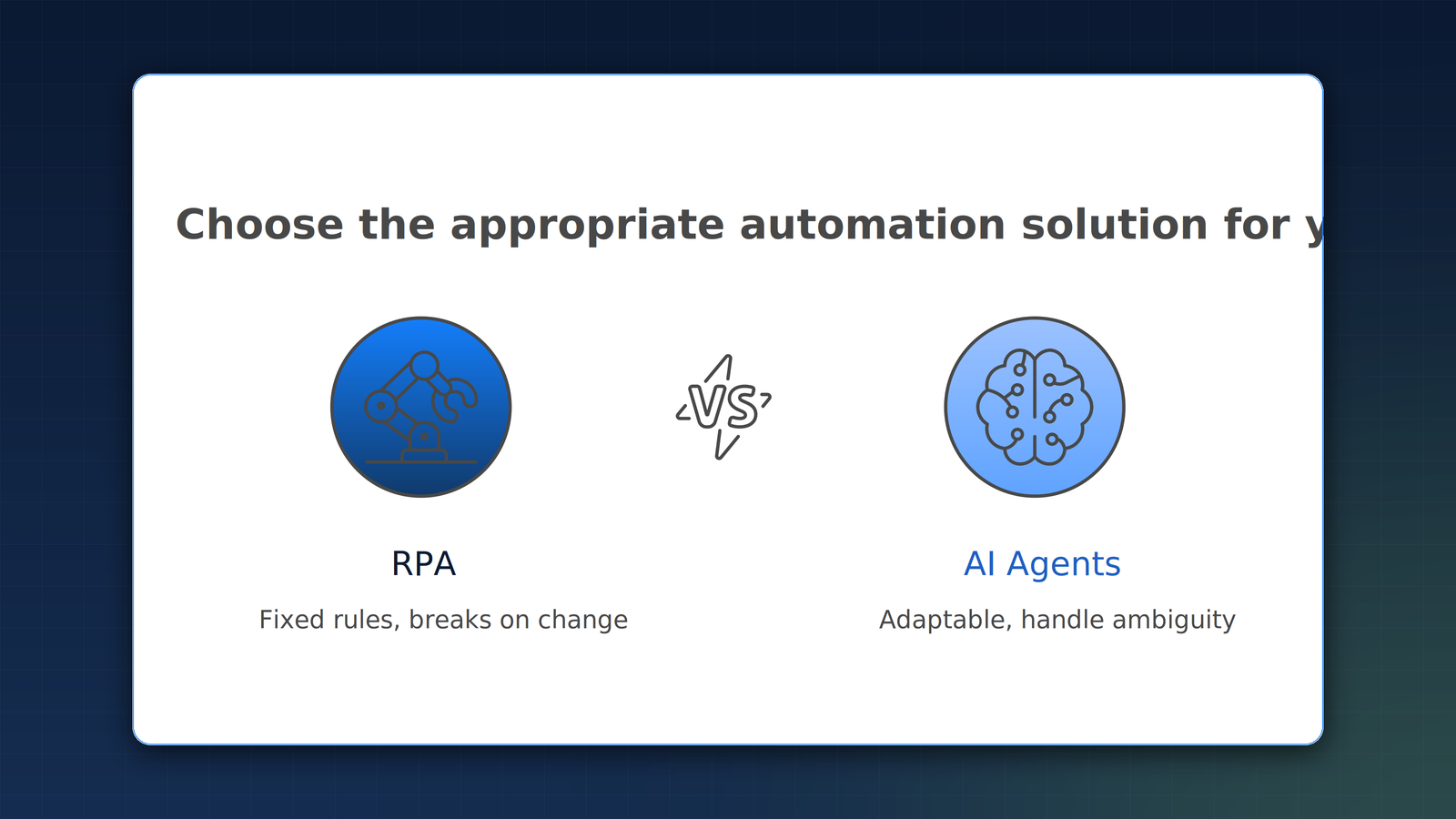
Traditional automation follows rigid, pre-programmed rules: if X happens, do Y. AI agents, by contrast, operate with contextual awareness. They can interpret ambiguous inputs, learn from outcomes, and adapt their behavior over time. An RPA bot might extract data from a fixed template. An AI agent can read an unfamiliar invoice format, identify the relevant fields, and route the document to the correct workflow without human intervention.
This distinction matters because business processes rarely follow perfect templates. According to IBM's 2026 AI ROI study, organizations deploying AI agents report a 3.7x return on investment compared to traditional automation, with top performers achieving 10.3x ROI. According to Gartner's 2026 intelligent automation forecast, AI agent adoption will grow 45% year-over-year through 2028 as organizations move beyond rule-based RPA. The difference lies in the agent's ability to handle exceptions that would otherwise require manual review. Where traditional RPA breaks when a form changes layout, an AI agent adapts on the fly, dramatically reducing the maintenance burden that plagues legacy automation deployments.
What Are AI Skills and Progressive Disclosure?
AI skills are modular capabilities that agents can invoke on demand. Think of them as specialized tools in a toolkit: one skill might handle document summarization, another might manage calendar scheduling, and a third might generate financial reports. Progressive disclosure is the principle of revealing complexity only when needed. Rather than granting an agent full access to every system on day one, skills are enabled incrementally as trust is established through measurable performance.
"Progressive disclosure in AI systems is not just a UX pattern. It is a safety mechanism. You expose capabilities incrementally so that each layer can be validated before the next is unlocked." — Dr. Fei-Fei Li, Co-Director, Stanford Human-Centered AI Institute
In practice, this means an AI agent starts with basic permissions and limited skills. As the system demonstrates reliability and the organization builds confidence, additional skills and autonomy are gradually enabled. This approach reduces risk while accelerating adoption. The skill-based architecture also enables rapid customization: organizations can compose agent capabilities from a library of pre-built skills rather than developing monolithic solutions from scratch, cutting deployment time from months to weeks.
Why Should Business Leaders Care About Agent Architecture?
The architecture of your AI agents determines how safely and effectively they scale across your organization. A well-designed agent system uses progressive disclosure to ensure that new capabilities are introduced with appropriate guardrails. According to PwC's 2026 enterprise AI benchmark, organizations using structured agent architectures saw a 40% improvement in task performance compared to ad-hoc deployments.
"The companies seeing the greatest returns from AI are those that treat agent deployment as an engineering discipline, not a science experiment. Architecture and governance matter as much as the model itself." — Satya Nadella, CEO, Microsoft
For B2B companies, this translates to faster time-to-value. Rather than spending months on a monolithic AI rollout, teams can deploy focused agents with specific skills and expand their scope as results are validated. This iterative approach aligns with how MIT-trained engineering teams approach complex system design. The architectural decisions made in the first deployment set the trajectory for every subsequent expansion, making early investment in proper agent architecture one of the highest-leverage decisions a technology leader can make.
How to Implement AI Agents with Progressive Disclosure
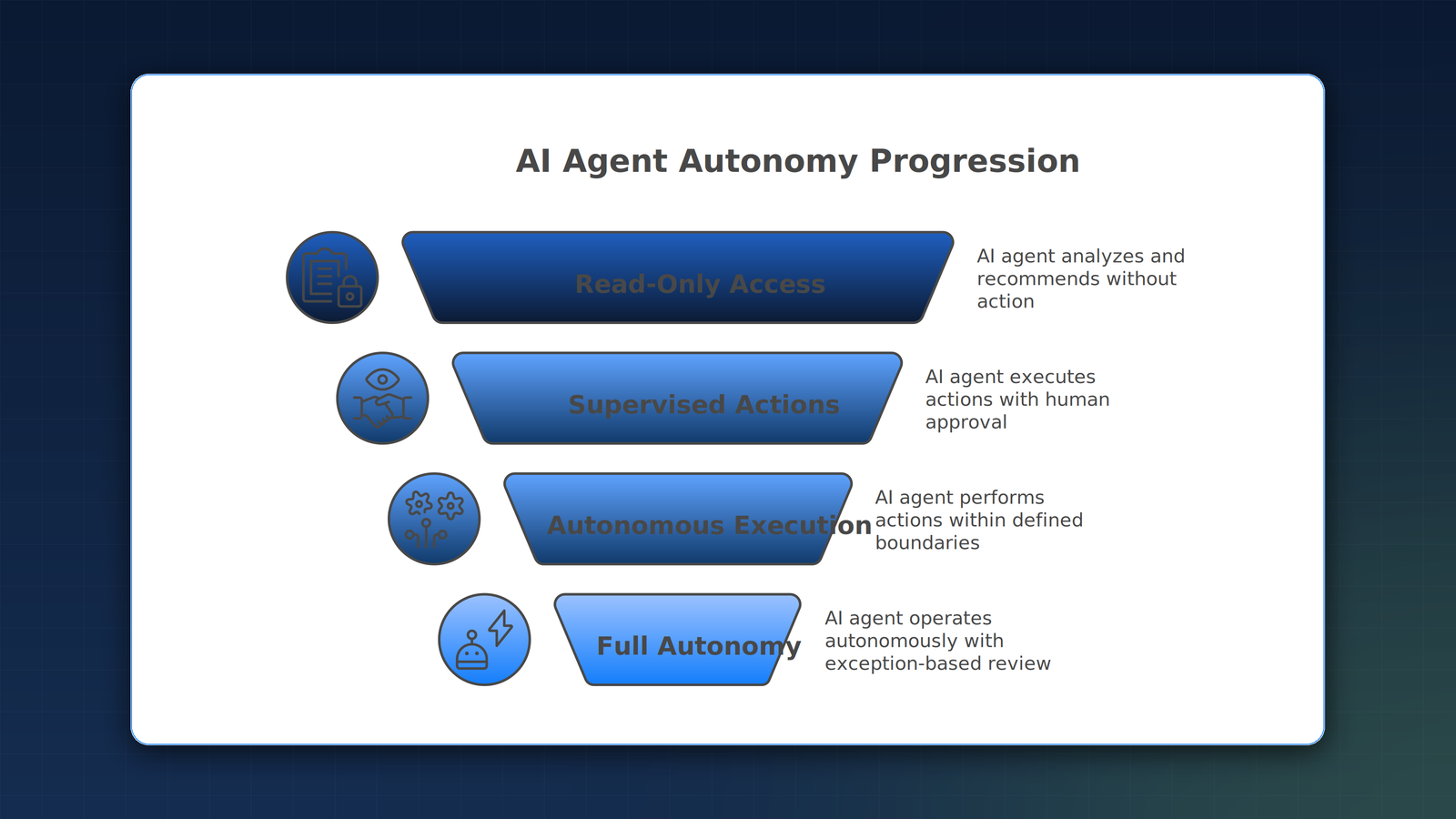
Implementation follows a clear sequence. First, identify high-volume, rule-heavy processes where agents can deliver immediate value. Second, define a skill hierarchy that maps to your business workflows. Third, establish clear escalation paths so agents know when to defer to human judgment. Fourth, instrument everything for observability so you can measure performance at each disclosure level.
- Level 1: Read-only access. Agent can analyze and recommend but not act.
- Level 2: Supervised actions. Agent can execute with human approval.
- Level 3: Autonomous execution within defined boundaries.
- Level 4: Full autonomy with exception-based human review.
Organizations that follow this framework report significantly faster adoption rates. The World Economic Forum estimates that 85% of companies will need to upskill workers to collaborate effectively with AI agents by 2028, and progressive disclosure makes that transition more manageable. Each level provides a natural checkpoint where teams can assess results, refine configurations, and build organizational confidence before advancing to greater autonomy. This measured approach also generates the performance data needed to build a compelling ROI case for expanding AI investment across additional departments, as explored in our article on AI use cases across every department. The progressive disclosure framework is not merely theoretical. It is the same approach used by leading AI-adopting organizations that IBM identifies as achieving 10.3x ROI on their AI investments, because it systematically eliminates the trust deficit that stalls most enterprise AI programs.
Key Takeaways
- AI agents are autonomous systems that go beyond rule-based automation, delivering 3.7x average ROI according to IBM research.
- Progressive disclosure is both a UX pattern and a safety mechanism that enables controlled scaling of agent capabilities.
- Structured agent architectures with modular skills outperform ad-hoc deployments by 40%, per PwC benchmarks.
- Implementation should follow a four-level disclosure framework, from read-only analysis to full autonomy.
- Organizations that invest in AI governance and guardrails early see faster and safer scaling.
Frequently Asked Questions
What is the difference between an AI agent and a chatbot?
A chatbot responds to conversational prompts within a narrow domain. An AI agent can perceive its environment, plan multi-step actions, use tools and skills, and execute autonomously. According to Deloitte's 2026 AI productivity report, AI agents deliver 66% productivity gains versus 15-20% for basic chatbot implementations because agents handle end-to-end workflows rather than isolated interactions. The architectural difference is fundamental: chatbots follow scripted conversation flows, while agents reason about goals and dynamically select the best approach to achieve them.
How long does it take to deploy AI agents in a business setting?
With progressive disclosure, initial agent deployments can be operational within 2-4 weeks. Full autonomy across complex workflows typically takes 3-6 months of incremental skill expansion and validation, depending on the complexity of the business processes involved and the maturity of the organization's data infrastructure. Starting with Level 1 read-only agents allows teams to validate data quality and process understanding before granting agents the ability to take action, significantly reducing deployment risk.
Are AI agents safe for handling sensitive business data?
When deployed with progressive disclosure and proper governance, yes. The key is implementing role-based access controls, audit logging, and escalation paths at every disclosure level. Organizations should follow the guardrail frameworks outlined by NIST and reviewed in our AI governance guide. Data encryption at rest and in transit, combined with network isolation and least-privilege access policies, ensures that agents only interact with the data they need to perform their assigned tasks.
What industries benefit most from AI agents?
Financial services, healthcare, logistics, legal, and professional services see the highest returns. According to Goldman Sachs' 2026 economic research, AI agents could automate tasks equivalent to 300 million full-time jobs globally, with B2B service industries leading adoption due to their high proportion of knowledge work. Industries with structured data, well-defined processes, and high manual execution costs see the fastest payback, often achieving positive ROI within the first quarter of deployment.
How do AI agents handle tasks they cannot complete?
Well-architected agents include escalation paths that route tasks to human operators when confidence is low or when the task falls outside defined boundaries. Progressive disclosure ensures agents only attempt tasks within their validated skill set, and comprehensive logging provides full visibility into every decision the agent makes. This fail-safe architecture means agents degrade gracefully rather than producing unreliable outputs, maintaining business process integrity even when encountering novel or ambiguous situations.
Next Steps
If your organization is exploring AI agents and skills-based automation, Stable Solutions can help you design an agent architecture with progressive disclosure built in from day one. Our MIT-trained team specializes in enterprise AI deployments that scale safely. Schedule a consultation to discuss your use case, or explore our full AI and automation capabilities.