

PwC surveyed 1,217 senior executives across 25 sectors and found that 74 percent of the economic value generated by AI is being captured by just 20 percent of companies. The study, published in April 2026, puts hard numbers on AI value concentration, and it should reframe the question your board is asking. The issue is not whether AI produces returns. It is why those returns keep landing at a small set of companies while the majority remain stuck in pilots, and what the leaders are doing structurally that the other 80 percent are not.
The 74/20 Split: What the Data Shows
The PwC AI Performance study measured revenue and efficiency gains attributable to AI, adjusted against industry medians, across 60 management and investment practices. The headline is the concentration itself: nearly three quarters of the value flows to one fifth of organizations. The more useful finding is that the divide is not explained by how many tools a company has deployed. The companies capturing outsized value are not simply deploying more AI. They deploy it differently, and the differences are specific, measurable, and replicable.
That distinction matters for how you read your own program. A portfolio of active pilots and a growing tool inventory can look like progress in a board deck while producing none of the structural changes that separate the leaders. Activity is not the metric. Captured value is.
What the Leaders Do Differently
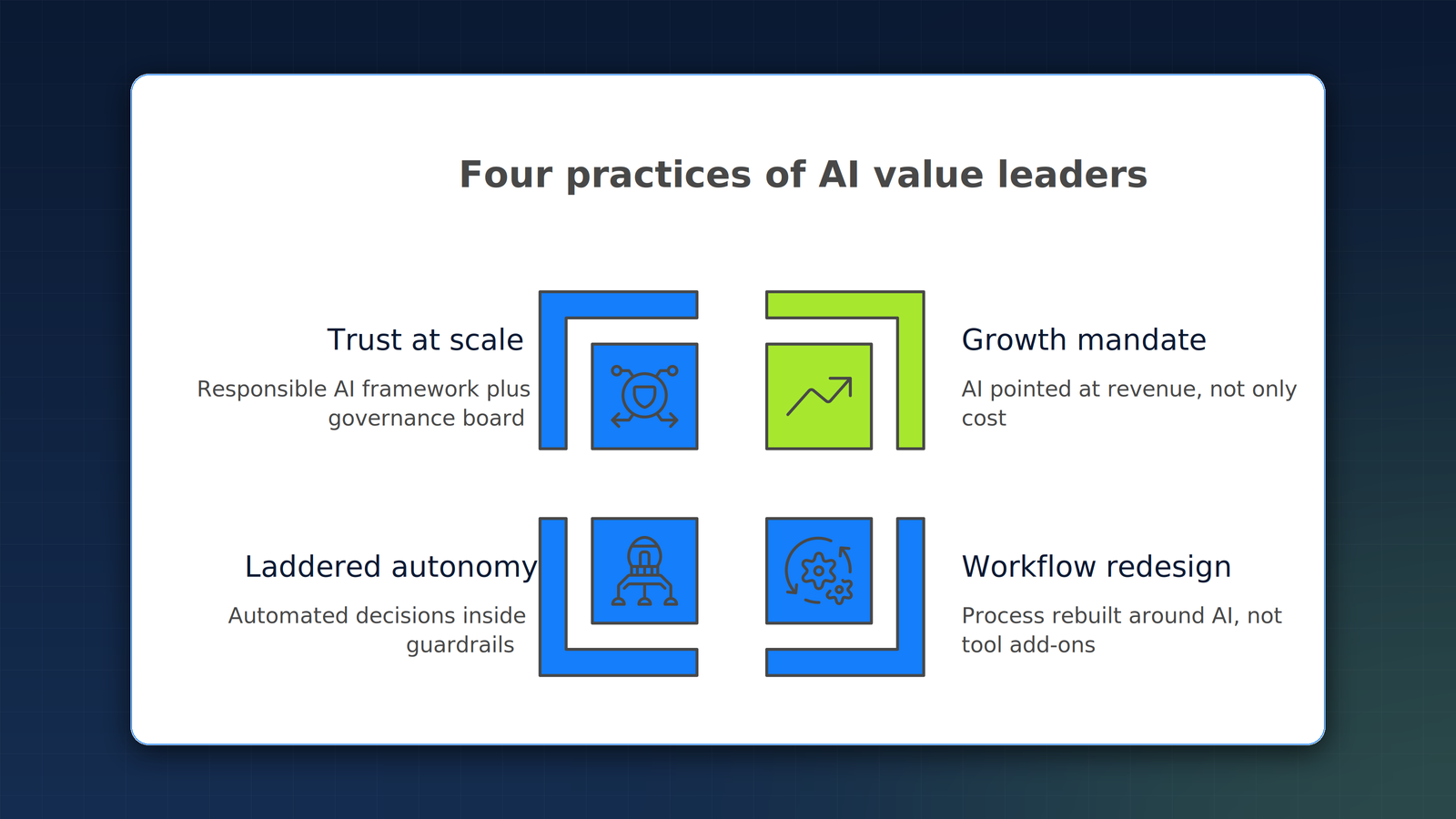
Four practices separate the top 20 percent, each quantified in the study.
- They point AI at growth, not just cost. Leaders are 2.6 times as likely to report that AI improves their ability to reinvent their business model, and two to three times as likely to use AI to pursue growth opportunities arising from industry convergence, meaning revenue plays that emerge where adjacent sectors overlap, such as partnerships outside their core industry. PwC found this growth orientation is the single strongest factor influencing AI-driven financial performance, ahead of efficiency gains.
- They redesign workflows instead of adding tools. Leaders are twice as likely to rebuild the underlying process around AI rather than bolting an assistant onto the existing one. A redesigned workflow compounds; a bolted-on tool plateaus.
- They automate real decisions, with guardrails. Leading companies are 1.8 times as likely to run AI that executes multiple tasks within defined guardrails, 1.9 times as likely to operate AI in autonomous, self-optimizing ways, and they are expanding the number of decisions made without human intervention at 2.8 times the rate of peers.
- They industrialize trust. Leaders are 1.7 times as likely to have a Responsible AI framework, an explicit set of policies governing how AI is built and used, and 1.5 times as likely to run a cross-functional AI governance board. The payoff is adoption: their employees are twice as likely to trust AI outputs, which is what allows the autonomy above to scale.
Why Most Programs Stay on the Wrong Side
Read as a system, the four practices explain why the gap widens rather than closes. A company that frames AI purely as a productivity tool caps its own upside: efficiency gains are real but bounded, while growth plays compound. A company that buys tools without redesigning workflows never changes the shape of its cost structure. And a company that skips the trust infrastructure cannot expand autonomy, because every automated decision still routes through a human bottleneck.
As Joe Atkinson, Global Chief AI Officer at PwC, put it: "Many companies are busy rolling out AI pilots, but only a minority are converting that activity into measurable financial returns. The leaders stand out because they point AI at growth, not just cost reduction, and back that ambition with the foundations that make AI scalable and reliable."
The study warns the divide will widen without a shift in approach, because leaders learn faster, scale proven use cases, and automate decisions safely at scale. Concentration is self-reinforcing. Each quarter spent in pilot mode is a quarter the top 20 percent spend compounding.
A Playbook for the Other 80 Percent
The encouraging reading of the data: the divide is behavioral, not structural. Nothing on the leader list requires a frontier lab budget. It requires an engineering-led program with four moves.
- Reframe the mandate from savings to revenue. Take your top three AI initiatives and ask what each would look like pointed at a growth question: a new offer, a new segment, a convergence play with an adjacent industry. If all three are cost plays, the portfolio is capped by design.
- Pick one workflow and rebuild it end to end. Not an assistant on top of the old process: a redesign of the process itself, with AI steps and human decision points placed deliberately. One rebuilt workflow that compounds beats ten pilots that plateau.
- Ladder autonomy deliberately. Expand the set of decisions AI makes without human intervention in explicit steps, each governed by defined guardrails and each measured, so autonomy grows with evidence rather than optimism.
- Stand up the trust mechanisms before you scale. A Responsible AI framework and a cross-functional governance board are not compliance theater; in the data, they are what makes employees trust outputs enough to let automation run.
This is R and D work, not procurement work, which is why the divide favors companies that treat it that way. The pattern matches what we found in our analysis of enterprise AI ROI data: returns follow engineering discipline, not spend.
Sources
- PwC, "Three-quarters of AI economic gains are being captured by just 20% of companies," 2026. Link.
Next Steps
The 74/20 split is a standing decision: keep running pilots that plateau, or rebuild the workflows and trust mechanisms that put you on the capturing side. Stable Solutions designs and ships the engineering-led AI programs that move companies across that line. Explore our Digital Growth Strategies or contact our team to pressure-test where your program sits against the leader practices.