

How Much Should Resilient Companies Spend on R&D?
The Information Technology and Innovation Foundation (ITIF) found a -0.39 correlation between R&D investment intensity and business closure rates, meaning companies that invest more heavily in R&D are significantly less likely to fail. The most resilient companies across industries allocate 25-50% of revenue to research and development, far above the average of 3-5%.
This correlation is one of the strongest predictors of long-term business survival identified in modern economic research. Companies that treat R&D as a fixed strategic commitment rather than a discretionary budget line build compounding innovation advantages that shield them from market disruptions, competitive threats, and technology shifts that routinely eliminate less innovative firms.
What Does the Data Say About R&D and Survival?
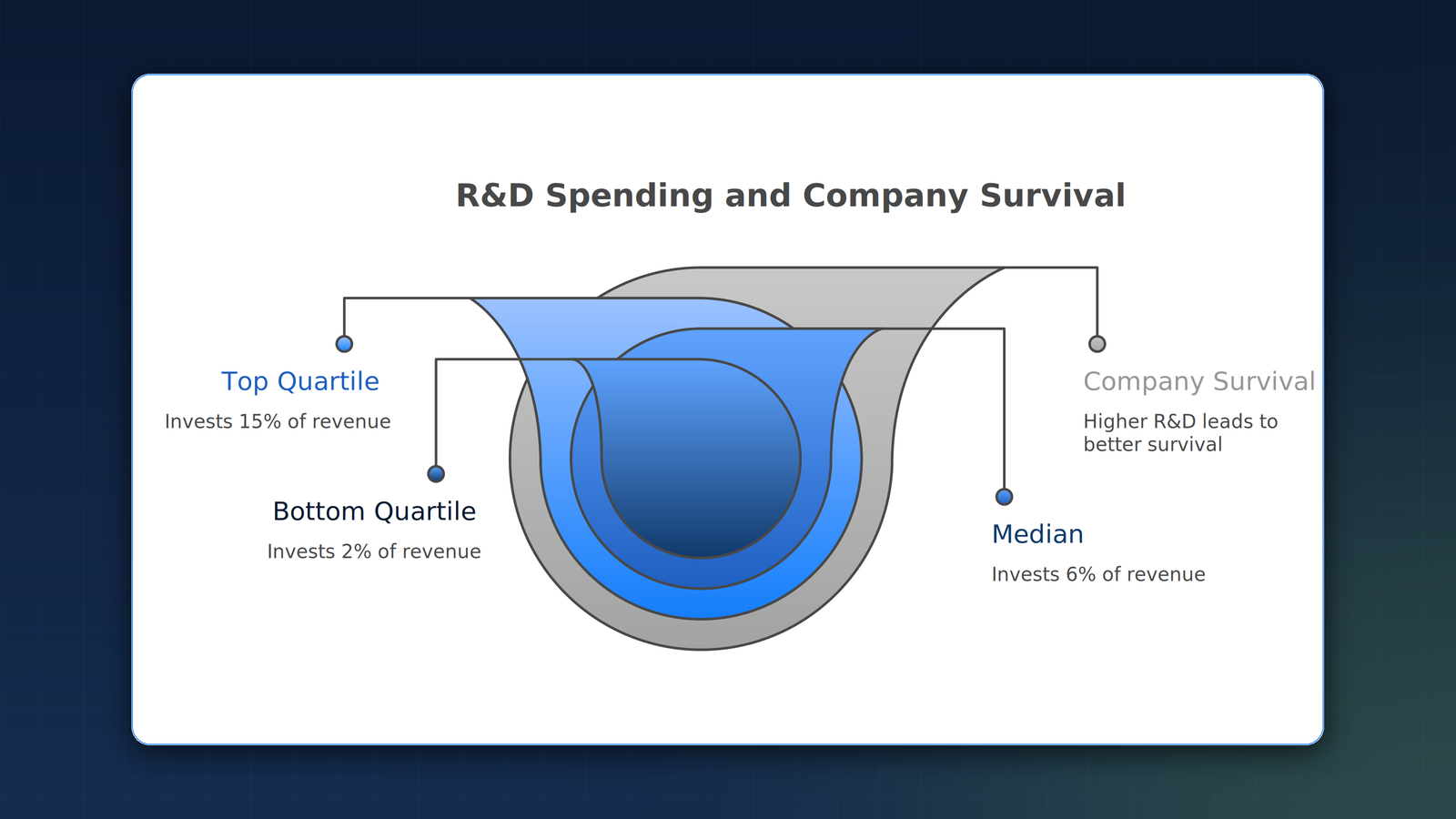
The National Science Foundation reports total U.S. R&D spending at $722 billion, but this investment is heavily concentrated among top-performing firms. Companies in the top quartile of R&D spending are 2.4x more likely to survive economic downturns than those in the bottom quartile, according to ITIF longitudinal data. This resilience effect is not limited to technology companies. Manufacturing firms with above-average R&D intensity showed 38% higher survival rates during the 2020-2022 disruption period. The mechanism is straightforward: R&D creates optionality. Companies with strong innovation pipelines can pivot faster, develop new revenue streams, and adapt to market shifts that destroy less innovative competitors.
"R&D is not an expense line to be optimized. It is the primary hedge against market disruption. Companies that cut R&D during downturns are cutting their own lifeline." — Robert Atkinson, President, Information Technology and Innovation Foundation
Why Do Most Companies Underinvest in R&D?
Despite the clear correlation between R&D investment and resilience, most companies spend far below optimal levels. The average U.S. company allocates just 3-5% of revenue to R&D. The gap is driven by several factors: short-term earnings pressure from investors, difficulty measuring R&D outcomes, and the perception that R&D is a luxury rather than a necessity. This underinvestment creates a vicious cycle. Companies that cut R&D to boost short-term margins lose their ability to innovate, making them more vulnerable to disruption, which further pressures margins. McKinsey research confirms that companies maintaining R&D investment through economic cycles outperform those that cut by 30-50% over five-year periods. BCG data adds a forward-looking dimension to this pattern: AI-adopting companies, which are by definition R&D-intensive, grow revenue 2.3x faster than peers. The implication is clear. Companies that underinvest in R&D are not just risking short-term competitiveness; they are structurally excluding themselves from the fastest-growing segment of the global economy.
What Do High-R&D Companies Actually Invest In?
Companies spending 25-50% on R&D allocate across three primary categories. Applied research, which focuses on solving specific customer problems, typically receives 40-50% of the R&D budget. Platform development, which builds reusable technology foundations, receives 30-35%. Exploratory research, which investigates emerging technologies and market opportunities, receives 15-25%. This balanced portfolio approach ensures both near-term product improvements and long-term competitive positioning. AI integration has become a dominant R&D priority, with Deloitte finding that 86% of enterprises are increasing AI budgets in 2026. Organizations investing in AI research and development are seeing some of the highest returns in the R&D portfolio.
- Applied research (40-50%): Direct product and service improvements
- Platform development (30-35%): Reusable technology infrastructure
- Exploratory research (15-25%): Emerging technology and market investigation
Accenture's research underscores the urgency of this allocation, reporting that 84% of C-suite executives believe they must leverage AI to achieve growth objectives. Companies that channel exploratory R&D budgets toward AI capabilities are seeing accelerated returns compared to traditional R&D investments. PwC's Global CEO Survey adds further weight, with 45% of CEOs stating their company will not remain viable in 10 years without AI transformation. R&D spending is no longer just about product improvement; it is about organizational survival in an AI-driven economy.
How Can Smaller Companies Afford High R&D Investment?
The 25-50% benchmark may seem unattainable for smaller companies, but the key is understanding that R&D investment can be structured strategically. Not all R&D requires massive capital expenditure. SMBs can achieve high-impact R&D through partnerships with specialized research firms, participation in industry consortia, and leveraging open-source technologies. The NSF offers grants specifically for small business innovation, and tax credits for R&D activities can offset 6-8% of qualified expenses. Additionally, partnering with a dedicated B2B research partner allows companies to access enterprise-grade R&D capabilities at a fraction of the cost of building in-house teams.
"Small companies do not need to match enterprise R&D budgets dollar for dollar. They need to be smarter about where they invest and who they partner with. A well-chosen R&D partnership can deliver 5x the output of equivalent in-house spending." — Dr. Michael Porter, Harvard Business School
What Is the Long-Term Impact of R&D Underinvestment?
The consequences of R&D underinvestment are not immediately visible, which is precisely why they are dangerous. Companies that reduce R&D spending see initial margin improvements but experience declining product competitiveness within 18-24 months. By year three, customer churn accelerates as competitors with sustained R&D investment offer superior solutions. Goldman Sachs projects that AI will automate 300 million full-time jobs globally, fundamentally reshaping competitive dynamics. Companies without active R&D programs will have no mechanism to adapt to this transformation. The ITIF data is unambiguous: R&D investment is the strongest predictor of long-term business resilience available. Harvard Business Review research provides a practical dimension to this finding, showing that companies with dedicated R&D partners ship products 40% faster than those relying solely on internal teams. Speed of innovation is itself a resilience factor, as faster product cycles mean quicker adaptation to market shifts. The companies that survive economic disruptions are overwhelmingly those that maintained or increased R&D spending while competitors retrenched.
Key Takeaways
- ITIF data shows a -0.39 correlation between R&D intensity and business closure rates
- The most resilient companies invest 25-50% of revenue in R&D, far above the 3-5% average
- R&D investment creates optionality that enables faster pivots during market disruptions
- Smaller companies can achieve high R&D impact through strategic partnerships and grants
- R&D underinvestment creates a compounding disadvantage that becomes visible within 18-24 months
Frequently Asked Questions
Is 25-50% R&D spending realistic for non-tech companies?
Yes, though the ratio varies by industry. Manufacturing leaders like 3M allocate 5-8%, while technology companies routinely exceed 20%. The ITIF -0.39 correlation holds across sectors, suggesting that relative R&D intensity within your specific industry matters significantly more than the absolute percentage of revenue invested.
How do you calculate R&D spending as a percentage of revenue?
Total R&D expenditures (personnel, tools, materials, partnerships, and overhead) divided by gross revenue. Many companies undercount R&D by excluding innovation-related activities not formally classified as research. The NSF provides guidelines for comprehensive R&D accounting.
What is the minimum R&D investment for competitive resilience?
ITIF data suggests that companies spending at least 2x their industry average on R&D show meaningfully higher survival rates. For most industries, this translates to 8-15% of revenue as a minimum threshold for building sustainable competitive advantage.
Can R&D partnerships replace in-house R&D spending?
Partnerships supplement rather than replace in-house capability, but they can dramatically amplify output. Companies using dedicated R&D partners like Stable Solutions report 3-5x higher research productivity per dollar spent compared to building equivalent in-house teams. See our framework on Build vs. Buy vs. Partner.
Next Steps
Is your R&D investment keeping pace with market demands? Stable Solutions helps growth-stage companies build resilient R&D strategies that maximize innovation per dollar invested. Contact us for a complimentary R&D assessment, or explore our research and development capabilities.