
What Is Parallel Development with Claude Code?
Parallel development with Claude Code uses dispatch and scheduling features to run multiple AI development agents concurrently, each working on independent features or tasks within the same project. Teams using this approach report delivery time reductions of 50% or more, according to Deloitte's 2026 developer productivity analysis, which found 66% productivity gains among organizations that fully leverage concurrent AI workflows.
How Do /schedule and Dispatch Work?
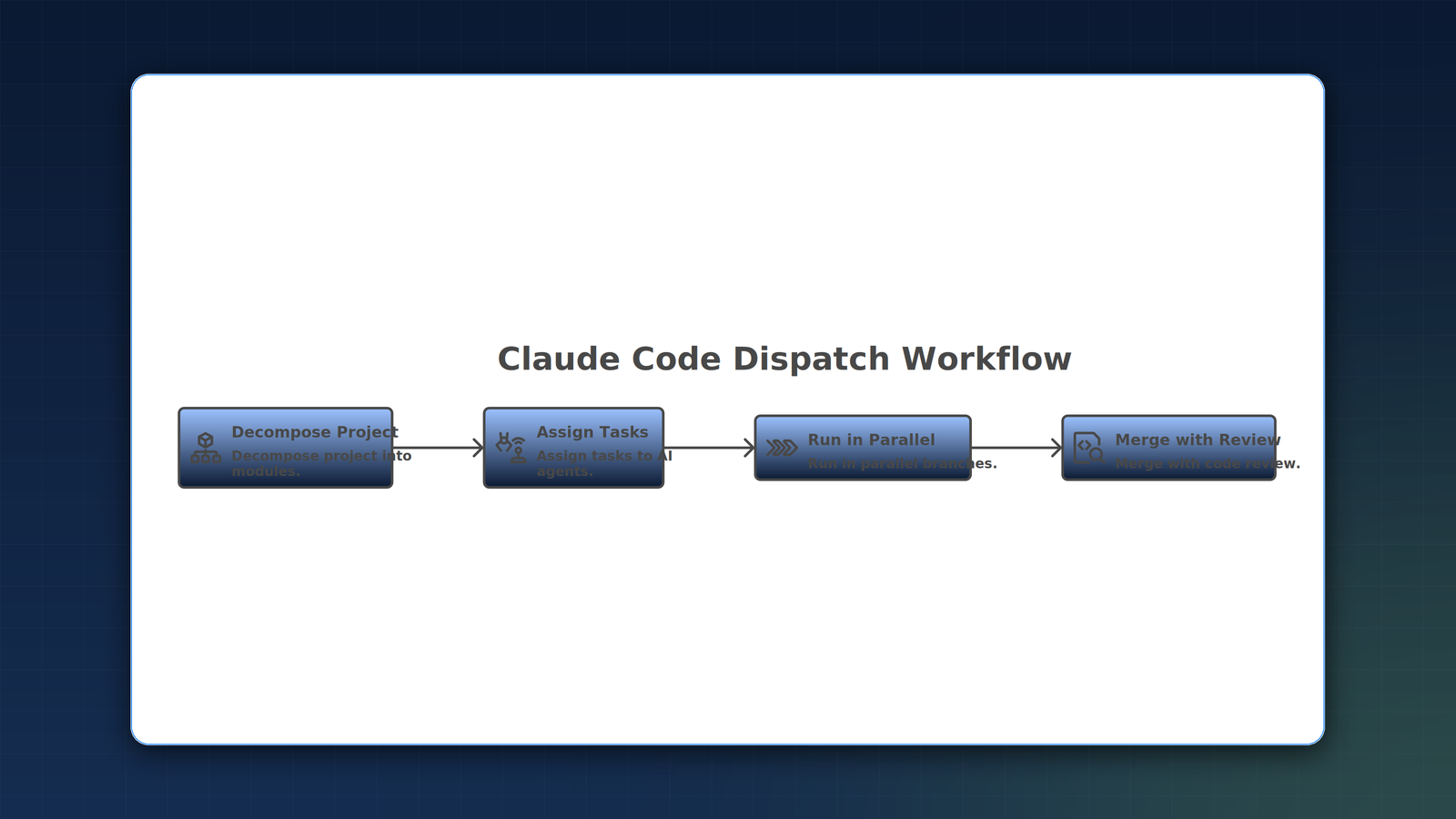
Claude Code's dispatch system allows a lead developer to decompose a project into independent work units and assign each unit to a separate AI agent instance. The /schedule command queues tasks with dependency awareness, ensuring that work proceeds in the correct order while maximizing concurrency. Think of it as a project manager that can spin up an entire development team on demand, each member working with full context of the project architecture and coding standards.
In a traditional workflow, a single developer works on one feature at a time. Even in a team setting, coordination overhead limits true parallelism. Standup meetings, Slack threads, code review wait times, and context-switching collectively consume 30-40% of team capacity. With dispatch, a senior engineer can define five features in the morning and have working implementations of all five by afternoon. Each agent operates in its own branch, with changes merged through standard code review processes. The result is a development model where human time is spent on the highest-value activities: architecture, decomposition, and review.
"The dispatch model fundamentally changes how we think about sprint planning. Instead of asking how many story points a team can handle, we ask how many independent work streams can be defined. That is the new bottleneck." — Kent Beck, Creator of Extreme Programming
What Results Are Teams Seeing?
The productivity data is compelling. According to NVIDIA's 2026 developer benchmarks, AI development tools operating with full codebase context deliver a 40% performance improvement. When you add parallelism on top of that contextual advantage, the gains multiply. At Stable Solutions, we have used dispatch-based parallel development to complete projects that would traditionally require a four-person team working for a month in under two weeks with a single senior engineer directing multiple AI agents.
According to IBM's 2026 ROI analysis, organizations deploying parallel AI development workflows report 3.7x returns on their AI investment, with top-performing teams achieving 10.3x ROI. The key driver is not just speed but the elimination of coordination overhead that typically consumes 30-40% of team capacity in conventional development environments. When agents work in parallel without requiring meetings, status updates, or handoff documentation, the time savings compound across every sprint.
How Do You Maintain Quality with Parallel AI Development?
Quality assurance in parallel AI development requires deliberate architecture. Each dispatched agent works in an isolated branch, so conflicts are surfaced during merge rather than during development. The review process becomes the critical quality gate, and the structured nature of dispatch actually improves review efficiency because each branch contains a focused, well-scoped change rather than a sprawling multi-feature commit.
- Automated testing: Each agent runs the full test suite before submitting its work for review, catching regressions immediately.
- Merge conflict resolution: Standard Git merge processes handle integration, with human engineers resolving architectural conflicts that automated tools cannot address.
- Architecture governance: A senior engineer defines interfaces and contracts before dispatching work, ensuring consistent patterns across parallel streams.
- Security scanning: Automated security tools validate each branch independently before merge approval, maintaining the same security posture as traditional development.
"Parallelism without architecture is chaos. The teams that succeed with dispatch are those that invest upfront in clear interfaces and contracts. The AI handles implementation. Humans handle design." — Martin Fowler, Chief Scientist, Thoughtworks
The combination of isolated branches, automated testing, and human review creates a quality framework that scales with the number of parallel agents. As teams gain experience with dispatch, they develop increasingly refined decomposition strategies that minimize cross-branch dependencies and maximize the independence of each work stream.
When Should You Use Parallel Development?
Parallel development with dispatch is most effective for projects with clear module boundaries. Microservice architectures, feature-flag-driven development, and component-based frontends are ideal candidates. Projects with tightly coupled codebases or extensive shared state require more careful decomposition before parallelism can be effective. As we discuss in our article on AI-powered subagents, the decomposition step is where experienced engineering judgment matters most.
The World Economic Forum estimates that 120 million workers globally will need reskilling to work alongside AI systems. For software teams, the most valuable new skill is the ability to decompose problems into parallelizable units and define clear interfaces between them. This is architectural thinking, and it is the skill that separates teams that get 2x gains from those that get 5x gains. Organizations that invest in training their senior engineers on effective AI-assisted decomposition strategies will see returns that compound with every project, because the patterns and interfaces developed for one project often transfer directly to subsequent work. According to Deloitte's 2026 AI productivity report, teams with six or more months of experience using parallel AI development workflows achieve productivity gains that are 2-3 times higher than first-time users, underscoring the value of early investment in this capability.
Key Takeaways
- Claude Code dispatch enables true parallel development by running multiple AI agents concurrently on independent features, eliminating the coordination overhead that consumes 30-40% of traditional team capacity.
- Teams report 50% or greater delivery time reductions when combining AI-assisted development with parallel dispatch workflows.
- Quality is maintained through isolated branches, automated testing, and human-led architecture governance and code review.
- The skill that matters most is problem decomposition: breaking projects into independent, parallelizable work units with clear interfaces.
- Projects with modular architectures and well-defined boundaries benefit the most from parallel AI development.
Frequently Asked Questions
Can dispatch handle dependencies between features?
Yes. The /schedule command supports dependency declarations so that dependent tasks wait for prerequisite tasks to complete before starting. This ensures correct execution order while maximizing concurrency for independent work streams. Complex dependency graphs are supported, enabling sophisticated orchestration of multi-phase projects. In practice, most well-architected projects have enough independent modules that 3-5 agents can work concurrently even when some tasks have sequential dependencies.
How many parallel agents can run simultaneously?
The practical limit depends on the project architecture more than the tooling. Projects with 5-10 clearly independent modules can effectively run that many concurrent agents. Beyond that, coordination overhead increases and returns diminish. The sweet spot for most teams is 3-7 parallel streams per senior engineer directing the work. The constraint is rarely computational — it is the quality of the task decomposition and the clarity of the interface contracts between modules.
Does parallel development create more merge conflicts?
When architecture is defined upfront with clear interfaces and contracts, merge conflicts are minimal. The key is investing in decomposition before dispatching work. Teams that skip this step do encounter more conflicts, which underscores the importance of experienced architectural oversight and well-defined module boundaries. Standard Git merge processes handle integration, with human engineers resolving any architectural conflicts that automated tools cannot address.
What size projects benefit from parallel development?
Projects with at least 3-4 independent features or modules see meaningful benefits. For smaller projects, the overhead of decomposition may not justify the parallelism. For larger projects with 10+ independent work streams, the time savings can be dramatic, often compressing month-long timelines into days. Microservice architectures, component-based frontends, and feature-flag-driven development are particularly well-suited because they naturally provide the module boundaries that enable effective parallel execution.
Next Steps
Ready to see how parallel AI development could accelerate your next project? Contact Stable Solutions for a project assessment. Our MIT-trained team will evaluate your architecture for parallelization potential and provide a timeline estimate using our dispatch-enhanced workflow. Learn more about our full development capabilities.