

How Much More Does Late AI Adoption Actually Cost?
McKinsey research demonstrates that companies adopting AI early achieve 20-30% cost reductions across operations, while late adopters implementing equivalent solutions pay 2-3x more due to increased competition for talent, higher vendor pricing, and the compounding advantage gap. The cost of waiting is not linear; it accelerates.
This compounding dynamic makes AI adoption timing one of the most consequential strategic decisions a company faces. Unlike investments with static returns, the value of early AI adoption grows over time while the cost of catching up escalates. Organizations that understand this asymmetry can use it to inform implementation timelines and partnership strategies that maximize their competitive window.
Why Does the Cost of Waiting Compound Over Time?
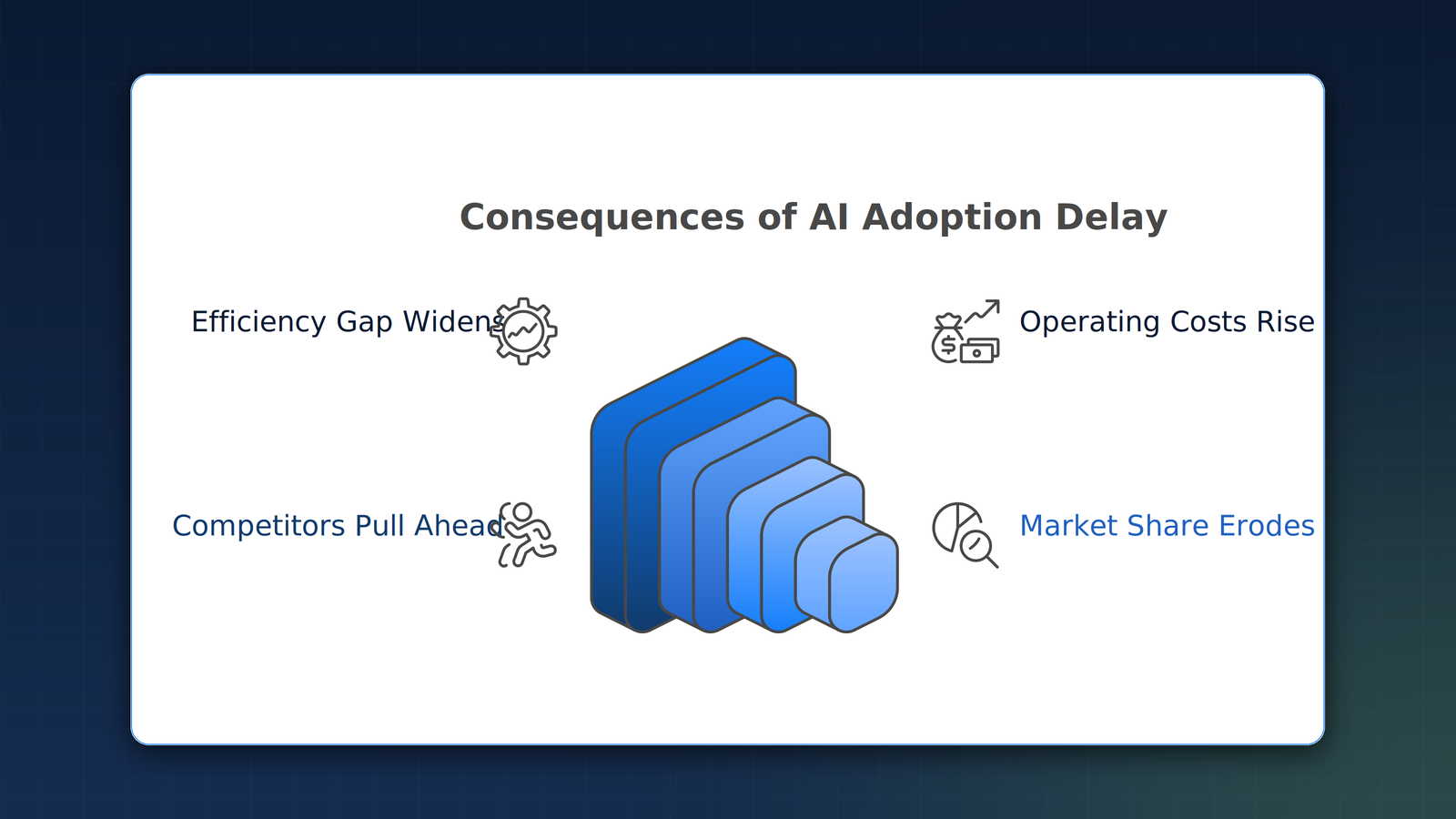
The economics of AI adoption follow a compounding curve, not a straight line. Early adopters reduce costs and reinvest those savings into further AI capabilities, creating a virtuous cycle. Meanwhile, companies that wait face multiple escalating cost pressures. AI talent becomes scarcer and more expensive as demand grows. Vendor pricing increases as AI moves from early-adopter to mainstream market pricing. And the competitive gap widens as AI-enabled competitors capture market share. Gartner projects that by 2027, 75% of enterprises will have AI in production, up from 5% in 2023. The companies implementing now are securing favorable talent, pricing, and competitive positions that will be unavailable to later entrants.
"Every quarter a company delays AI adoption, it is not just missing savings. It is funding a competitor's advantage. The compounding effect means a two-year delay can result in a permanent competitive disadvantage." — Jacques Bughin, former Director, McKinsey Global Institute
What Do Early Adopters Gain That Late Adopters Cannot Replicate?
Early AI adopters build three assets that late adopters cannot easily replicate. First, they accumulate proprietary training data. AI systems improve with data, and companies that deploy earlier have years of operational data that new implementations cannot match. Second, they develop organizational AI literacy. Teams that work alongside AI tools for years develop intuitions and workflows that cannot be trained in weeks. Third, they build institutional knowledge about what works. Failed experiments and successful iterations create implementation playbooks that give early adopters a structural advantage. IBM's enterprise data shows top AI performers achieving 10.3x ROI compared to the 3.7x average, and a significant portion of that outperformance is attributable to implementation experience accumulated over time. BCG reinforces this finding, reporting that AI-adopting companies grow revenue 2.3x faster than peers, and that the growth differential widens over time as early adopters compound their data and workflow advantages. Accenture data showing 84% of C-suite executives committed to leveraging AI for growth means the competitive pressure from AI-enabled rivals will only intensify, making early accumulation of these irreplicable assets increasingly valuable.
What Are the Direct Financial Costs of Delayed AI Adoption?
The direct financial costs of waiting can be categorized into three buckets. Implementation costs increase by 15-25% annually as AI moves from niche to mainstream adoption, according to Deloitte. Opportunity costs from foregone efficiency gains average 20-30% of operational expenses for each year of delay, based on McKinsey benchmarks. Competitive costs, the hardest to measure but often the largest, include lost market share, reduced pricing power, and diminished ability to attract top talent. Consider a company with $10 million in annual operational costs. Early AI adoption yielding a 25% efficiency gain saves $2.5 million per year. A two-year delay means $5 million in foregone savings, plus 15-25% higher implementation costs when the company eventually adopts.
- Implementation cost inflation: 15-25% annually (Deloitte)
- Foregone efficiency gains: 20-30% of operational costs per year (McKinsey)
- Competitive cost: Lost market share, reduced pricing power, talent disadvantage
Is There a Point Where It Becomes Too Late to Adopt AI?
While it is never technically too late to implement AI, there is a window of maximum advantage that is narrowing. Goldman Sachs estimates AI could automate 300 million full-time jobs globally, indicating the scale of transformation ahead. Companies that adopt within the current window, roughly 2024-2027, are positioned to shape how AI integrates with their operations. Those adopting after 2027 will be implementing in a market where competitors have already optimized and where AI vendor pricing has fully normalized at higher levels. The World Economic Forum notes that 85% of companies plan to upskill workers alongside AI adoption, but the training infrastructure and talent pipelines needed for this transition take 2-3 years to build.
"The window for AI adoption advantage is not closing, but it is narrowing. Companies that move now will define the competitive landscape. Those that wait will be forced to operate within constraints set by earlier movers." — Andrew Ng, Founder of DeepLearning.AI and former Chief Scientist at Baidu
How Can Companies Accelerate Their AI Adoption Timeline?
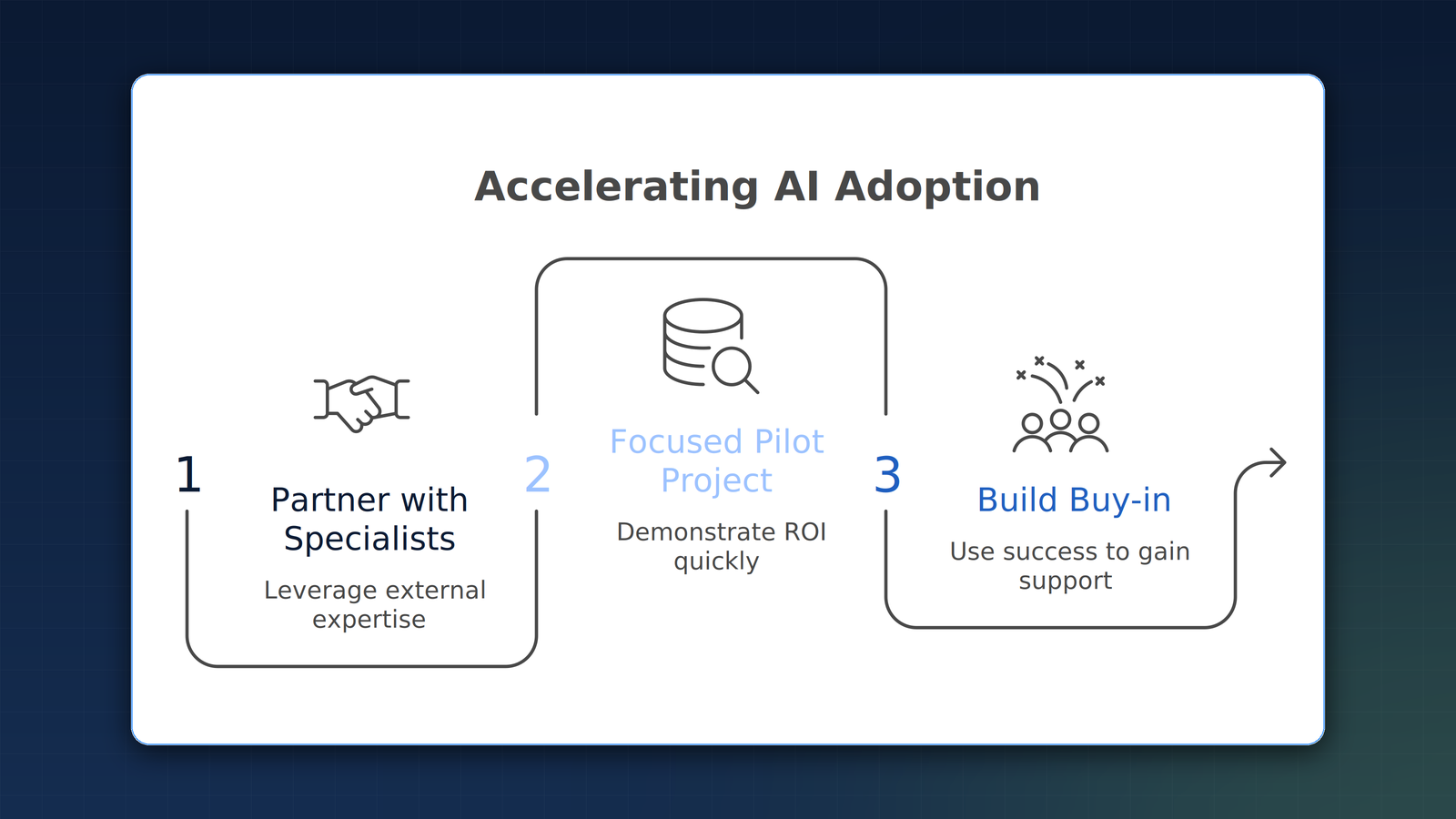
The most effective strategy for accelerating AI adoption is partnering with experienced implementation specialists rather than building entirely from scratch. Deloitte reports that companies using external AI partners achieve 30-40% faster time-to-value compared to purely in-house approaches. Start with a focused pilot in a high-impact area, demonstrate ROI within 90 days, and use that success to build organizational buy-in for broader deployment. Stable Solutions provides AI integration services designed to compress adoption timelines while building internal capability. The goal is not to depend on a partner permanently but to use external expertise to close the adoption gap faster than competitors.
Key Takeaways
- Early AI adopters achieve 20-30% cost reductions; late adopters pay 2-3x more for equivalent solutions (McKinsey)
- The cost of waiting compounds through talent scarcity, vendor pricing increases, and widening competitive gaps
- Early adopters accumulate irreplicable advantages: proprietary data, organizational literacy, and implementation knowledge
- Implementation costs inflate 15-25% annually as AI moves to mainstream adoption
- The optimal adoption window (2024-2027) is narrowing; partnering with specialists can compress timelines by 30-40%
Frequently Asked Questions
How much does a one-year delay in AI adoption actually cost?
Based on McKinsey and Deloitte data, a one-year delay costs approximately 20-30% of operational expenses in foregone efficiency gains, plus 15-25% higher implementation costs when you eventually adopt. For a company with $10M in operations, this translates to $2-3M in total cost of delay.
Can late adopters catch up to early AI adopters?
Partial catch-up is possible, but the data advantage of early adopters, years of proprietary training data and implementation experience, creates a structural gap that is difficult to close. IBM reports that implementation maturity accounts for a significant portion of the gap between 3.7x average and 10.3x top-quartile ROI.
What is the fastest way to start seeing AI ROI?
Focus on a single high-impact use case with clean data and clear success metrics. Companies following this approach typically achieve break-even within 3-6 months. Partnering with an experienced AI integration firm can further compress this timeline.
Is it better to wait for AI technology to mature before adopting?
No. While AI technology will continue to improve, the competitive advantages of early adoption, including data accumulation, organizational learning, and cost savings, outweigh the benefits of waiting for marginal technology improvements. The companies waiting for "perfect" AI are funding their competitors' advantage. PwC's Global CEO Survey confirms this, with 45% of CEOs recognizing that delayed transformation threatens their company's long-term viability.
Next Steps
Every quarter of delay increases the cost of eventual AI adoption. Stable Solutions helps companies close the adoption gap with structured AI integration programs that deliver measurable ROI within 90 days. Contact us today to assess your adoption timeline, or explore our capabilities to see how we compress implementation timelines. For more on AI investment returns, see our analysis on the 3.7x ROI of AI integration.