

Why Is Your AI App Estimate Wrong Before Work Starts?
Gartner forecasts that through 2026, organizations will abandon 60% of AI projects that are not supported by AI-ready data. In a Gartner survey of 248 data management leaders, 63% either did not have the right data management practices for AI or were unsure whether they did. Those two numbers mean most AI app estimates are being produced before the thing that determines the timeline is known.
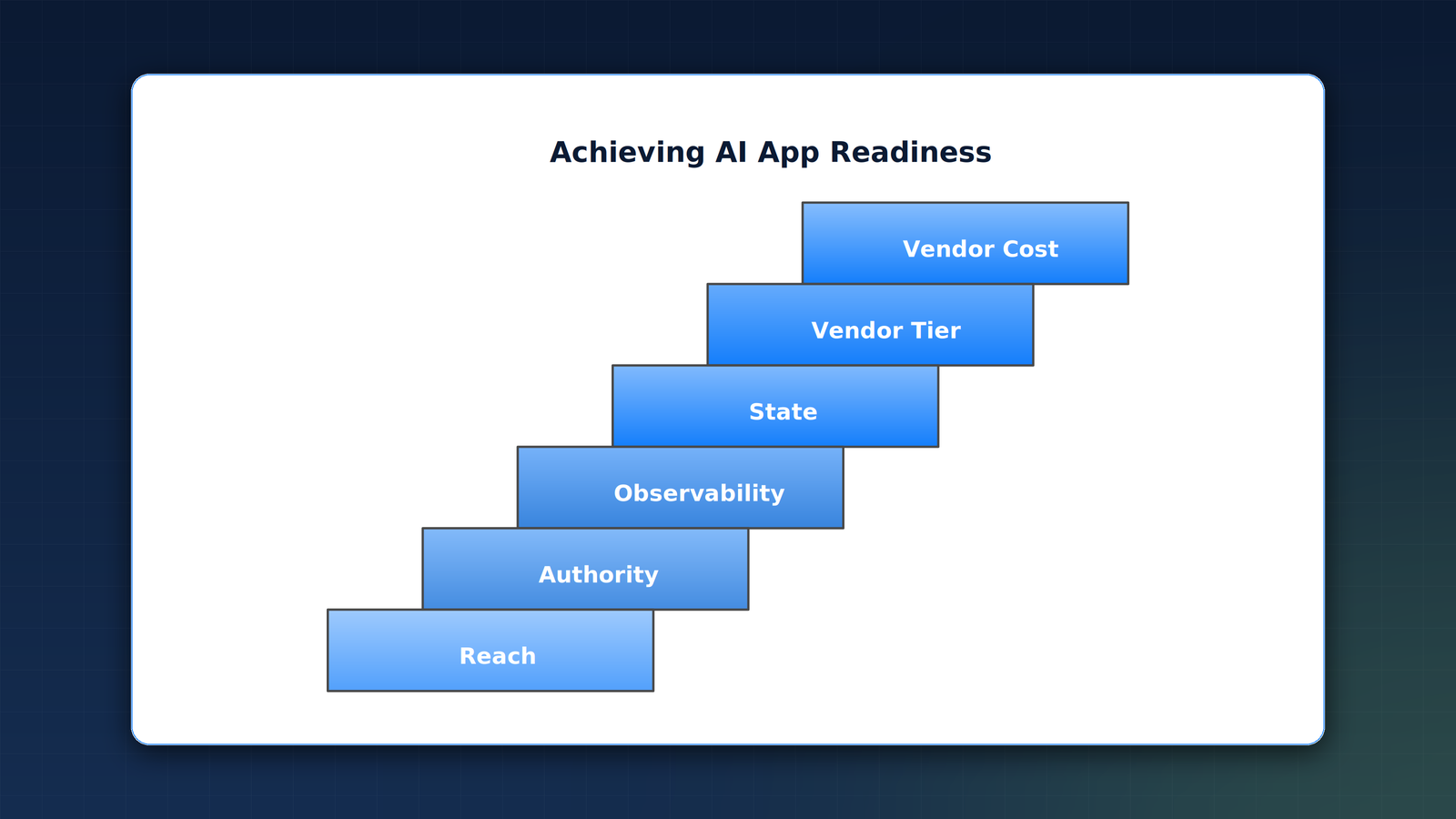
An estimate is a claim about work you understand. For an enterprise AI app, two things sit upstream of that understanding, and neither one is visible in a feature list. The first is what your data estate actually permits. The second is what your vendor contracts actually permit. We call them gates because until each one is open, a date is not an estimate. It is a guess with a decimal point.
This is a different question from whether a working demo can become a product, which we covered in our AI prototype to production framework. That piece asks which prototypes deserve to be productized. This one asks what has to be true before any number you produce is worth defending to a board.
Gate One: Can the Agent Reach Correct Records Under the Right Permissions?
Agentic AI, software that plans and carries out a multi-step task across your systems rather than answering a single prompt, only performs as well as its reach. MIT Technology Review published findings in July 2026 from thousands of agentic workload experiments run by Intel, and the load-bearing conclusion for anyone holding a budget is that agentic AI is a systems problem rather than only an inference problem. Inference, a single model run from prompt to response, is the part that is easy to price. The system around it is where the schedule lives.
Data readiness for an AI app is not a measure of how much data you hold. It is four specific capabilities, and each one is a separate engineering commitment.
- Reach. The agent can query the records that make its answer correct, at the moment it needs them. Most systems of record were not built to be queried this way, which makes this integration work rather than configuration.
- Authority. The agent acts with the permissions of the person it is acting for, and no more. Every system it can write to is a grant you authored deliberately.
- Observability. Observability, the ability to reconstruct what a system did and why after it did it, is what converts an incident into a fix and answers the question an auditor will ask. We treated this in depth in our piece on observability for production AI agents.
- State. What the agent carries between steps, and what it is required to forget, decides whether a multi-step task completes or drifts. State handling is where long-running agent work usually breaks, and it is the most expensive decision to reverse.
Assess those four honestly and Gate One either opens or gives you a scope of remediation work with a real cost. What it will not give you is permission to skip ahead. If your organization sits in the 63% that are unsure about data practices for AI, that remediation is your critical path, and the choice of model is not yet a decision worth having.
Gate Two: Does Your Vendor Contract Permit the Feature?
The second gate is the one no internal estimate surfaces, because it does not live in your codebase. It lives in your vendor agreements.
TechRadar reported in July 2026 that agentic capability is increasingly gated behind platform migrations. In the case it examined, access to a major vendor agentic assistant was extended to on-premise customers only on the condition that they commit to moving the majority of their estate to cloud enterprise resource planning, the system of record for finance, supply chain, and operations. The same report notes that 61% of members of the Americas SAP Users Group named budget as their single biggest challenge this year.
Read those together and the consequence for scoping is direct. The capability you are budgeting may be gated behind a platform migration you have not budgeted, on a schedule set by a vendor rather than by your team. A migration of that size is not a line item an engineering lead can absorb. It is a commercial decision about contract timing and spend, and it moves the delivery date regardless of how well the build is going.
Gate Two opens when you can name, for every capability in the scope, which vendor tier it requires and what that tier costs. Until then the roadmap contains a dependency owned by nobody.
How Do You Tell a Real Agentic Vendor From a Relabeled One?
Both gates assume the product does what the category label says. Often it does not. Gartner uses the term agent washing for the practice of rebranding existing products, including assistants, robotic process automation, and chatbots, as agentic without substantial agentic capability. The scale is the useful figure: among the thousands of vendors marketing agentic products, Gartner estimates only about 130 are genuine.
That ratio should change your diligence. Ask a vendor to demonstrate the product planning and then acting across two systems it does not own, and to produce a log of every tool call it made. A product that can only respond inside its own interface is an assistant, which may be exactly what you need, but it will not carry a scope written for an agent.
Running Both Gates Before You Commit a Date
This is the sequence we use when a client asks what an enterprise AI app will cost and by when.
- Test reach and authority on one real workflow. Pick a single high-value task and confirm the agent can retrieve the right records under the right permissions. One honest test tells you more about the schedule than a quarter of planning.
- Write the permission boundary before the feature. Name every system the agent may write to and every action it is refused, in writing, ahead of implementation. Boundaries authored after a demo become retrofits, and retrofitted permissions are how agents reach data nobody intended.
- Fund observability in the first release. Not phase two. Phase two does not get funded, and the first release is the one that surprises you.
- Map every capability to a vendor tier and price it. Produce the list, with costs and dates, and assign it to an executive with budget authority.
- Only then publish a date. With both gates documented, the number you give the board carries the two dependencies that would otherwise break it.
The output is not a single figure for an AI feature. It is a costed readiness scope, a named vendor dependency, and a date that survives contact with both. Teams still choosing a client architecture should pair this with the native or cross-platform decision, which determines where the model runs before either gate is assessed.
Key Takeaways
- Gartner forecasts that 60% of AI projects not supported by AI-ready data will be abandoned through 2026, and 63% of 248 surveyed data management leaders lacked or were unsure of the right data practices for AI.
- Data readiness for an AI app means four specific capabilities: reach, authority, observability, and state handling.
- Agentic AI is a systems problem rather than only an inference problem, per Intel research published by MIT Technology Review, so the system around the model sets the schedule.
- Agentic features gated behind vendor platform migrations create a dependency on a schedule your team does not control, and it belongs to an executive rather than the build team.
- Gartner estimates only about 130 genuine agentic vendors exist among thousands claiming the category, so diligence has to test planning and acting across systems, not category labels.
Frequently Asked Questions
How long does it take to assess both gates?
For a single workflow, two to four weeks is typical, and most of that is confirming what the data layer permits rather than writing code. It is the cheapest four weeks in the project, because it converts a schedule built on assumption into one built on a test.
Can we start building before Gate One is open?
You can build a prototype, and you often should, because a prototype is how you test reach and authority cheaply. What you should not do is commit a production date. Gartner attributes 60% of AI project abandonment through 2026 to the absence of AI-ready data, and a committed date is what turns that gap into a cancelled program.
What if the vendor migration is unaffordable this year?
Then the scope changes rather than the date slipping later. Identify which capabilities depend on that tier, remove them from the current release, and ship what your present contract supports. This is a better outcome than discovering the gate at integration, which is where most teams find it.
Who owns the vendor dependency?
An executive with budget authority, not the engineering lead. When capability is gated behind a platform migration, the decision is commercial, and treating it as a technical dependency leaves it unowned until it becomes a delay.
Sources
- Gartner, "Lack of AI-Ready Data Puts AI Projects at Risk," 2025.
- MIT Technology Review, "Building the enterprise environment for agentic AI," 2026. Link.
- TechRadar, "Agentic AI has a price: it's called ERP migration," 2026. Link.
- Gartner, "Gartner Predicts Over 40% of Agentic AI Projects Will Be Canceled by End of 2027," 2025.
Next Steps
If you have been asked for an AI app date and the honest answer is that nobody has tested what your data or your vendor contract permits, those two tests are the work to do first. Stable Solutions runs both gates as a scoped assessment, then builds against the result. Explore our App and Web Development services or contact our team to pressure-test a scope you already hold.