
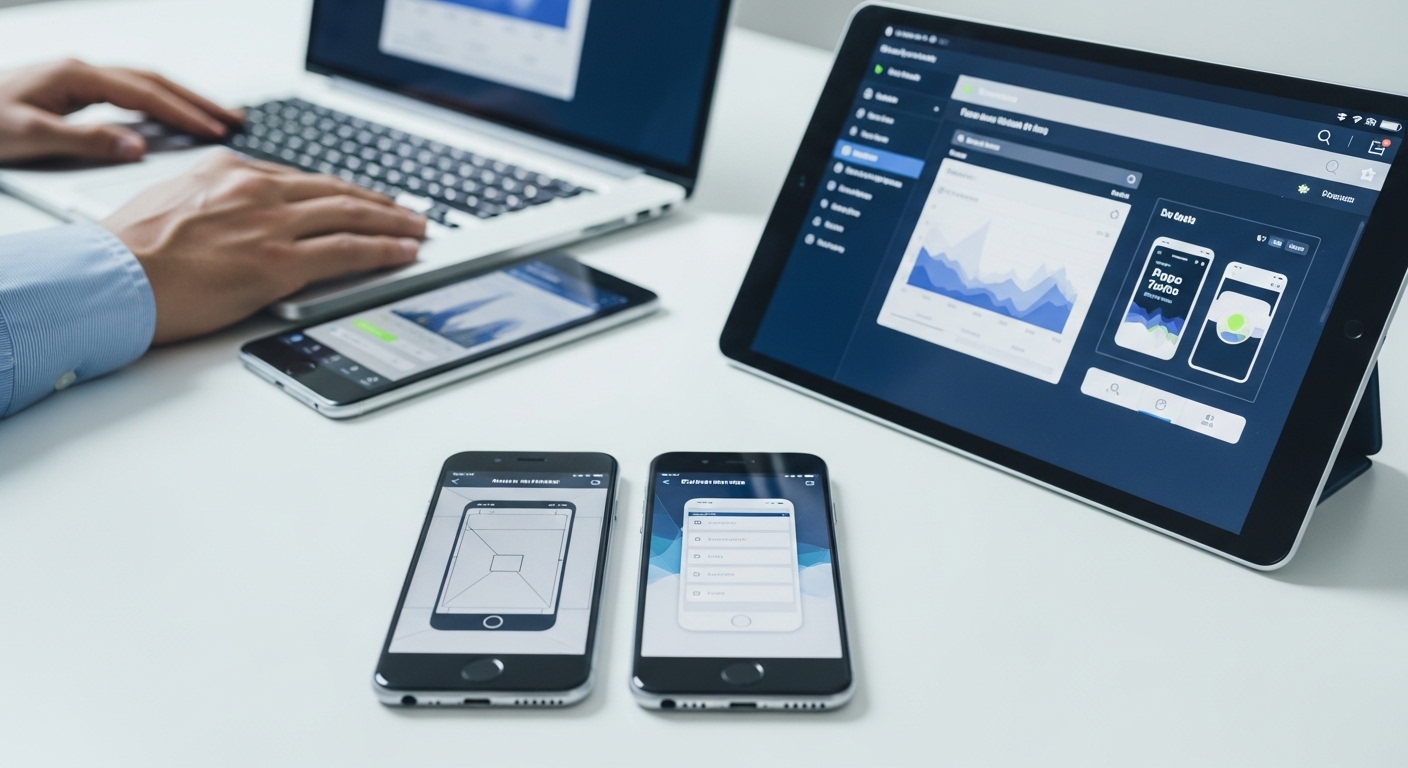
Why your AI built app demo is not a product yet
An AI tool can now generate a working app in an afternoon, which is exactly why the hard part of app development moved rather than vanished. At Google I/O 2026, Google AI Studio gained the ability to build native Android apps from a plain text description, shrinking what used to take weeks of setup and coding into minutes. The press now calls this vibe coding, the practice of generating software by describing what you want in natural language instead of writing the code by hand. Cursor, Replit, Lovable, and Claude Code race in the same direction. For a technology leader who just watched a non engineer produce a running app on a screen share, the question writes itself: why does a real app still take a partner and a budget? The answer sits in what that demo cannot do yet. Google AI Studio previews the app in a browser emulator and lets you load it onto your own phone over a cable. Publishing it to the store, and wiring it to a real backend through Firebase, are listed as capabilities that are coming, not ones that ship today. The demo is real. It is also not a product.

The prototype is the cheap 20 percent
Building was never the bottleneck, and it gets cheaper every quarter. Gartner forecast that by 2025, 70% of new applications would be built with low code or no code tools, up from less than 25% in 2020, and AI app generation extends that curve by removing even the drag and drop step. So a running demo is no longer the milestone that matters. A prototype is software built to prove an idea works. Production software is built to survive real users, real data, and real failure, and the distance between the two is most of the cost. The long understood reality of software is that writing the first version is a minority of total spend, with the rest going to integration, hardening, and maintenance after launch. AI collapses that first slice toward zero. It does not touch the larger one.
Where AI generated apps break on the way to production
The gap is not a matter of polish. It is structural, and it shows up in the same five places almost every time.
- Backend and data integration. A generated app runs against mock data inside an emulator. A real one reads and writes to the systems your business already runs, behind authentication and rate limits the demo never saw. This integration surface is where pilots most often stall.
- Security and access review. Generated code ships with whatever patterns the model learned, secure and insecure alike. Before an app touches customer data, someone has to review how it stores secrets, authenticates users, and handles input it does not trust.
- Store compliance and device fragmentation. Apple and Google reject submissions that miss privacy, permission, or content rules. And the app has to behave across device fragmentation, the wide range of operating system versions, screen sizes, and hardware an app must support, not just the single emulator it was born in.
- Scale and reliability. A demo serves one user, you. Production serves thousands at once, with uptime targets, monitoring, and a plan for the day a dependency fails.
- Maintenance on a moving platform. iOS and Android ship breaking changes every year. An app nobody owns is an app that breaks the next time the platform moves under it.
A framework for deciding which prototypes to productize
Not every AI generated prototype deserves the investment to harden it, and treating all of them as shippable is how budgets get burned. Gartner expects over 40% of agentic AI projects, the ones that run software acting on its own rather than waiting for a prompt, to be canceled by the end of 2027, citing escalating costs, unclear business value, and inadequate risk controls. MIT research tells the same story from the value side: in its GenAI Divide report, 95% of enterprise generative AI pilots delivered no measurable return. The prototypes worth moving forward score high on four questions.
- Stakes. Does the app touch real customers, money, or regulated data? Higher stakes justify the productization work and demand it.
- Integration surface. How many of the systems you already run must it connect to? The more it touches, the less the generated starting point is worth, and the more the engineering decides the outcome.
- Compliance exposure. Does it handle personal data, payments, or anything an auditor will ask about? If yes, store review and security work are not optional.
- Maintenance horizon. Will it still matter in two years? If so, someone has to own it across platform changes. If not, the prototype may be all you ever needed.
An app that scores low on all four may be fine exactly as the AI built it, a throwaway internal tool. An app that scores high is a production engagement wearing a prototype costume, and the real decision is build versus partner, the same call we framed for AI generated code in the AI code rework tax.
Why productizing a prototype is an R&D job
The work the demo skips is precisely the work that decides whether the app survives contact with production, and it is research and engineering work, not staffing hours. Stable Solutions treats the prototype as the start of the validate in production step, not the finish line: we take the generated starting point, then build the integration, security, and platform durability a real deployment needs. That is the same design time discipline behind the placement calls in on device versus cloud AI for mobile, where the cheaper path is getting the hard decisions right before launch rather than re platforming after. AI gives every team a faster first draft. Turning that draft into something your customers can trust is still the job.
Key Takeaways
- AI app builders like Google AI Studio compress app creation from weeks to minutes, but their own roadmaps show publishing and backend integration are still the unfinished part.
- A prototype proves an idea; production software survives real users, data, and failure, and that gap holds most of the cost and risk.
- AI generated apps break on the way to production in five predictable places: backend integration, security review, store compliance and device fragmentation, scale, and maintenance.
- Score each prototype on stakes, integration surface, compliance exposure, and maintenance horizon before deciding to productize it.
- Hardening a high stakes prototype is an R&D engagement, not a staffing task, and the real decision is build versus partner.
Frequently Asked Questions
If AI can build the app, why pay for development at all?
Because the build was never the expensive part. The cost lives in integration, security, store compliance, scale, and years of maintenance, none of which the demo includes. AI lowers the cost of the first draft, not the cost of a product people rely on.
Are AI generated apps safe to ship as is?
Not for anything that touches customer data or money. Generated code reflects the patterns it learned, secure and insecure alike, so it needs the same security and access review any production app gets before launch.
When is an AI generated prototype good enough on its own?
When the stakes are low and the lifespan is short: an internal throwaway tool, a quick proof for a meeting, a test of an idea. The moment real customers, regulated data, or a multi year horizon enter the picture, it needs to be productized.
Sources
- TechCrunch, "Google AI Studio now lets anyone build Android apps in minutes," 2026. Link.
- Gartner, "Gartner Says Cloud Will Be the Centerpiece of New Digital Experiences," 2021. Link.
- Gartner, "Gartner Predicts Over 40% of Agentic AI Projects Will Be Canceled by End of 2027," 2025. Link.
- MIT NANDA, "The GenAI Divide: State of AI in Business 2025," 2025. Link.
Next Steps
If a generated prototype is sitting on a laptop and the question is whether to ship it, the next move is to score it on stakes, integration, compliance, and lifespan, then decide build versus partner. Stable Solutions productizes AI generated app prototypes as an R&D partner, building the integration, security, and platform durability production demands. Explore our App and Web Development work or contact our team to pressure test a prototype before it goes live.