

Why Are AI Integration Costs Rising?
Gartner projects that 75% of enterprises will have AI in production by 2027, up from just 5% in 2023. This 15x increase in demand is driving AI integration costs up by 15-25% annually as competition for AI talent, compute resources, and specialized tooling intensifies across every industry.
The supply-demand imbalance in AI integration services follows a pattern familiar from previous technology cycles like cloud migration, but at a significantly faster pace. Companies that recognize this cost trajectory and act within the current pricing window can lock in implementation economics that will be substantially less favorable within 18-24 months as mainstream adoption reaches its peak.
What Is Driving the Cost Increases?
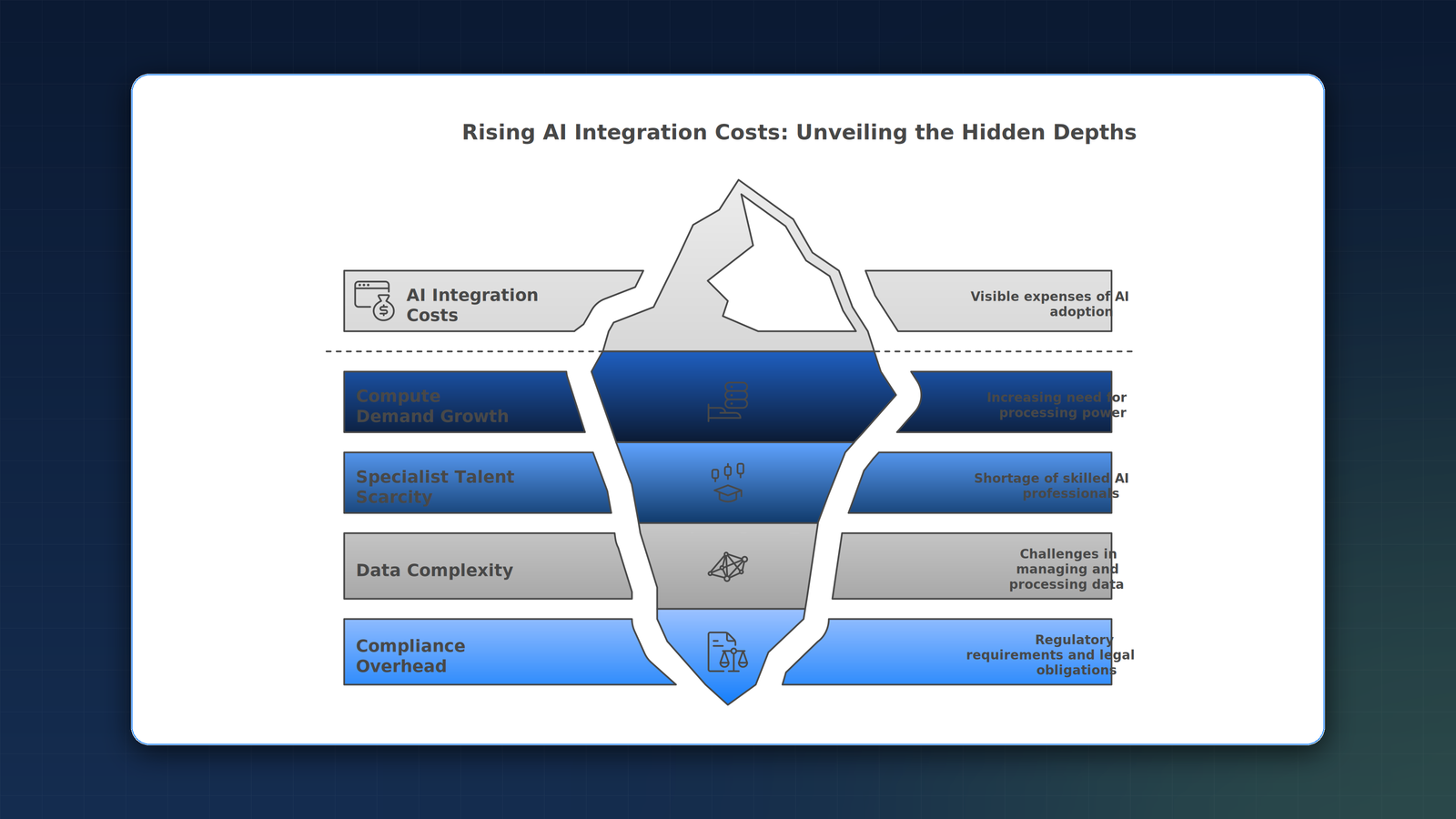
Three primary forces are pushing AI integration costs higher. First, AI talent demand far outstrips supply. The World Economic Forum estimates that 120 million workers globally need reskilling for AI, but the pipeline of qualified AI engineers and data scientists grows at only 10-15% annually. Salaries for senior AI engineers have increased 30-40% since 2024. Second, compute costs are rising as enterprises compete for GPU capacity and cloud AI infrastructure. Third, the consulting and integration market is consolidating, with fewer providers able to deliver enterprise-grade implementations. Deloitte reports that 86% of enterprises are increasing AI budgets in 2026, creating unprecedented demand pressure on a constrained supply of implementation capacity.
"We are in the early innings of an enterprise AI adoption wave that will be larger than cloud migration. The companies securing implementation capacity and talent now are locking in favorable economics that will not be available in 18 months." — Thomas Kurian, CEO, Google Cloud
What Does the Current Pricing Window Look Like?
The current window for favorable AI integration pricing is roughly 2024-2027. During this period, enough specialized providers exist to maintain competitive pricing, open-source tooling reduces infrastructure costs, and early-adopter incentives from major cloud providers offset some implementation expenses. McKinsey data shows early adopters achieving 20-30% cost reductions, while companies implementing after the mainstream adoption wave pay 2-3x more. The pricing dynamics mirror previous technology cycles. Companies that migrated to cloud early (2010-2015) secured significantly better pricing than those who waited until 2018-2022 when demand peaked. AI integration is following the same curve but at a faster pace.
Accenture reinforces the urgency, reporting that 84% of C-suite executives believe they must leverage AI to achieve growth objectives. This near-universal executive recognition of AI's importance is itself a demand signal: as more organizations move from AI exploration to production deployment, the competition for implementation resources will intensify dramatically. PwC's Global CEO Survey adds another dimension, with 45% of CEOs stating their company will not be viable in 10 years without AI transformation. When nearly half of all CEOs view AI as existential, the resulting demand pressure on integration capacity will be unprecedented.
- 2024-2025: Early adopter pricing, abundant provider capacity, cloud incentives
- 2026-2027: Transitional pricing, increasing competition for capacity
- 2028+: Mainstream pricing, premium costs for remaining capacity, limited incentives
How Much Can Companies Save by Acting Now?
The financial case for acting within the current window is compelling. Based on the 15-25% annual cost inflation rate, a $500,000 AI integration project started in 2026 would cost $575,000-$625,000 if delayed to 2027, and $660,000-$780,000 if delayed to 2028. Beyond direct cost savings, early implementation generates ROI sooner. IBM data shows average AI returns of 3.7x, meaning a $500,000 investment generates $1.85 million in value. Every year of delay is not just higher costs; it is $1.85 million in foregone returns. NVIDIA and PwC research reinforces this, showing 40% performance improvements and 5-10% revenue uplift from AI integration, gains that compound with each quarter of operation.
What Should Companies Prioritize in the Current Window?
Given the narrowing window, companies should focus on three priorities. First, secure AI implementation partnerships now, before provider capacity becomes fully subscribed. Second, identify and launch two to three high-impact AI use cases that can demonstrate ROI within 6-12 months. Third, begin building internal AI literacy so the organization can scale AI adoption efficiently once initial projects succeed. Stable Solutions offers AI integration programs designed to maximize the current pricing window while building long-term internal capability. The goal is to establish AI foundations now, when economics are favorable, and scale from a position of experience rather than urgency.
"The smartest move a growth-stage company can make in 2026 is to lock in AI implementation capacity and pricing. The demand curve makes the math unambiguous." — Satya Nadella, CEO, Microsoft
What Happens to Companies That Miss the Window?
Companies that delay AI integration beyond the current window face a three-part penalty. They pay higher implementation costs. They compete against AI-enabled rivals who have already reduced costs and improved performance. And they struggle to attract talent, as top AI professionals prefer organizations with mature AI capabilities. Goldman Sachs projects AI could automate 300 million full-time jobs globally, meaning companies without AI capabilities will face workforce disruption without the tools to manage it. The ITIF data showing a -0.39 correlation between R&D investment and business failure rates underscores the survival implications. BCG data amplifies the competitive urgency, showing that AI-adopting companies grow revenue 2.3x faster than peers. Companies that miss the integration window are not just paying higher costs; they are competing against rivals that have already locked in the revenue growth advantages of mature AI deployment. Harvard Business Review research confirms that companies with dedicated R&D partners ship products 40% faster, suggesting that the partnership model is particularly valuable for organizations seeking to move quickly within the current pricing window.
Key Takeaways
- AI integration costs are rising 15-25% annually as enterprise adoption surges from 5% to 75% (Gartner)
- The favorable pricing window runs roughly 2024-2027, after which mainstream demand will push costs significantly higher
- A $500K project delayed one year costs $75K-$125K more, plus $1.85M in foregone ROI (IBM 3.7x benchmark)
- Securing implementation partnerships and launching pilot projects now locks in favorable economics
- Companies missing the window face higher costs, stronger competitors, and talent disadvantages
Frequently Asked Questions
How much will AI integration cost in 2028 vs. today?
Based on Deloitte's 15-25% annual cost inflation rate, a project costing $500,000 today would cost approximately $660,000-$780,000 in 2028. This accounts for talent cost increases, compute pricing, and reduced provider incentives as demand peaks.
Are cloud provider AI credits and incentives still available?
Yes, major cloud providers (AWS, Google Cloud, Azure) continue to offer early-adopter AI credits and favorable pricing through 2026-2027. These incentives are designed to accelerate enterprise adoption and will phase out as AI becomes standard infrastructure. Harvard Business Review notes that companies with dedicated R&D partners are better positioned to identify and secure these incentives, as partners maintain relationships across the provider ecosystem.
Can open-source AI tools reduce integration costs?
Open-source frameworks reduce infrastructure costs by 20-40%, but implementation, customization, and ongoing maintenance still require skilled teams. The talent shortage affects open-source and proprietary approaches equally, making provider partnerships valuable regardless of technology stack.
What is the minimum viable AI investment to benefit from the current window?
Companies can secure meaningful AI capabilities with $50,000-$150,000 for targeted automation projects. The key is starting now to accumulate experience and data while favorable pricing persists. Contact Stable Solutions for a scoped assessment.
Next Steps
The AI integration pricing window is narrowing. Stable Solutions helps companies maximize this window with accelerated implementation programs that deliver ROI within 90 days. Schedule a consultation to lock in favorable project economics, or explore our capabilities. See also our related analysis on the cost of waiting on AI adoption.