

Why Can You No Longer See Your Brand Inside AI Answers?
Your buyers have stopped reading your website and started reading the answer an AI gives them. Generative engine optimization (GEO) is making a brand more likely to be surfaced and cited inside AI-generated answers, and generative engine optimization measurement is the practice of instrumenting how often, how accurately, and how favorably a brand appears inside the answers produced by AI search engines such as ChatGPT, Perplexity, and Google AI Overviews, then reporting that visibility to the board the way web analytics once reported traffic. Similarweb found that zero-click searches, meaning searches that end on the results page without any click to a website, grew from 56% to 69% between May 2024 and May 2025 after Google launched AI Overviews, the AI-generated summary that sits above the traditional blue links. The demand did not vanish. It moved inside an answer you cannot currently see, and that is the visibility gap most enterprise marketing teams are now flying blind into.
What Is the Difference Between GEO, AEO, and Old SEO?
Three terms matter here. Generative engine optimization (GEO), defined above, is the optimization practice itself. Answer engine optimization (AEO) is the closely related discipline of structuring content so an answer engine, meaning any system that returns a direct synthesized answer rather than a list of links, can extract and reuse it. Classic SEO still ranks pages for human clicks. The mistake is treating this as a content problem. It is a measurement problem first. Conductor analyzed 3.3 billion sessions across more than 13,000 enterprise domains and found that AI referral traffic, meaning visits that land on the site from a link inside an AI answer, is currently just over 1% of total web visits and growing by roughly 1% each month on average. A channel that compounds monthly is not a rounding error you ignore. It is a channel you instrument before your competitors do.
The 5 Metrics: A Generative Engine Optimization Measurement Framework
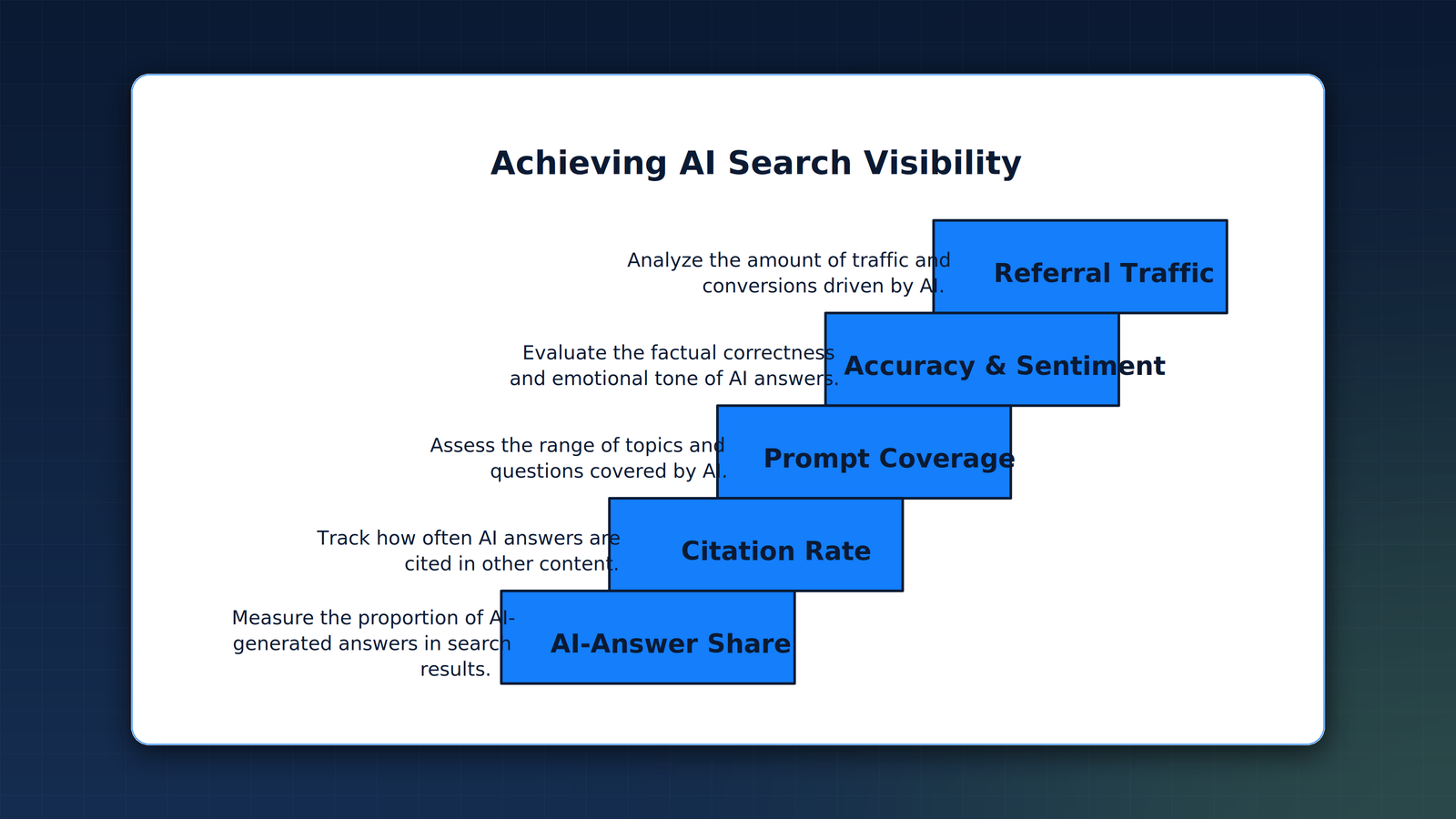
The board does not need another dashboard of vanity metrics. It needs five numbers that answer one question: when a buyer asks an AI about our category, do we show up, are we right, and does it drive pipeline? Install these five.
- AI-answer share-of-voice. Share-of-voice is the percentage of a defined set of buyer prompts where the brand appears or is named versus the total competitive set. Run your 50 to 100 priority prompts across each major answer engine on a fixed cadence and count how often you surface against named rivals. This is the headline board number.
- Citation rate. Citation rate is how often an answer engine names the brand domain as a linked source for its claim. Appearing in the prose is good. Being the cited source is better, because citation is what survives when the model paraphrases. Track cited versus mentioned-only separately.
- Prompt coverage. Prompt coverage is the share of buying-relevant prompts where the brand appears at all, even once. A high share-of-voice on ten prompts while invisible on the other ninety is a coverage hole. Coverage tells you the breadth of the gap before you optimize the depth.
- Mention accuracy and sentiment. This measures whether what the AI says about the brand is factually correct and favorable. An answer engine that confidently states the wrong pricing, the wrong capability, or an outdated claim is actively losing you deals. Score every surfaced mention for accuracy and tone, and treat a confident error as a priority defect, not a footnote.
- AI referral traffic and downstream conversion. Tie that AI referral traffic, currently just over 1% of visits and growing monthly per Conductor, through to pipeline and revenue. ChatGPT drives 87.4% of AI referral traffic, so segment it as its own source and follow it to closed-won, not just to a session count.
Zero-click searches grew from 56% to 69% in a single year after AI Overviews launched. The buyer still has the question. You have simply lost the ability to see your own answer.
Why Is This a Board Conversation, Not a Marketing Tactic?
Because the spend logic has inverted. Google AI Overviews now appear for 25.11% of analyzed keywords, per Conductor, which means a quarter of your category language is already being answered by a machine before a buyer ever forms an opinion of you. When a CMO cannot quantify how the brand appears inside ChatGPT, Perplexity, and Gemini, AI-driven demand is invisible to the board, and invisible demand does not get funded. The fix is not buying more content. It is installing instrumentation, the same shift our SEO analysis on search in the age of AI argued for. Measure first, then optimize against a baseline you can defend in a quarterly review.
Key Takeaways
- Zero-click searches rose from 56% to 69% in a year after AI Overviews launched, so the buying question now ends inside an answer you cannot see (Similarweb).
- AI referral traffic is just over 1% of visits and growing roughly 1% per month, with ChatGPT driving 87.4% of it (Conductor).
- Generative engine optimization measurement means instrumenting five numbers: share-of-voice, citation rate, prompt coverage, accuracy and sentiment, and AI referral conversion.
- Mention accuracy is a defect class, not a vanity metric. A confident AI error about your brand loses deals quietly.
- This is a board-level visibility decision. Report AI-answer share-of-voice the way you once reported web traffic.
Frequently Asked Questions
What is generative engine optimization measurement?
It is the discipline of tracking how often, how accurately, and how favorably your brand appears inside AI-generated answers across engines like ChatGPT, Perplexity, and Google AI Overviews, then reporting that visibility as a board-level metric rather than a marketing afterthought.
How is AI-answer share-of-voice actually calculated?
Define a fixed set of buying-relevant prompts, run them across each answer engine on a regular cadence, and measure the percentage where your brand appears or is cited against the full competitive set. Consistency of the prompt set over time is what makes the trend defensible.
Is this just SEO with a new name?
No. Classic SEO optimizes pages to earn human clicks from a ranked list. GEO and AEO optimize for being surfaced and cited inside a synthesized answer, where there may be no click at all. The measurement layer is different because the unit of visibility is an answer, not a ranking position.
Sources
- Similarweb, "Zero-Click Searches Grew From 56% to 69% Since Google AI Overviews Launched," 2025. Link.
- Conductor, "The 2026 AEO / GEO Benchmarks Report," 2026. Link.
Next Steps
The decision in front of you is whether AI-answer visibility stays invisible to your board or becomes a number you report every quarter. Stable Solutions builds the measurement instrumentation, multi-LLM share-of-voice tracking and an answer-engine visibility dashboard, as a research-driven R&D partner rather than a content vendor. Explore our Digital Growth Strategies or contact our team to baseline where your brand stands inside AI answers today.