

Why Do In-House AI Experiments Fail So Often?
Industry data consistently shows that 70-85% of in-house AI experiments fail to reach production, according to Gartner. The primary cause is not technological limitation but methodological weakness. MIT-trained B2B research partners bring structured research frameworks, cross-industry experience, and rigorous validation processes that dramatically improve AI implementation success rates.
Understanding why in-house experiments fail and what research-trained partners do differently is essential for companies evaluating their AI investment strategy and implementation approach.
What Makes Research Methodology the Difference-Maker?
The gap between in-house experimentation and structured research is methodological rigor. In-house teams typically approach AI with a technology-first mindset: select a tool, run an experiment, and hope for results. Research-trained partners apply the scientific method: define hypotheses, establish baselines, design controlled experiments, validate results statistically, and iterate systematically. This methodological discipline is what MIT and other top research institutions instill over years of training. It is why pharmaceutical companies rely on trained researchers rather than amateur experimentation, and the same principle applies to AI. Deloitte's data showing 66% productivity gains from AI represents the results of structured implementation, not casual experimentation. Organizations pursuing in-house experiments without research methodology are essentially running uncontrolled trials with predictable failure rates. Accenture confirms this assessment, finding that 84% of C-suite executives recognize the need to leverage AI for growth, yet most organizations lack the internal research discipline to translate that recognition into successful implementations. The failure is not one of ambition but of method.
"The difference between an AI experiment and an AI implementation is the same as the difference between anecdotal evidence and a clinical trial. Methodology is what separates signal from noise." — Dr. Andrew McAfee, Co-Director, MIT Initiative on the Digital Economy
What Specific Capabilities Do MIT-Trained Partners Bring?
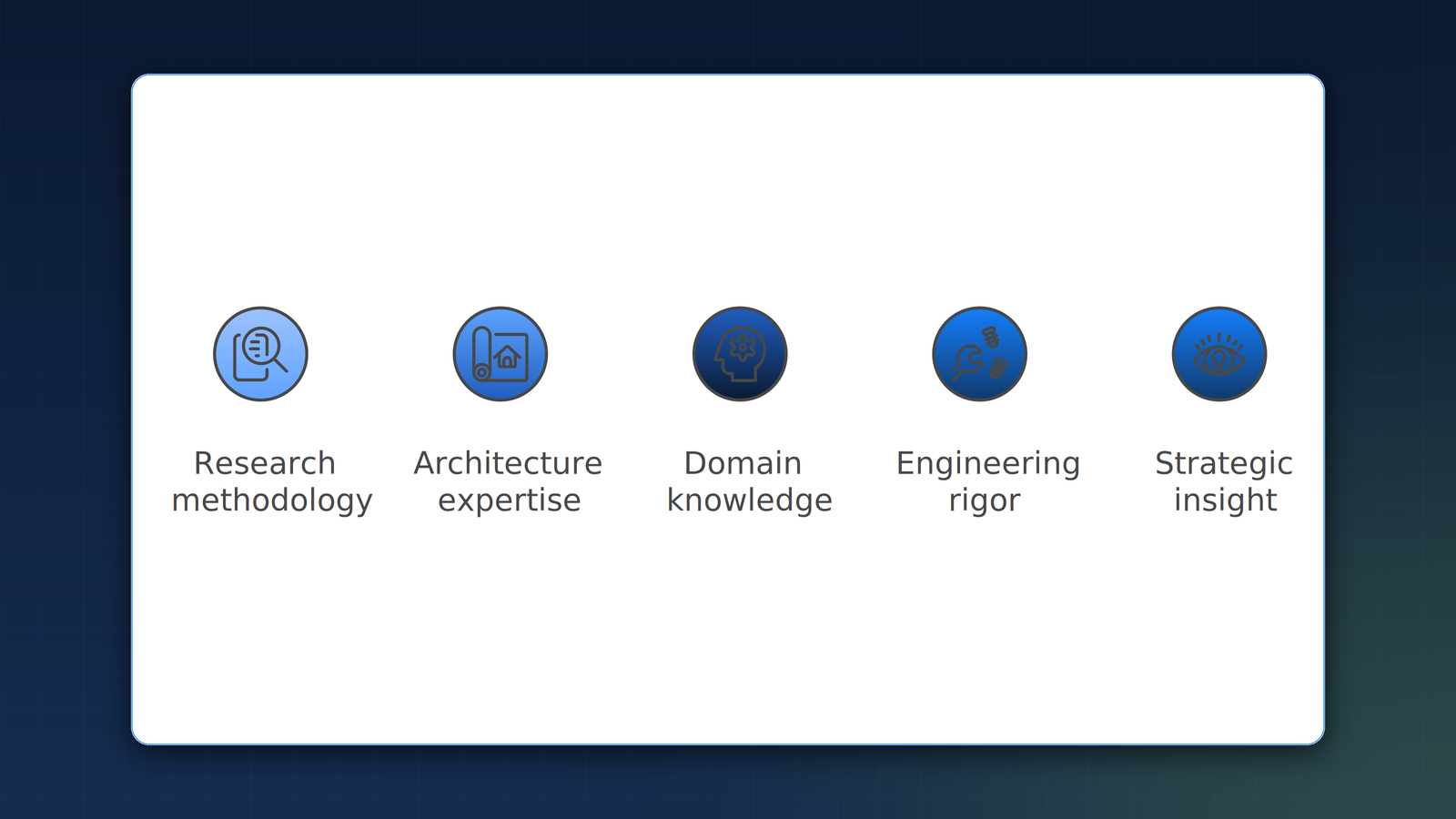
MIT-trained B2B research partners offer five capabilities that in-house teams rarely possess. First, cross-industry pattern recognition from working across multiple domains, enabling them to apply proven solutions from adjacent industries. Second, rigorous evaluation frameworks that prevent overinvestment in low-probability approaches. Third, access to cutting-edge research networks and pre-publication findings that inform implementation strategy. Fourth, structured experimentation methodologies that reduce the cost and time of finding effective solutions. Fifth, calibrated risk assessment based on quantitative evidence rather than organizational politics. IBM's enterprise data showing the gap between 3.7x average and 10.3x top-performer ROI is heavily influenced by implementation methodology. Top performers use research-grade approaches; average performers do not.
- Cross-industry pattern recognition: Solutions proven in adjacent domains
- Rigorous evaluation frameworks: Evidence-based investment decisions
- Research network access: Cutting-edge findings before publication
- Structured experimentation: Lower cost, faster iteration
- Calibrated risk assessment: Quantitative rather than political decision-making
Harvard Business Review research underscores the impact of these capabilities, finding that companies with dedicated R&D partners ship products 40% faster than those relying solely on internal teams. This speed advantage is particularly critical in AI, where the competitive landscape shifts rapidly and the window for establishing first-mover advantage is narrow. BCG data reinforces the point, showing that AI-adopting companies grow revenue 2.3x faster than peers, and companies working with research-trained partners are disproportionately represented among those fast-growth organizations.
How Does the ROI Compare Between In-House and Partner-Led R&D?
The financial case for research partnerships is compelling. Deloitte reports that companies using external R&D partners achieve 30-40% faster time-to-value compared to purely in-house approaches. When combined with higher success rates, the total ROI difference is dramatic. Consider a company investing $500,000 in AI integration. An in-house approach with a 20% success rate (typical for unstructured experimentation) yields an expected value of $100,000 in successful project output. A partner-led approach with a 60% success rate (reflecting structured methodology) yields $300,000 in expected value from the same investment. The ROI advantage of structured research is not marginal; it is transformational. Stable Solutions applies MIT-caliber research methodology to every B2B engagement, ensuring that AI investments deliver measurable, validated returns.
"In our research at MIT, we consistently find that organizations applying rigorous experimental methodology to AI implementation see 2-3x higher success rates. The methodology is not optional; it is the primary determinant of outcomes." — Erik Brynjolfsson, Director, Stanford Digital Economy Lab (former MIT)
When Should Companies Choose Partners Over In-House R&D?
The decision framework is straightforward. Choose in-house R&D when you have deep domain expertise in the specific AI application, a team with research methodology training, clean and accessible data, and a timeline that allows for multiple iteration cycles. Choose a research partner when you need to move faster than in-house experimentation allows, when the AI application crosses domain boundaries, when the stakes are high enough that failure is costly, or when your team lacks research methodology experience. Most growth-stage companies find that a hybrid model works best: partner for initial implementation and methodology transfer, then build in-house capability over time. This approach captures the speed and success rate advantages of partnerships while building long-term internal competency.
What Results Should Companies Expect from Research-Grade AI Implementation?
Research-grade AI implementation consistently outperforms ad hoc approaches across every metric. Success rates increase from 15-30% to 50-70%. Time-to-value decreases by 30-40% (Deloitte). ROI improves from below-average (1-2x) to top-quartile (5-10x based on IBM benchmarks). Companies working with experienced AI research partners report higher confidence in scaling successful pilots because the methodology ensures that results are reproducible, not accidental. NVIDIA and PwC data showing 40% performance improvements and 5-10% revenue uplift reflects what structured, research-grade implementation achieves.
Key Takeaways
- 70-85% of in-house AI experiments fail to reach production, primarily due to methodological weakness (Gartner)
- Research-trained partners bring structured experimentation, cross-industry patterns, and rigorous validation
- Partner-led R&D achieves 30-40% faster time-to-value and 2-3x higher success rates than unstructured in-house approaches
- The hybrid model (partner for initial implementation, build in-house over time) optimizes for both speed and long-term capability
- Research-grade methodology is the primary determinant of AI implementation outcomes, not technology choice
Frequently Asked Questions
Why is the in-house AI failure rate so high?
The primary cause is methodological weakness, not technological limitation. Gartner identifies three specific drivers: lack of research methodology (treating AI as a technology problem rather than a research problem), insufficient data preparation (underestimating the effort required for clean training data), and misaligned success metrics (optimizing for technical performance rather than business outcomes).
What makes MIT-trained researchers different from general AI consultants?
MIT-trained researchers bring hypothesis-driven methodology, statistical rigor, and experience with peer-reviewed validation processes. General AI consultants often bring technology expertise without the experimental discipline that determines whether implementations succeed at scale. PwC's Global CEO Survey highlights this distinction, with 45% of CEOs acknowledging that their company's viability depends on transformation quality, not just transformation speed.
How long does a typical research-partner AI engagement take?
Initial pilot projects typically run 8-16 weeks, with measurable results within the first 6-8 weeks. Full implementation programs span 6-12 months, including methodology transfer and internal capability building. Contact Stable Solutions for engagement scoping.
Can research partnerships work for small companies?
Absolutely. Research partnerships are often more valuable for smaller companies because they provide access to capabilities that would be impossible to build in-house. The ITIF -0.39 correlation between R&D intensity and business failure applies to companies of all sizes. See our analysis on how SMBs can compete with enterprise R&D budgets through strategic partnerships.
Next Steps
Stop experimenting and start researching. Stable Solutions brings MIT-caliber research methodology to every B2B AI engagement, delivering success rates 2-3x higher than in-house approaches. Schedule a consultation to discuss how structured research methodology can transform your AI outcomes, or explore our capabilities.