

Can SMBs Really Compete with Enterprise R&D Budgets?
While the National Science Foundation reports $722 billion in total U.S. R&D spending, the majority is concentrated in large enterprises. However, ITIF data showing a -0.39 correlation between R&D intensity and business failure applies equally to small businesses. SMBs that invest strategically in R&D, even with smaller budgets, achieve comparable innovation outcomes through focus, partnerships, and agility.
The question is not whether SMBs can afford to invest in R&D, but whether they can afford not to. The following sections break down the strategies that allow resource-constrained companies to compete effectively with enterprise-level innovation programs.
What Advantages Do SMBs Have in R&D?
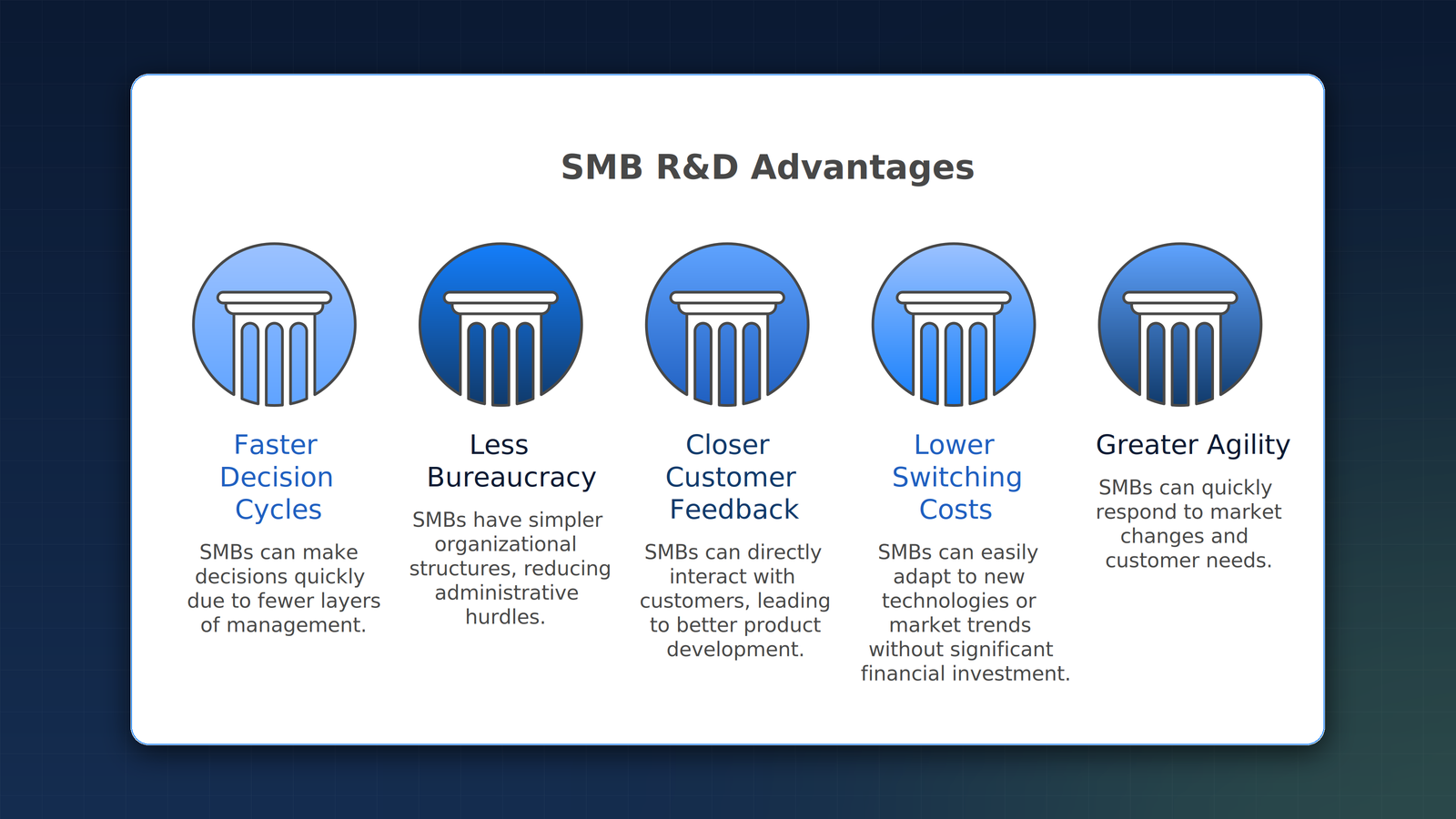
Small businesses possess structural advantages that large enterprises cannot replicate. Decision-making speed is the most significant: SMBs can move from concept to prototype in weeks, while enterprises often require months of approval processes. This speed advantage compounds when combined with customer proximity. SMBs typically have direct relationships with their customers, enabling faster feedback cycles and more targeted innovation. Research from the Small Business Administration shows that small firms produce 16 times more patents per employee than large firms. The key is not spending more, but spending smarter. Where enterprises must invest across broad portfolios, SMBs can concentrate resources on specific high-impact opportunities where they have domain expertise and customer insight.
"Small companies do not need to outspend their larger competitors. They need to out-focus them. A $200,000 R&D investment targeted at a specific customer problem will outperform a $2 million investment spread across a dozen initiatives." — Steve Blank, Serial Entrepreneur and Stanford Professor
How Can SMBs Structure Their R&D Investment?
The most effective SMB R&D strategy follows a 70-20-10 allocation model. Seventy percent goes to applied research directly tied to current customer needs and product improvements. Twenty percent goes to adjacent innovation, exploring nearby market opportunities and technology extensions. Ten percent goes to exploratory research, investigating emerging technologies that could create future competitive advantages. This allocation ensures immediate product improvement while maintaining a pipeline of future innovations. For a company investing $300,000 annually in R&D, this translates to $210,000 in direct product improvement, $60,000 in market expansion research, and $30,000 in technology exploration including AI integration opportunities.
- 70% applied research: Direct product and service improvements tied to customer needs
- 20% adjacent innovation: Nearby market opportunities and technology extensions
- 10% exploratory research: Emerging technologies and future competitive positioning
How Do R&D Partnerships Level the Playing Field?
R&D partnerships are the single most powerful lever SMBs have for competing with enterprise innovation budgets. By partnering with specialized research firms, SMBs access enterprise-grade talent, tools, and methodologies at a fraction of the cost of building in-house teams. Deloitte research indicates that companies using external R&D partners achieve 30-40% faster time-to-value compared to purely in-house approaches. For SMBs, this advantage is even more pronounced because they are accessing capabilities they could not afford to build internally. A dedicated B2B research partner like Stable Solutions provides the depth of expertise that typically requires a team of 5-10 specialists, available on a project basis rather than as permanent overhead. McKinsey data confirms that the most innovative SMBs leverage partner ecosystems rather than trying to build everything internally. BCG research provides additional evidence, showing that AI-adopting companies grow revenue 2.3x faster than peers regardless of company size. For SMBs, the partnership model is the most efficient path to AI adoption because it provides access to the research methodology, implementation experience, and technical infrastructure that would cost millions to build internally. Harvard Business Review data reinforces this finding, noting that companies with dedicated R&D partners ship products 40% faster, an advantage that is proportionally more impactful for resource-constrained small businesses.
"The SMBs that are disrupting their industries are not the ones with the biggest R&D budgets. They are the ones with the smartest R&D partnerships. Access to specialized expertise is more valuable than headcount." — Clayton Christensen (legacy research), Harvard Business School
What R&D Tax Incentives Are Available to SMBs?
Small businesses have access to significant R&D funding sources that many overlook. The federal R&D tax credit allows qualifying businesses to offset 6-8% of qualified research expenditures against payroll taxes. The NSF Small Business Innovation Research (SBIR) program provides grants of $275,000 to $1 million for qualified projects. State-level R&D credits vary but can add another 3-10% in tax savings. Many SMBs undercount their qualifying R&D activities. Software development, process improvement experiments, product testing, and even certain types of market research can qualify for R&D credits. A proper R&D tax study typically uncovers $50,000-$200,000 in annual credits that SMBs have been leaving on the table. PwC's Global CEO Survey, while focused on larger enterprises, contains lessons for SMBs: 45% of CEOs believe their company will not survive without AI transformation. For small businesses, the combination of R&D tax incentives, grant funding, and strategic partnerships makes the financial barrier to meaningful innovation lower than most founders assume.
How Can SMBs Build Long-Term R&D Capability?
Building sustainable R&D capability requires a phased approach. In year one, focus on establishing R&D partnerships and launching two to three targeted projects that demonstrate ROI. Use early wins to build internal support for increased R&D investment. In year two, begin developing internal R&D competency by hiring one to two specialists and transitioning routine research in-house while maintaining partnerships for specialized work. By year three, the SMB should have a hybrid R&D model combining internal capability with strategic partnerships, supported by R&D tax credits and potentially grant funding. The ITIF data is clear: sustained R&D investment correlates with business resilience regardless of company size.
Key Takeaways
- SMBs produce 16x more patents per employee than large firms, proving focus beats budget (SBA)
- The 70-20-10 R&D allocation model balances immediate improvement with future innovation
- R&D partnerships provide enterprise-grade capabilities at a fraction of in-house team costs
- R&D tax credits and SBIR grants can fund 15-30% of total R&D expenditure for qualifying SMBs
- A phased approach to R&D capability building reduces risk while compounding innovation advantage
Frequently Asked Questions
What is the minimum R&D budget for a small business to be competitive?
Research suggests investing at least 2x your industry average R&D intensity. For most SMBs, this translates to $100,000-$500,000 annually. Strategic partnerships and tax credits can stretch this budget significantly. Even $50,000 invested in a focused R&D project can yield meaningful competitive advantages.
How do SMBs choose the right R&D partner?
Look for partners with relevant domain expertise, a track record of working with companies at your stage, and a collaborative approach that builds your internal capability alongside delivering external results. MIT-trained partners with B2B research experience offer the strongest combination of rigor and practical business focus.
Should SMBs focus R&D on AI specifically?
AI should be a component of R&D strategy, not the entirety. IBM data shows 3.7x average ROI on AI investments, making it a high-value R&D allocation. But the best SMB R&D programs address specific customer problems first and deploy AI as a tool within that context. See our analysis on AI integration ROI.
How do R&D partnerships differ from consulting engagements?
R&D partnerships involve shared risk, iterative collaboration, and capability transfer. Consulting engagements typically deliver recommendations. A true R&D partner works alongside your team, builds prototypes, tests hypotheses, and transfers knowledge so your internal capability grows over time.
Next Steps
Ready to build an R&D strategy that competes with enterprise budgets? Stable Solutions specializes in helping growth-stage companies maximize innovation per dollar through strategic R&D partnerships. Contact us for a complimentary R&D strategy session, or explore our capabilities to see how we help SMBs punch above their weight in innovation.