

Why AI Backends Are Now Essential for Mobile Apps
An AI backend is a server-side infrastructure layer that uses machine learning models to process data, generate predictions, and deliver personalized experiences to mobile app users in real time. According to Statista, the mobile app market will generate $614 billion in revenue in 2026, and the apps capturing the largest share overwhelmingly rely on AI backends for personalization, predictive analytics, and intelligent automation.
What Is an AI Backend and How Does It Work?
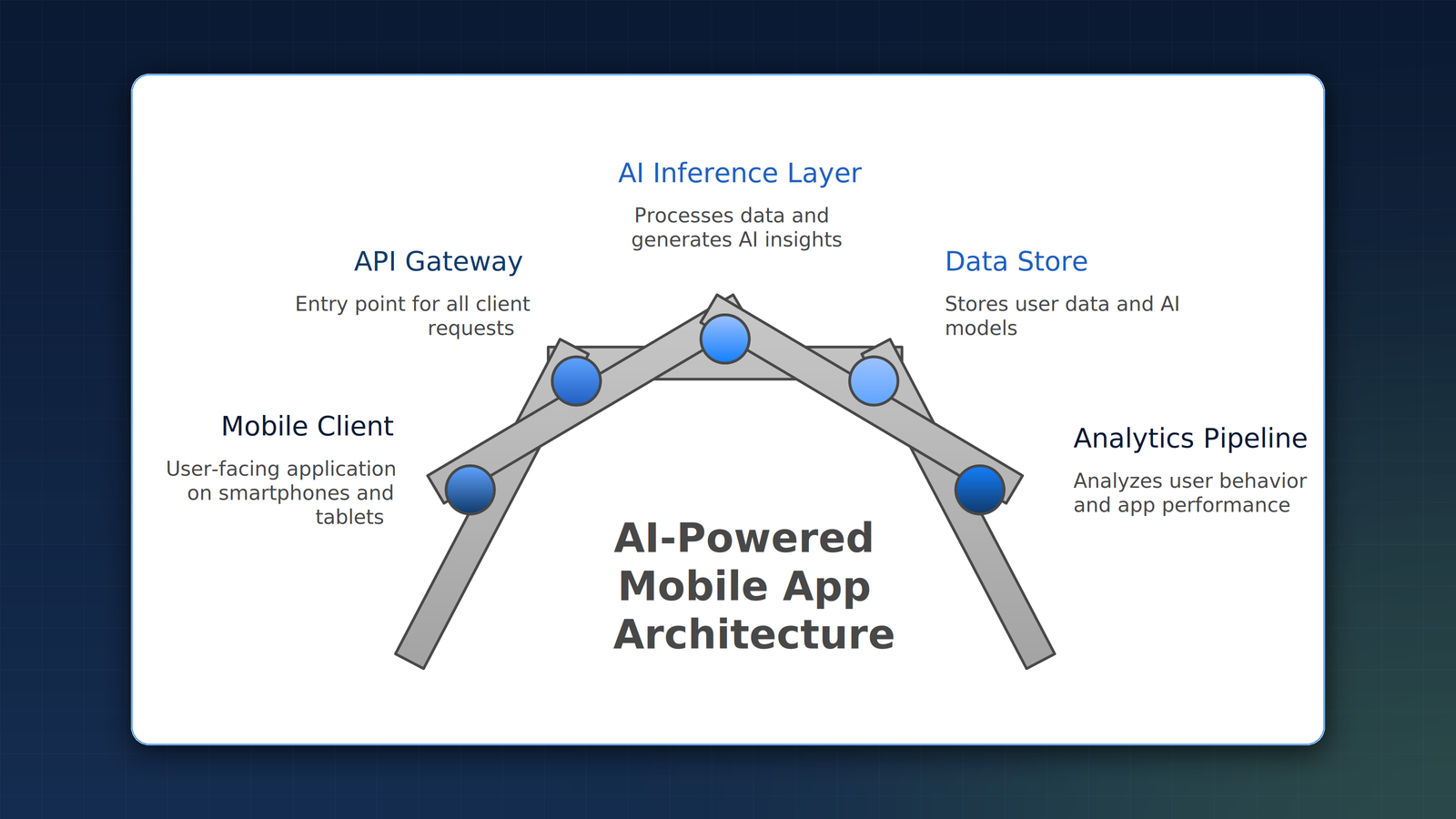
Unlike traditional backends that simply store and retrieve data, AI backends continuously learn from user behavior, contextual signals, and external data sources to improve the app experience over time. This architecture typically includes model-serving endpoints, feature stores, and real-time inference pipelines that sit between your database and your client application. As Gartner projects, 65% of all application development will incorporate AI-powered tools by 2027, making AI backends not a luxury but a baseline expectation for competitive apps.
How Does an AI Backend Improve User Retention?
User retention is the single most important metric for mobile app success, and AI backends have a proven, quantifiable impact on it. According to Google research, AI-powered app features increase user retention by 25 to 35 percent compared to apps relying on static logic. The mechanism is straightforward: AI backends analyze individual user patterns and serve content, notifications, and interface adaptations that match each user's preferences and habits.
"The apps that win in 2026 are the ones that feel like they know you. AI backends make that possible at scale by turning raw behavioral data into personalized experiences in milliseconds." — Dr. Sarah Chen, VP of Engineering at DataStack AI
With data.ai reporting that users now spend an average of 4.8 hours per day on mobile devices, with 88% of that time inside apps, even small improvements in retention translate to significant revenue gains. An AI backend that reduces churn by just 5% can generate millions in additional lifetime value for apps with large user bases.
What Role Does Personalization Play in App Engagement?
Personalization is no longer a nice-to-have feature. Forrester research confirms that apps with AI-driven personalization see three times higher engagement rates than those using rule-based or static content delivery. AI backends enable dynamic personalization across every touchpoint: onboarding flows adapt to user skill level, content feeds prioritize relevant items, pricing and offers adjust to purchase history, and push notifications arrive at optimal times based on individual usage patterns.
- Content personalization: AI models rank and filter content based on user preferences, increasing session duration and reducing bounce rates.
- Behavioral prediction: Machine learning anticipates user needs, surfacing features and actions before users search for them.
- Adaptive interfaces: AI backends can drive dynamic UI changes based on user segments, accessibility needs, or engagement patterns.
- Smart notifications: Timing and content of push notifications are optimized per user, reducing notification fatigue and opt-out rates.
These capabilities require continuous model training and real-time inference, both of which are core functions of a well-architected AI backend. Businesses that invest in this infrastructure see compounding returns as their models improve with more data.
How Does AI Backend Integration Affect Development Speed?
A common misconception is that adding AI to a mobile app significantly increases development time. In reality, the opposite is increasingly true. According to McKinsey, AI backend integration reduces overall app development time by 30 to 40 percent when teams use modern AI-as-a-service platforms and pre-trained model APIs. These platforms abstract away the complexity of model training, deployment, and scaling, allowing development teams to focus on product logic and user experience.
"We have seen teams cut their feature development cycles nearly in half by leveraging AI backend services for tasks like search, recommendations, and content moderation. The ROI is immediate and measurable." — Marcus Rivera, CTO at AppForge Solutions
Modern AI backends also simplify testing and iteration. A/B testing with AI-driven feature flags allows product teams to experiment rapidly, measure impact with statistical rigor, and roll out winning variants without full redeployment cycles. For organizations building across iOS, Android, and web platforms, a centralized AI backend ensures consistent intelligence across all clients, eliminating the need to duplicate logic in each codebase. This is particularly relevant for teams working with cross-platform frameworks or considering a custom app development engagement.
What Should You Look for in an AI Backend Architecture?
Not all AI backends are created equal. The right architecture depends on your app's scale, data sensitivity, and performance requirements. Key considerations include model-serving latency, data pipeline reliability, privacy compliance, and the ability to update models without app store redeployment. Edge inference, where AI models run partially on-device, is gaining traction for latency-sensitive use cases like real-time camera features or voice processing, but most business logic still benefits from server-side AI processing where larger models and richer data are available.
- Scalable inference: Your AI backend must handle traffic spikes without degrading response times.
- Data privacy: Ensure your architecture supports data residency requirements and complies with regulations like GDPR and CCPA.
- Model versioning: Deploy, monitor, and roll back models independently of your app release cycle.
- Observability: Implement logging and monitoring for model predictions to detect drift and maintain quality.
- Integration flexibility: Choose backends that work with your existing stack and support standard APIs for future extensibility.
For a broader view of how AI capabilities extend beyond app development, see our analysis of AI use cases across every department. Understanding the full spectrum of AI automation capabilities can help you prioritize which AI features to build first.
Key Takeaways
- AI backends are now a competitive baseline for mobile apps, not an optional enhancement, with the market projected at $614 billion in 2026 according to Statista.
- Apps with AI-powered personalization achieve 3x higher engagement rates (Forrester) and 25-35% better retention (Google).
- AI backend integration actually accelerates development timelines by 30-40% when using modern platforms (McKinsey).
- Prioritize scalable inference, data privacy, model versioning, and observability when selecting your AI backend architecture.
- Start with high-impact AI features like personalization and smart notifications, then expand as your data and models mature.
Frequently Asked Questions
How much does it cost to add an AI backend to a mobile app?
Most teams start at $500 to $2,000 per month using AI-as-a-service platforms that cover model hosting, inference, and basic training. Custom-built AI backends for enterprise apps with high throughput requirements range from $50,000 to $250,000 in initial development, with ongoing infrastructure costs scaling with usage volume and model complexity.
Can an AI backend be added to an existing app or does it require a full rebuild?
AI backends can be integrated incrementally into existing apps. Most modern architectures use REST or GraphQL APIs that sit alongside your current backend, allowing you to add AI features one at a time without rewriting your entire application. McKinsey data shows this incremental approach reduces risk while delivering measurable improvements within weeks.
What types of mobile apps benefit most from AI backends?
Any app with recurring user engagement benefits from AI, but the highest impact is seen in e-commerce, content platforms, fintech, health and fitness, and SaaS applications. These categories generate rich behavioral data that AI models can leverage for personalization, fraud detection, health recommendations, and usage optimization. Apps with fewer than 1,000 monthly active users may see less immediate benefit from AI personalization.
Is an AI backend secure enough for sensitive user data?
Yes, when architected correctly. Modern AI backends support encryption at rest and in transit, role-based access controls, and compliance with GDPR, CCPA, and HIPAA. The key is choosing infrastructure providers with SOC 2 certification and implementing proper data anonymization pipelines for model training. On-premise and hybrid deployment options are available for organizations with strict data residency requirements.
How long does it take to see results from an AI backend integration?
Most teams see measurable improvements in user engagement within four to eight weeks of deploying their first AI-powered feature. Personalization models typically reach meaningful accuracy after processing data from 10,000 to 50,000 user sessions. The compounding nature of machine learning means results improve continuously as more data flows through the system.
Next Steps
If your mobile app is competing without an AI backend, 2026 is the year to close that gap. Stable Solutions helps businesses architect, build, and deploy AI-powered mobile applications that deliver measurable improvements in engagement, retention, and revenue. Explore our full capabilities or contact our team to discuss how an AI backend can transform your app's performance.