

How Much Is Technology Debt Really Costing Your Business?
McKinsey estimates that technology debt consumes 20-40% of engineering capacity at the average enterprise, equivalent to losing one in every three to five engineers to maintenance rather than innovation. A dedicated R&D partner transforms this drag into competitive advantage by systematically converting legacy liabilities into modern, AI-ready infrastructure that generates returns rather than costs.
For companies carrying significant legacy system burden, understanding the true cost of technology debt and the structured path to remediation is the first step toward turning a liability into a strategic asset.
Why Does Technology Debt Accumulate and Why Is It Dangerous?
Technology debt accumulates through rational short-term decisions that create long-term liabilities. Every shortcut taken to meet a deadline, every deferred upgrade, and every workaround that becomes permanent adds to the debt balance. The danger is not the debt itself but its compounding nature. Like financial debt, technology debt accrues interest. Outdated systems become harder and more expensive to maintain. Integration with new tools becomes increasingly complex. Security vulnerabilities multiply. And engineering teams spend progressively more time on maintenance and less on innovation. Gartner projects that by 2027, 75% of enterprises will have AI in production. Companies carrying heavy technology debt will find AI integration 3-5x more expensive and time-consuming than those with modern infrastructure, creating a double disadvantage: higher costs and later adoption.
The scale of the problem is staggering when viewed in financial terms. For a company with 50 engineers averaging $175,000 in fully loaded costs, 30% technology debt translates to $2.6 million annually spent on maintenance rather than innovation. Accenture reports that 84% of C-suite executives believe they must leverage AI to achieve growth objectives, yet technology debt prevents many of these same organizations from acting on that conviction. The compounding effect means that every quarter of delayed remediation increases the total cost of modernization by 10-15%, as legacy systems become further entangled with newer components built on top of them.
"Technology debt is the silent killer of innovation. Companies do not notice it accumulating until it is consuming 40% of their engineering capacity. By then, the cost of remediation has grown exponentially." — Martin Fowler, Chief Scientist, ThoughtWorks
How Does a Dedicated R&D Partner Address Technology Debt Differently?
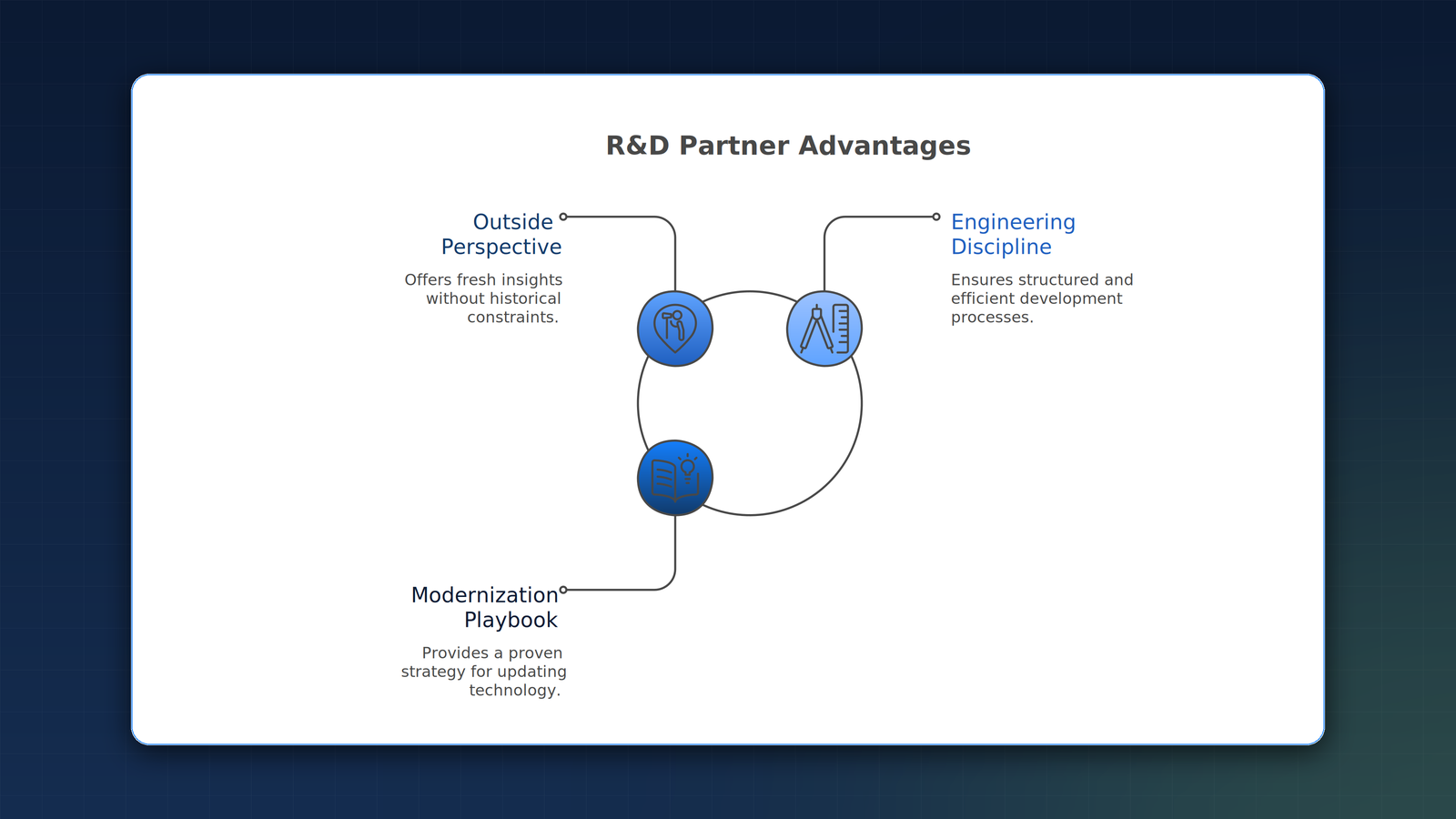
Internal teams typically address technology debt reactively, fixing things when they break or when the pain becomes unbearable. A dedicated R&D partner brings three advantages to technology debt remediation. First, objectivity. Internal teams have emotional attachments to systems they built and political constraints that make honest assessment difficult. External partners evaluate technology debt purely on business impact and remediation cost. Second, cross-industry perspective. Having worked across multiple organizations, R&D partners recognize patterns of technology debt and apply proven remediation strategies rather than reinventing solutions. Third, dedicated capacity. Internal engineering teams are perpetually torn between feature development and debt reduction. A dedicated partner provides focused capacity for debt remediation without competing with product roadmap priorities. Deloitte data showing 30-40% faster time-to-value for partner-led projects applies directly to technology debt remediation.
Harvard Business Review research reinforces this advantage, finding that companies with dedicated R&D partners ship products 40% faster than those relying solely on internal teams. When applied to technology debt remediation, this acceleration means that modernization projects that would take 18 months internally can be completed in 10-12 months with partner support. The faster timeline is not just about convenience; it directly impacts competitive positioning. Every month spent in remediation is a month where competitors with cleaner infrastructure are deploying AI capabilities and capturing market share. BCG data shows that AI-adopting companies grow revenue 2.3x faster than peers, making the speed of debt remediation a direct determinant of revenue trajectory.
What Does the Technology Debt to Competitive Advantage Transformation Look Like?
The transformation follows a structured four-phase process. Phase one is assessment: cataloging all technology debt, quantifying its business impact, and prioritizing by remediation ROI. Phase two is architecture: designing a modern, modular architecture that addresses current debt while preventing future accumulation. Phase three is migration: systematically converting legacy systems to modern infrastructure, starting with highest-ROI components. Phase four is optimization: integrating AI and automation capabilities that the modern architecture enables, turning what was a liability into a competitive advantage. The key insight is that technology debt remediation should not just restore neutral functionality; it should leapfrog to AI-ready infrastructure that generates competitive advantage.
- Phase 1 — Assessment: Catalog debt, quantify impact, prioritize by ROI (4-6 weeks)
- Phase 2 — Architecture: Design modern, modular, AI-ready infrastructure (4-8 weeks)
- Phase 3 — Migration: Systematic conversion starting with highest-ROI components (3-9 months)
- Phase 4 — Optimization: AI and automation integration on modern infrastructure (ongoing)
PwC's Global CEO Survey found that 45% of CEOs believe their company will not be viable in 10 years without AI transformation. For companies burdened by technology debt, this transformation is impossible without first modernizing the underlying infrastructure. The four-phase approach ensures that remediation is not just a cleanup exercise but a strategic repositioning that enables the AI capabilities essential for long-term viability. Each phase builds on the previous one, creating measurable value at every step rather than requiring a risky big-bang migration.
What ROI Can Companies Expect from Technology Debt Remediation?
The ROI of systematic technology debt remediation is substantial and measurable. Companies that reduce technology debt from 40% to 15% of engineering capacity effectively gain 25 percentage points of engineering output, equivalent to a 60% increase in productive engineering capacity without hiring. At average engineering costs of $150,000-$200,000 per year per engineer, a team of 20 recovers $750,000-$1,000,000 in productive capacity annually. IBM's benchmark data suggests that companies with modern, AI-ready infrastructure achieve closer to the 10.3x top-performer ROI on AI investments versus the 3.7x average, because clean infrastructure enables faster, more effective AI deployment. NVIDIA and PwC's 40% performance improvement from AI integration is only achievable when the underlying infrastructure supports it.
"The companies we see achieving top-quartile AI returns almost universally addressed their technology debt first. You cannot build AI capabilities on a foundation of legacy spaghetti. The infrastructure investment pays for itself through AI enablement." — Dr. Priya Sharma, AI Strategy Lead, Deloitte Consulting
How Can Companies Get Started on Technology Debt Transformation?
Start with a comprehensive technology debt audit that quantifies the business impact of each debt category. This audit should produce a prioritized remediation roadmap with clear ROI projections for each phase. The most effective approach is partnering with a dedicated R&D firm that brings both the assessment methodology and the implementation capability. AI integration should be planned as part of the remediation architecture from day one, ensuring that debt reduction directly enables competitive capability rather than simply returning to neutral. The NSF reports $722 billion in total U.S. R&D spending, and an increasing share is directed at modernization and AI-readiness. Companies that align their technology debt remediation with this broader R&D investment trend position themselves for sustained competitive advantage.
Key Takeaways
- Technology debt consumes 20-40% of engineering capacity at the average enterprise (McKinsey)
- Debt compounds over time, making AI integration 3-5x more expensive for companies with heavy legacy systems
- Dedicated R&D partners bring objectivity, cross-industry perspective, and focused capacity that internal teams lack
- Systematic remediation can recover 60% of engineering capacity currently lost to maintenance
- Technology debt remediation should target AI-ready infrastructure, turning a liability into competitive advantage
Frequently Asked Questions
How do you quantify technology debt?
Technology debt is measured across four dimensions. These are maintenance cost (percentage of engineering time spent on upkeep), integration friction (time and cost to connect new tools), security exposure (number and severity of vulnerabilities), and opportunity cost (features and capabilities that cannot be built on current infrastructure). McKinsey's 20-40% capacity figure captures the maintenance dimension.
How long does technology debt remediation take?
A comprehensive technology debt transformation typically takes 6-18 months depending on system complexity. The phased approach (assess, architect, migrate, optimize) allows companies to realize incremental value at each stage rather than waiting for a complete overhaul. Quick wins in the first 3 months build momentum and organizational support.
Can you reduce technology debt while maintaining product development velocity?
Yes, and this is precisely why a dedicated R&D partner is valuable. Internal teams must choose between debt reduction and feature development. A partner provides parallel capacity specifically for debt remediation, allowing the internal team to maintain product velocity. Deloitte reports this parallel approach achieves 30-40% faster outcomes. See our Build vs. Buy vs. Partner framework.
What is the relationship between technology debt and AI readiness?
Technology debt and AI readiness are inversely correlated. Heavy technology debt means fragmented data, rigid architectures, and maintenance-focused engineering teams, all of which impede AI integration. Companies that address technology debt as a pathway to AI readiness see compounding returns: lower maintenance costs plus higher AI ROI (IBM 3.7x-10.3x benchmark).
Next Steps
Stop paying interest on technology debt and start converting it into competitive advantage. Stable Solutions provides dedicated R&D partnership for technology debt assessment, remediation, and AI-ready modernization. Contact us for a technology debt audit, or explore our capabilities to see how we transform legacy liabilities into modern competitive assets.