

Why Agentic Marketing Is Now a Governance Problem, Not a Tooling One
Your martech stack (the marketing technology platforms your team runs, from your CRM to your content and campaign tools) is filling with autonomous marketing agents faster than anyone can govern them, and the bill for that gap is coming due. Gartner predicts that over 40% of agentic AI projects will be canceled by the end of 2027, citing escalating costs, unclear business value, and inadequate risk controls. The differentiator for a CMO in 2026 is not which agents you buy. It is the operating model and guardrails you install before scaling a fleet of them.
First, the terms, because they get used loosely. An AI agent is software that pursues a goal across multiple steps with some autonomy, deciding what to do next rather than following a fixed script. Agentic marketing is the use of those agents to plan, produce, and run marketing work, from drafting campaigns to routing approvals to optimizing spend, with limited human involvement per task. The capability is real and arriving fast. The layer underneath it is what most organizations lack.
The Buying Is Outrunning the Governance
The market signal this month is hard to miss. Gradial, an enterprise agentic-marketing platform, raised 65 million dollars in a Series C round led by Insight Partners, on the thesis that agents should orchestrate work across your existing marketing tools. In the same week, WPP Enterprise Solutions signed a multi-year strategic collaboration with AWS to operationalize agentic AI across brand marketing stacks. Capital and the largest agencies are both betting that autonomous agents become the default way marketing gets done.
The demand side is not keeping pace on governance. In a Boston Consulting Group survey of 300 CMOs across B2C and B2B, 90% said generative AI is already reshaping how consumers discover and evaluate brands, yet only 8% run campaigns where multiple agents operate autonomously, and 42% still use generative AI only to assist with individual tasks. The gap between belief and operating reality is the exposure. Agents enter the stack one tool at a time, each sold on its own merits, with no shared owner, no shared guardrail, and no shared definition of done.
The risk is not a single rogue agent. It is a fleet of them, bought separately, accountable to no one, that a CMO cannot defend to the board on either spend or risk.
What a CMO Cannot Currently Answer
Put the uncomfortable questions on the table, because the board eventually will. Who owns the marketing agents as a portfolio. What is each one allowed to do without a human approving it. What is the total spend across all of them, and what value has it returned. When an agent publishes something off-brand or non-compliant, who is accountable and how fast can you stop it. If the honest answer to most of these is unclear, you do not have an agentic marketing capability. You have agent sprawl, and weak governance with unclear value is the pattern Gartner names behind the cancellations.
The Agentic Marketing Operating Model
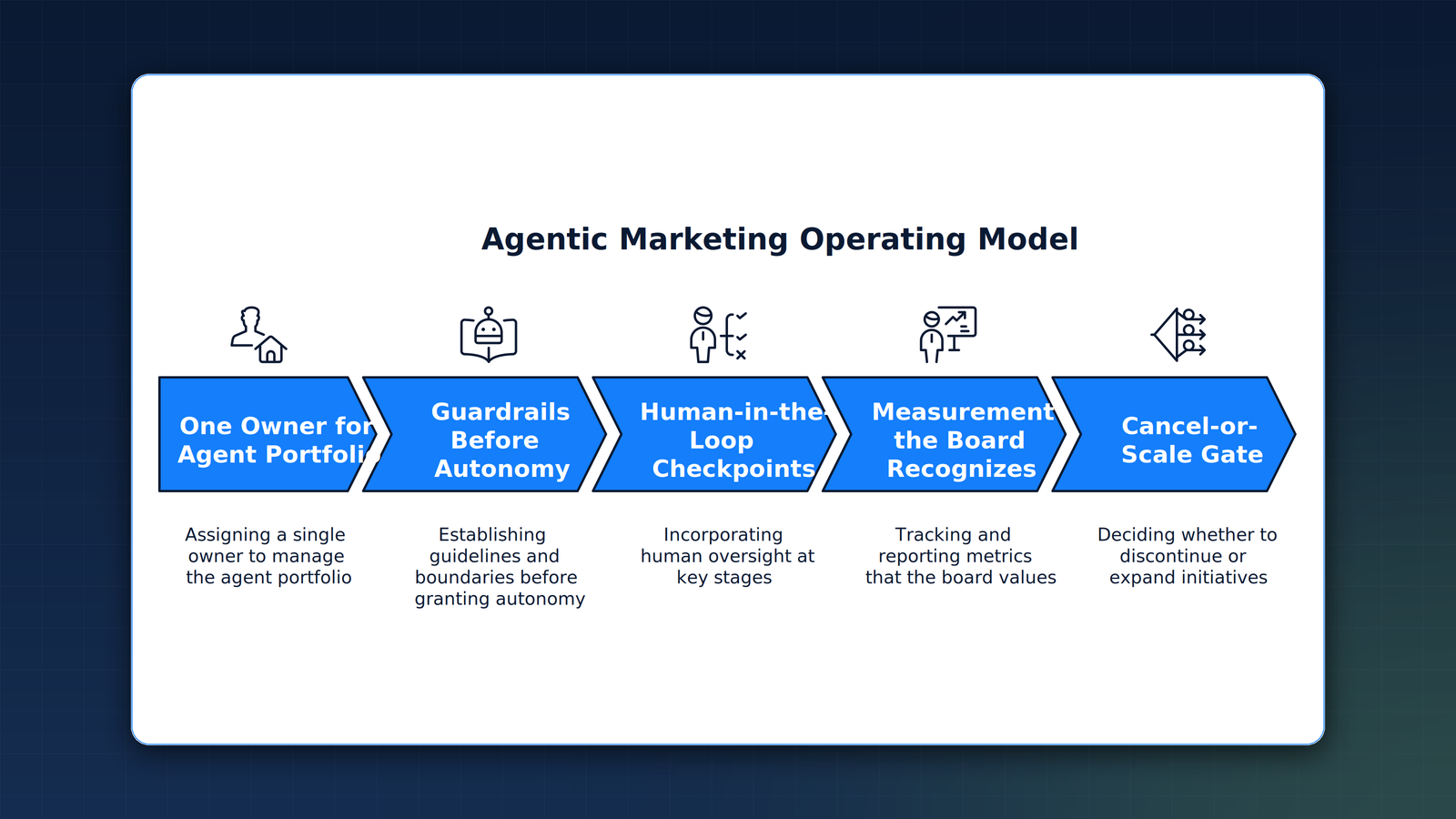
An operating model is the structure that defines who owns the agents, what they are permitted to do, and how their work is checked before it reaches a customer. It has to be installed before scaling, not after. The framework has five parts, and the figure below shows how they sequence.
1. One owner for the agent portfolio
Name a single accountable owner for every marketing agent, the way you would for any other budget line or vendor relationship. Sprawl happens because each agent is someone else side project. Portfolio ownership makes spend and risk legible.
2. Guardrails before autonomy
A guardrail is a hard constraint on what an agent may do on its own, for example a spend ceiling, channels it cannot post to without sign-off, or brand and compliance rules it cannot override. Set these before an agent goes live, not after an incident. An agent without a guardrail is not autonomous. It is unsupervised.
3. Human-in-the-loop checkpoints
Human-in-the-loop means a person reviews and approves specific agent decisions before they take effect. The skill is choosing where. Put the checkpoint on the few actions that carry brand, legal, or budget consequence, and let the agent run the rest. A checkpoint on every action defeats the point. A checkpoint on none is how off-brand work reaches a customer.
4. Measurement the board recognizes
Tie each agent to a metric the board already tracks, pipeline, cost per qualified lead, time to launch, not to agent-internal vanity counts like tasks completed. If an agent cannot be tied to a business outcome, that is the finding.
5. A cancel-or-scale gate
Review the portfolio on a fixed cadence and make an explicit decision on each agent: scale it, hold it, or cancel it. Canceling an agent that does not earn its keep is a healthy outcome of governance, not a failure of it. The organizations that survive the 2027 cancellation wave will be the ones that cancelled deliberately and early, on their own terms, rather than having a stalled program written off all at once.
Why This Is an R&D Problem, Not Another Agent to Buy
Notice what the operating model is not. It is not another agent, platform, or license added to the stack. It is the research and engineering discipline that decides which agents earn autonomy, wires the guardrails and checkpoints into the workflow, and instruments the measurement so the cancel-or-scale gate has real numbers to act on. Retrofitting governance onto a sprawl of live agents is far harder than building it in, so the work has to happen before the fleet scales.
This is the same governance discipline we apply to autonomous systems on the engineering side, framed in our work on moving an AI agent from pilot to production, and it pairs with the measurement rigor in the GEO visibility gap for CMOs. Stable Solutions installs the agentic marketing operating model, the ownership, the guardrails, the human-in-the-loop checkpoints, and the cancel-or-scale gate, as a research-driven R&D partner. We are not another agent vendor adding to the sprawl. We are the team that makes it governable.
Key Takeaways
- Agentic marketing capability is arriving fast (a 65 million dollar Gradial raise, a WPP and AWS collaboration in one week), but governance is not keeping pace.
- Belief outruns reality: 90% of CMOs say generative AI is reshaping brand discovery, yet only 8% run autonomous multi-agent campaigns (BCG).
- Gartner expects over 40% of agentic AI projects canceled by the end of 2027, with weak governance and unclear value among the named causes.
- The differentiator is the operating model: one owner, guardrails before autonomy, human-in-the-loop checkpoints, board-recognized measurement, and a cancel-or-scale gate.
- This is an R&D problem to design before scaling, not another agent to buy.
Frequently Asked Questions
What is agentic marketing?
Agentic marketing is the use of AI agents, software that pursues a goal across multiple steps with some autonomy, to plan, produce, and run marketing work with limited human involvement per task. It goes beyond generative AI assisting with a single draft, toward agents that decide and act across a workflow.
Why do so many agentic AI projects get canceled?
Gartner forecasts over 40% canceled by the end of 2027, citing escalating costs, unclear business value, and inadequate risk controls. In marketing, agents bought one tool at a time with no shared owner or guardrail accumulate cost and risk no one can defend, which is the pattern that gets a program written off.
What is a human-in-the-loop checkpoint, and where should it go?
It is a point where a person reviews and approves an agent decision before it takes effect. Place checkpoints on the few actions with brand, legal, or budget consequence, and let agents run the rest. Reviewing every action defeats the efficiency; reviewing none is how off-brand work reaches customers.
Sources
- Gartner, "Gartner Predicts Over 40% of Agentic AI Projects Will Be Canceled by End of 2027," 2025. Link.
- Boston Consulting Group, "How CMOs are Moving Agentic Marketing from Illusion to Reality," 2026. Link.
- GeekWire, "Gradial raises $65M as startup sees rapid growth around agentic tools for enterprise marketing," 2026. Link.
- Adweek, "WPP Enterprise Solutions and AWS Team Up on Agentic Transformation," 2026. Link.
Next Steps
The decision in front of you is not which marketing agents to buy; it is whether you install the operating model that makes a fleet of them governable before you scale it. Stable Solutions designs and installs the ownership, guardrails, human-in-the-loop checkpoints, and cancel-or-scale gate for agentic marketing as a research-driven R&D partner. Explore our Digital Growth Strategies or contact our team to install the governance before the sprawl becomes a liability.