
Agent platform selection has quietly become a protocol decision. The AI agent interoperability standards that determine whether your agents can talk to your tools, your data, and each other, MCP and A2A, both moved under neutral foundation governance in the past year, and the platforms your teams already run are shipping support for them. That changes what an enterprise should evaluate first when it signs an agent platform contract. Feature lists age in months. The integration layer you build against is what you will still be living with in 2029.
How Agent Interoperability Standards Consolidated
An AI agent is software that uses a model to plan and execute multi-step work, deciding at each step which tool to call or which system to query. Every agent therefore needs two kinds of connections: connections to tools and data, and connections to other agents. In under two years, a single open standard has pulled ahead in each layer.
The Model Context Protocol (MCP) is an open standard that gives any model a uniform way to connect to tools and data sources. Anthropic released it in November 2024, and in December 2025 donated it to the Agentic AI Foundation, a directed fund under the Linux Foundation co-founded by Anthropic, Block, and OpenAI with support from Google, Microsoft, AWS, Cloudflare, and Bloomberg. At the time of the donation, MCP counted over 97 million monthly downloads of its software development kits, more than 10,000 active MCP servers (small services that expose a tool or data source to any MCP-speaking model), and first-class client support in ChatGPT, Claude, Cursor, Gemini, Microsoft Copilot, and Visual Studio Code.
Agent2Agent (A2A) is an open protocol that lets independent agents discover each other, exchange information, and coordinate tasks across vendors. Google announced it in April 2025 and donated it to the Linux Foundation that June, with AWS, Cisco, Microsoft, Salesforce, SAP, and ServiceNow as foundational members. More than 100 companies now support the specification.
Neither protocol is a product. That is the point. They are the plumbing under whichever agent platforms you buy, and they are now governed by foundations rather than by any single vendor roadmap.
Neutral Governance Changes the Procurement Math
Before the donations, betting on either protocol meant betting on its owner. A standard controlled by one vendor can be repriced, relicensed, or steered toward that vendor at any point. Foundation governance removes that risk: the specification stays open, the roadmap is decided by a multi-vendor community, and no participant can revoke your access to the standard your integration code targets.
For a buyer, that converts protocol conformance into something rare in enterprise software: an exit right. Integration code written against MCP survives a model vendor switch. A workflow composed over A2A survives an orchestration vendor switch. Compare that with integration code written against a proprietary plugin format, which survives exactly as long as your relationship with that vendor.
The adoption signal worth noting this month: Apple, historically slow to open its platforms to developer-facing AI, shipped an official Safari MCP server in Safari Technology Preview 247 in July, giving agents seventeen tools for inspecting and debugging live web pages. When the cautious vendors ship conformance surfaces, a standard has stopped being an experiment and started being infrastructure. We made a related argument about the model layer in our analysis of the frontier model buyers market: pricing power moves to buyers when switching costs fall. Protocol conformance is the integration-layer version of the same lever.
The Conformance-First Evaluation Framework
When your organization evaluates an agent platform, orchestration product, or agent-adjacent SaaS tool, run these five checks before the feature demo.
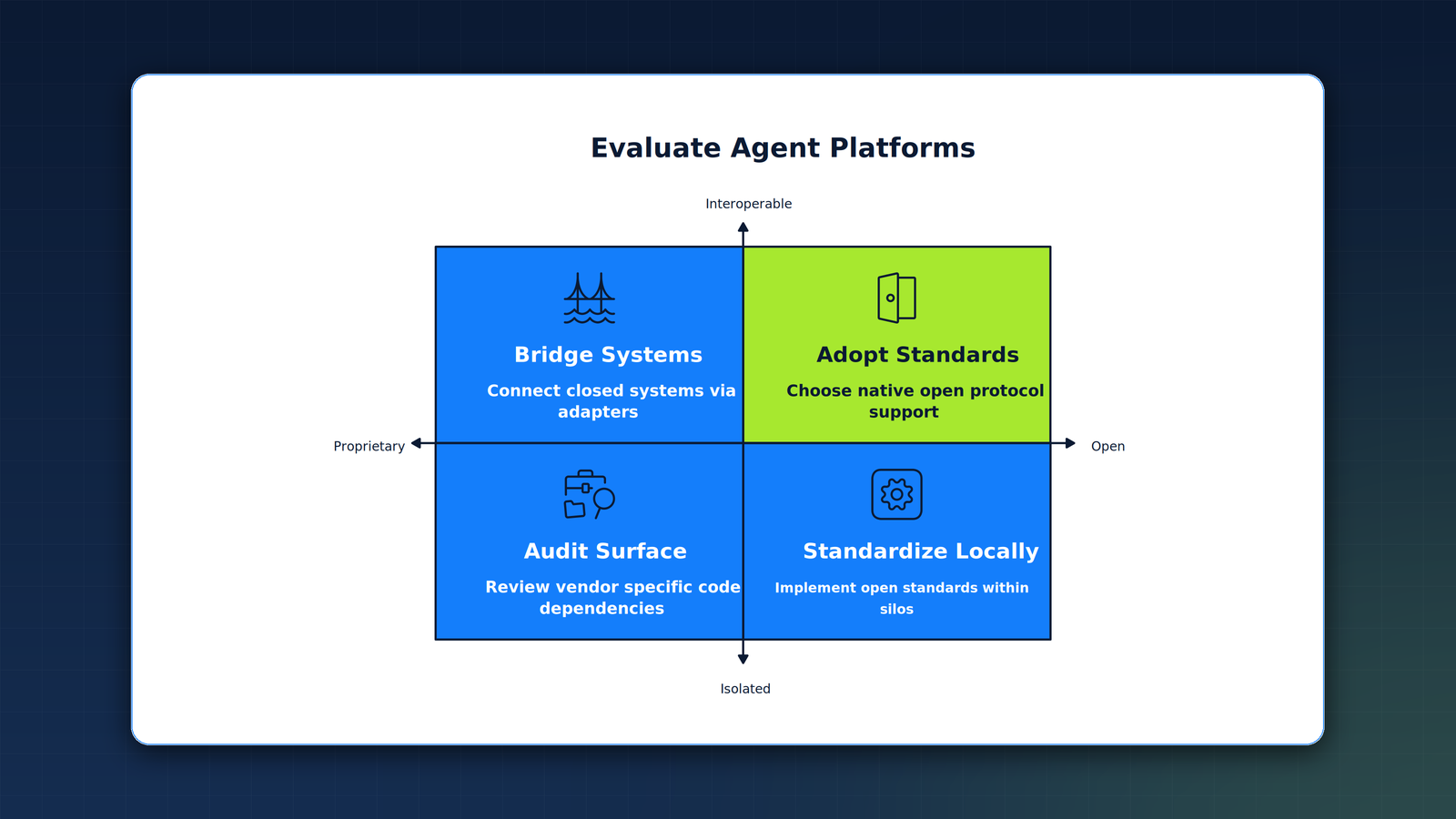
- Native protocol support, not adapters. The platform should speak MCP for tool and data access and A2A for cross-agent communication out of the box. A vendor-built "bridge" or "connector pack" is a proprietary layer wearing a standard as a costume, and it usually lags the specification by months.
- The round-trip test. During the pilot, swap one model and one tool behind the protocol without touching your integration code. If the swap requires rework, the conformance is marketing.
- Proprietary surface audit. Measure what fraction of your integration code targets vendor-specific APIs versus the open protocols. Every line on the proprietary side is future rework you are agreeing to fund.
- Governance participation. Check whether the vendor is a member of the Agentic AI Foundation or a contributor to the A2A project. Membership is not a guarantee of quality, but absence from both while claiming "open" is a signal worth questioning.
- Security posture on the protocol surface. An MCP server is code you run with access to your systems, and it belongs in your threat model like any other dependency. Ask how servers are vetted, permissioned, and updated. Our framework for securing AI coding agents covers the discipline this requires in build pipelines.
What Protocol Conformance Does Not Solve
Conformance is a filter, not a decision. It does not design your orchestration logic, define your escalation paths, or make an underpowered agent useful. The market it filters is noisy: Gartner forecasts that more than 40% of agentic AI projects will be canceled by the end of 2027, citing escalating costs, unclear business value, and inadequate risk controls, and estimates that only about 130 of the thousands of vendors marketing agentic products offer genuine agentic capabilities. A vendor can conform to every protocol and still fail your use case. What conformance buys you is cheaper failure: a stack you can rewire instead of rewrite, and a procurement posture where leaving is always priced in.
The work that remains after the filter, scoping the workflows, defining triggers and outcomes, and validating agents in production, is engineering work. It is where the value concentrates, and it is independent of which logo sits on the platform.
Sources
- Anthropic, "Donating the Model Context Protocol and establishing the Agentic AI Foundation," 2025. Link.
- The Linux Foundation, "Linux Foundation Announces the Formation of the Agentic AI Foundation (AAIF)," 2025. Link.
- The Linux Foundation, "Linux Foundation Launches the Agent2Agent Protocol Project," 2025. Link.
- Google Developers Blog, "Google Cloud donates A2A to Linux Foundation," 2025. Link.
- WebKit, "Introducing the Safari MCP server for web developers," 2026. Link.
- Gartner, "Gartner Predicts Over 40% of Agentic AI Projects Will Be Canceled by End of 2027," 2025. Link.
Next Steps
Your next agent platform contract will lock in an integration layer for years, and the protocols it conforms to decide how expensive your exits are. Stable Solutions designs agent systems on open standards, runs conformance evaluations against vendor claims, and validates the result in production. Explore our AI Automation services or contact our team to pressure-test a platform decision before you sign it.