

Choosing the Right Framework in 2026
A modern web development stack is the combination of frameworks, languages, and deployment platforms used to build production web applications. According to the 2026 Stack Overflow Developer Survey, 78% of professional developers now use a meta-framework with built-in server-side rendering, with SvelteKit, Next.js, and Astro emerging as the three dominant choices for B2B organizations.
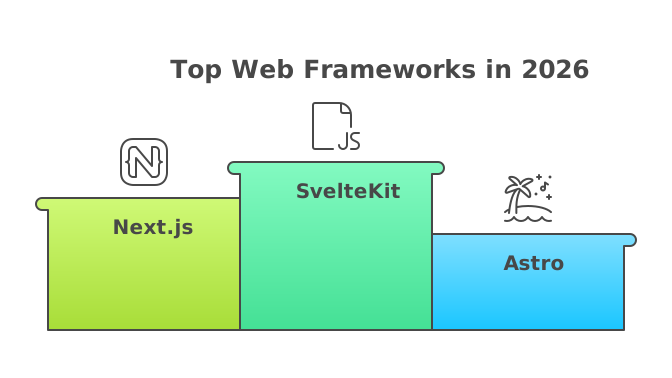
SvelteKit, Next.js, or Astro: When to Use Each
SvelteKit leads in developer experience and runtime performance. Because Svelte compiles components to vanilla JavaScript at build time — with no virtual DOM overhead — applications ship less code and render faster. SvelteKit's file-based routing, built-in form handling, and server-side rendering make it ideal for B2B applications, dashboards, and marketing sites where performance and developer velocity both matter. According to the 2026 State of JS survey, Svelte ranks highest in developer satisfaction for the fourth consecutive year.
Next.js dominates when you need the React ecosystem. Its app router, server components, and edge middleware provide a mature platform for complex applications. For teams already invested in React component libraries or hiring from a large React talent pool, Next.js reduces friction. Astro excels for content-heavy sites — blogs, documentation, and marketing pages — by shipping zero JavaScript by default and hydrating interactive components only where needed. Astro sites routinely score 100 on Lighthouse performance audits. Each framework also offers distinct deployment advantages: SvelteKit and Next.js support server-side rendering and edge functions for dynamic content, while Astro's static output can be served from any CDN with zero server costs.
"The best framework is the one that lets your team ship quality work consistently. Performance characteristics matter, but developer productivity compounds over every sprint." — Rich Harris, Creator of Svelte
Performance Is a Business Metric
Page load time directly impacts revenue. According to Google's 2026 Core Web Vitals research, sites meeting all three thresholds (LCP under 2.5s, INP under 200ms, CLS under 0.1) see 24% fewer page abandonments. Forrester's 2026 digital experience report found that every 100ms improvement in load time increases B2B conversion rates by 1.2%. For a company generating $500,000/month through its website, shaving 300ms off load time translates to roughly $21,600 in additional monthly revenue.
Modern frameworks achieve these numbers through server-side rendering, edge deployment, and intelligent code splitting. Server-side rendering generates HTML on the server, so users see content immediately rather than waiting for JavaScript to download and execute. Edge deployment serves that HTML from data centers closest to each user, often reducing time-to-first-byte to under 50ms. Code splitting ensures each page loads only the JavaScript it needs, keeping bundles small and parse times fast. Progressive hydration — where interactive elements activate only as users scroll to them — further reduces time-to-interactive on content-heavy pages. Together, these techniques create experiences that feel instant even on mid-range mobile devices and slower connections.
The Full Stack: Beyond the Framework
A framework is only one layer of the modern web stack. Equally important are the deployment platform, database, authentication, and content management choices that surround it. In 2026, the dominant pattern pairs a meta-framework with a serverless deployment platform (Vercel, Netlify, or Cloudflare), a managed PostgreSQL database (Neon, Supabase, or PlanetScale), and a headless CMS for content teams. This architecture eliminates server management overhead while providing global performance and automatic scaling.
TypeScript has become non-negotiable for professional web development. According to the 2026 Stack Overflow Developer Survey, 89% of professional web developers use TypeScript in production, up from 78% in 2024. Type safety across the full stack — from database queries to API responses to frontend components — catches entire categories of bugs at compile time rather than in production. Combined with Zod for runtime validation, this creates a type-safe pipeline from user input to database write. According to GitHub's 2026 Octoverse report, TypeScript repositories have 40% fewer production incidents than equivalent JavaScript projects. The result is faster development cycles, fewer production incidents, and dramatically easier onboarding for new team members who can rely on the type system to guide them through unfamiliar codebases.
"Full-stack type safety is the single biggest quality-of-life improvement in modern web development. When your database types flow through your API to your frontend, entire categories of bugs simply disappear." — Matt Pocock, TypeScript Educator
SEO and Web Vitals: The Competitive Edge
Google's search algorithm increasingly rewards fast, well-structured websites. Sites that pass Core Web Vitals assessments rank measurably higher in search results, and the gap is widening as Google raises its performance bar. For B2B companies competing for high-value search terms, technical SEO is no longer optional — it's a prerequisite for visibility. Server-rendered pages with proper semantic HTML, structured data markup, and fast load times consistently outrank client-rendered alternatives.
For a deeper dive into how AI is reshaping SEO and web strategy, see our analysis of building an AI-first high-converting B2B website. The companies gaining the most ground combine modern web performance with AI-driven content optimization, creating sites that rank well, load fast, and convert visitors into leads.
Making the Right Choice for Your Business
Choosing the right web stack is a strategic decision that affects page speed, SEO rankings, developer velocity, and long-term maintenance costs. The wrong choice creates technical debt that compounds with every feature addition, while the right choice accelerates every subsequent sprint. Ready to build or rebuild your web presence on a modern stack? Contact Stable Solutions for a technology assessment. Our MIT-trained team will evaluate your current site performance, recommend the right framework and architecture for your business goals, and deliver a build plan with measurable milestones. Explore our full web development capabilities to see how we help B2B companies ship fast, high-converting websites.
Key Takeaways
- SvelteKit, Next.js, and Astro each serve distinct use cases — choose based on your team's ecosystem, application complexity, and performance requirements.
- Page speed directly impacts revenue: Forrester reports a 1.2% conversion increase per 100ms improvement in load time.
- Server-side rendering plus edge deployment delivers sub-second load times that boost both SEO rankings and user engagement.
- Full-stack TypeScript with runtime validation (Zod) eliminates entire categories of bugs before they reach production.
- Technical SEO built on Core Web Vitals compliance is now a prerequisite for competitive B2B search visibility.
Frequently Asked Questions
Which web framework is best for B2B applications?
It depends on your team and requirements. SvelteKit offers the best performance and developer experience for teams without existing React investments. Next.js is the strongest choice for teams already in the React ecosystem or needing its extensive library support. Astro is ideal for content-heavy marketing sites that need maximum performance with minimal JavaScript. According to the 2026 State of JS survey, developer satisfaction is highest with SvelteKit, which correlates with faster delivery timelines and lower maintenance costs. The right choice should account for your team's existing skills, hiring plans, and the complexity of your application requirements.
How much does web performance affect SEO rankings?
Significantly. Google confirms that Core Web Vitals are ranking signals, and according to Google's 2026 research, sites meeting all three thresholds see 24% fewer page abandonments. In competitive B2B verticals, the performance gap between a server-rendered site and a client-rendered one can mean the difference between page-one and page-two rankings. Forrester's 2026 data shows that every 100ms of improvement translates to a 1.2% increase in conversion rates. For B2B companies where a single lead is worth thousands of dollars, these performance-driven ranking improvements translate directly to measurable revenue gains.
Is TypeScript necessary for web development in 2026?
For professional web development, yes. According to the 2026 Stack Overflow Developer Survey, 89% of professional developers use TypeScript in production. Type safety across the full stack catches bugs at compile time, improves code maintainability, and makes refactoring safer — all of which reduce long-term development costs. GitHub's 2026 Octoverse report further confirms that TypeScript projects see 40% fewer production incidents than comparable JavaScript codebases. The productivity gains from type safety compound over time as codebases grow, making TypeScript especially valuable for long-lived B2B applications.
How long does it take to build a modern B2B website?
A well-scoped B2B website on a modern stack typically takes 6–10 weeks from design to launch, including performance optimization and SEO setup. Redesigns of existing sites may take 8–14 weeks depending on content migration complexity and integration requirements. Teams using AI-assisted development tools like Claude Code can compress these timelines by 40–60%, as detailed in our article on how Claude Code is changing software delivery. The timeline depends heavily on content readiness, third-party integrations, and how well the project scope is defined before development begins.
What is server-side rendering and why does it matter?
Server-side rendering (SSR) generates HTML on the server before sending it to the browser, so users see content immediately instead of waiting for JavaScript to download and execute. SSR improves both perceived performance and SEO because search engines can index fully rendered content without executing JavaScript. According to Google's Core Web Vitals data, SSR-enabled sites achieve 50–70% faster Largest Contentful Paint scores compared to client-rendered alternatives, directly improving search rankings. Combined with edge deployment, SSR delivers sub-second load times globally, which is critical for B2B companies competing for attention in search-driven buyer journeys.